Tharoor Questions If Awareness of Empire's Atrocities Has Grown

Synopsis
Congress MP Dr. Shashi Tharoor on 7 July 2026 questioned whether awareness of British Empire's atrocities has genuinely grown, signalling doubt that a decade of public debate has shifted mainstream understanding as much as he had believed.
Key Takeaways
Shashi Tharoor posted on 7 July 2026 questioning whether public understanding of British colonial atrocities has improved in recent years.
Tharoor's 2015 Oxford Union speech on reparations was a landmark moment that drew tens of millions of views and reignited the colonial reparations debate globally.
His 2016 book An Era of Darkness documented British colonial economic policies that reduced India's share of global GDP from roughly 23 per cent to under 4 per cent .
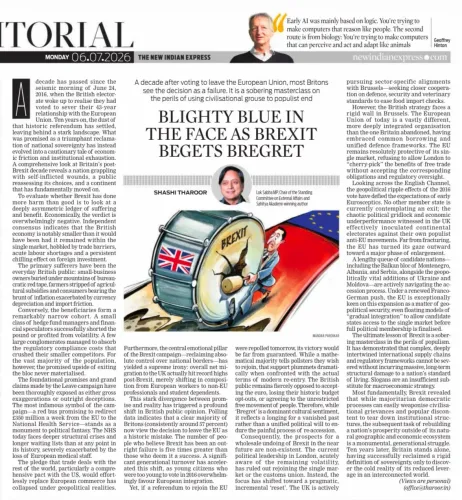
The post reflects ongoing disputes in India and the UK over how empire is taught in schools, represented in museums, and memorialised in public spaces.
The immediate trigger for the July 2026 post has not been identified; Tharoor's question is expected to draw responses from historians, educators, and policymakers.
Congress MP Dr. Shashi Tharoor on Tuesday, 7 July 2026 publicly questioned whether public understanding of the British Empire's atrocities has meaningfully improved in recent years, expressing surprise that perceptions may not have shifted as much as he had assumed.
Context
Tharoor's post reads: 'Has this not changed at all in recent years? I was under the impression that there is a much better understanding of Empire and its atrocities today than a decade ago? Not so?!' The rhetorical tone suggests he encountered something — a survey, a conversation, or a cultural moment — that challenged his assumption that colonial history is now better understood by mainstream audiences, particularly in Britain.
The Thiruvananthapuram MP has been one of India's most prominent voices on the subject of British colonial legacy. His 2015 speech at the Oxford Union — in which he argued that Britain owes reparations to India for the systematic drain of wealth during colonial rule — was viewed tens of millions of times online and is widely credited with reigniting the reparations debate in both countries.
Policy Backdrop
Tharoor followed the Oxford Union address with his 2016 book An Era of Darkness, a detailed historical account of the British Empire's economic and administrative impact on India. The book argued that India's share of global GDP fell from roughly 23 per cent to under 4 per cent during British rule, and documented policies that contributed to recurring famines and deindustrialisation.
The broader debate over how empire is taught and remembered has continued in both India and the United Kingdom. Disputes over school curricula, museum repatriation of artefacts, and the framing of public memorials have kept colonial history in the public conversation. Tharoor's interventions are part of a longer pattern of Indian political figures using cultural and intellectual platforms to shape contemporary bilateral perceptions of the imperial period.
Stakeholders and Impact
The question resonates across several communities: Indian historians and post-colonial scholars who have long argued that empire's violence is systematically minimised in Western education; British educators navigating a contested national curriculum; and diaspora communities in the UK who occupy the intersection of both narratives.
For Indian policymakers, the framing of colonial history carries practical weight. Calls for an acknowledgement of historical wrongs — if not formal reparations — periodically surface in parliamentary debates and in the context of India-UK bilateral negotiations. Tharoor's public commentary, even in the form of a brief social-media question, tends to draw significant attention from both scholarly and political audiences given his standing as a former UN Under-Secretary-General and published historian.
What's Next
Tharoor's post does not specify what prompted his reassessment, and the immediate trigger remains unclear. However, the question is likely to generate responses from historians, educators, and commentators on both sides of the debate. Any forthcoming India-UK joint statements, parliamentary questions on historical education, or proposed changes to the UK national curriculum on empire could provide the context that sharpens the discussion Tharoor appears to be opening.
The post underscores that, a decade after the Oxford Union moment catalysed global debate, the question of whether that awareness has translated into lasting attitudinal change remains, for Tharoor at least, genuinely open.
Point of View
Framing this as an open question rather than a settled verdict is itself a rhetorical move, inviting audiences to reassess the progress of the reckoning. The post fits a broader pattern in which Indian political figures use cultural commentary to keep colonial accountability on the agenda, particularly as India's global standing grows and bilateral frameworks like the India-UK Free Trade Agreement attract scrutiny. Whether the question prompts institutional responses — in curriculum reform, museum policy, or diplomatic language — will determine whether this moment is a conversation-starter or a passing observation.
NationPress
7 Jul 2026
Frequently Asked Questions
What did Shashi Tharoor say about the British Empire on 7 July 2026?
Tharoor posted on X questioning whether public understanding of the British Empire's atrocities has improved in recent years, expressing surprise that awareness may not have grown as much as he had assumed over the past decade.
What is Shashi Tharoor's Oxford Union speech about?
In his 2015 Oxford Union speech, Tharoor argued that Britain owes reparations to India for the economic exploitation and atrocities of colonial rule, citing the drain of wealth that reduced India's share of global GDP from roughly 23 per cent to under 4 per cent .
What is Shashi Tharoor's book An Era of Darkness about?
Published in 2016 , An Era of Darkness documents the British Empire's economic and administrative impact on India, covering policies that contributed to famines, deindustrialisation, and institutional damage during nearly two centuries of colonial rule.
Has Britain acknowledged colonial atrocities against India?
Britain has not issued a formal apology or committed to reparations for colonial rule in India. The question of acknowledgement periodically surfaces in diplomatic and parliamentary contexts, and remains a subject of active debate among historians and policymakers in both countries.
Why does Shashi Tharoor speak about British colonialism?
As a Congress MP, former Union Minister, former UN Under-Secretary-General , and published historian, Tharoor has made colonial accountability a central part of his public intellectual identity, arguing that understanding empire's legacy is essential for contemporary India-UK relations.