Tharoor Reviews Brexit at 10: Few Gains, Many Losses
Synopsis
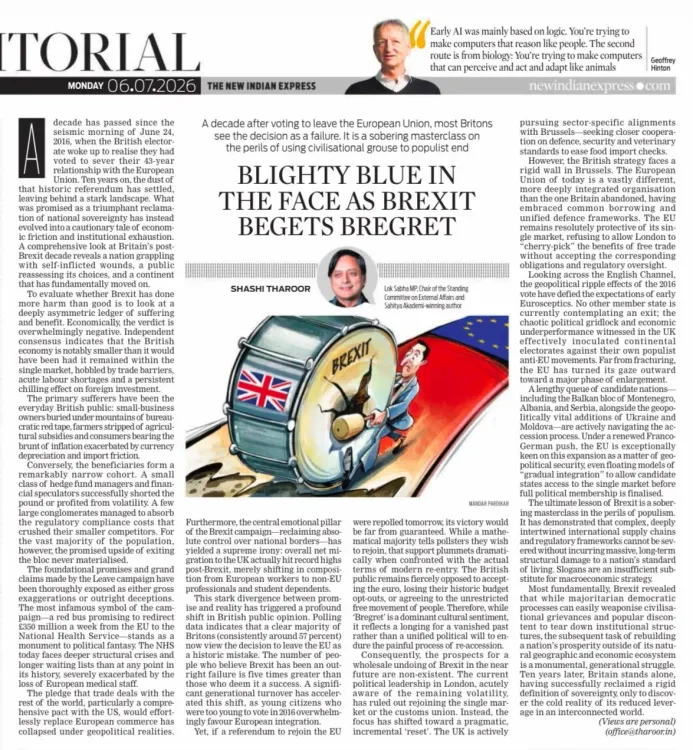
On Brexit's tenth anniversary, Congress MP Dr. Shashi Tharoor published a critical review arguing the UK's departure from the EU produced few gains and substantial losses, questioning whether hollow sovereignty rhetoric has been replaced by widespread 'Bregret' among British voters.
Key Takeaways
Shashi Tharoor published a review of Brexit on its tenth anniversary , 6 July 2026 .
The Brexit referendum was held on 23 June 2016 , with 51.9 per cent voting to leave the EU .
The UK had been an EU/EEC member for 43 years , joining on 1 January 1973 and formally leaving on 31 January 2020 .
Tharoor characterises Brexit's balance sheet as 'few gains, plenty of losses' and raises the concept of 'Bregret' — public remorse over the decision.
The EU-UK Trade and Cooperation Agreement (in force 1 May 2021 ) governs post-Brexit ties but has introduced significant trade friction for UK businesses and exporters.
India has pursued separate bilateral trade talks with the post-Brexit UK , reflecting the changed diplomatic landscape.
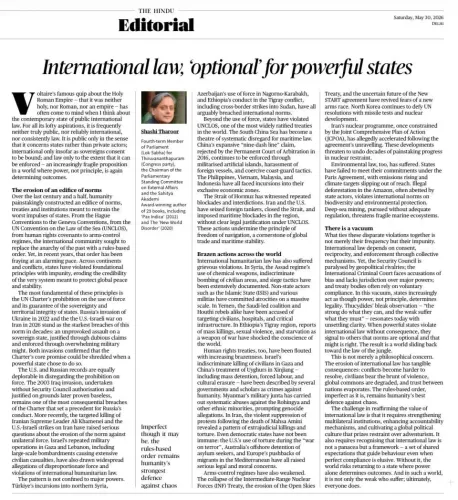
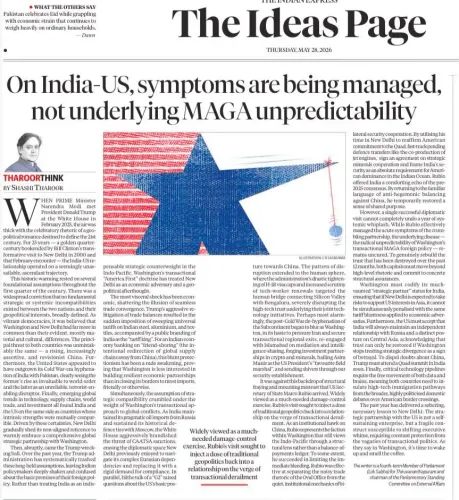
Congress MP Dr. Shashi Tharoor on Monday, 6 July 2026 published a sweeping review of Brexit marking exactly a decade since British voters chose to end the United Kingdom's 43-year membership of the European Union, arguing the exercise yielded few gains and significant losses. Writing in an Indian English-language daily, Tharoor questioned whether the hollow bravado over a reassertion of sovereignty has now given way to widespread 'Bregret' — a portmanteau capturing public remorse over the decision.
Context
The Brexit referendum was held on 23 June 2016, when 51.9 per cent of British voters chose to leave the EU in a result that shocked global markets and redrew the political map of Europe. The UK had been a member of the European Economic Community — the EU's predecessor — since 1 January 1973, making its membership span precisely 43 years at the time of the vote. The formal withdrawal was completed on 31 January 2020, and the EU-UK Trade and Cooperation Agreement entered into force on 1 May 2021 to govern post-departure economic ties.
Tharoor, a former UN Under-Secretary-General and former Union Minister of State for External Affairs, has long been among the most prominent Indian voices on global affairs. His commentary on Brexit carries the weight of someone who spent years in multilateral diplomacy and has watched European integration from close quarters.
Policy Backdrop
The central promise of the Leave campaign was the recovery of sovereign decision-making — over borders, laws, and trade — from Brussels. Proponents argued the UK would be free to strike faster, better bilateral trade deals with partners including India, the United States, and Commonwealth nations. In the decade since, that promise has been tested against the hard arithmetic of trade friction, supply-chain disruption, and reduced labour mobility with EU member states.
The EU-UK Trade and Cooperation Agreement, while averting a no-deal cliff edge, introduced new customs checks, regulatory divergence costs, and barriers to services trade that did not exist when the UK was inside the single market. Northern Ireland arrangements have remained a persistent political flashpoint, requiring successive rounds of negotiation between London and Brussels. Tharoor's framing — 'few gains, plenty of losses' — maps closely onto the analytical consensus that has emerged from economic institutions tracking post-Brexit outcomes.
Stakeholders and Impact
UK businesses, particularly exporters of goods and financial services, have borne the most direct costs of regulatory divergence and new border procedures. British exporters to EU markets have faced additional paperwork, rules-of-origin requirements, and, in some sectors, outright market-access restrictions that were absent before departure. For India, Brexit has created a distinct bilateral dynamic: fresh trade negotiations with a post-Brexit UK have proceeded separately from any engagement with Brussels, offering both opportunities and complexities for Indian exporters and investors.
Public opinion within the UK has shifted noticeably since 2016. Polling over the past several years has consistently shown that a majority of British respondents, when asked, say Brexit was the wrong decision — the sentiment Tharoor labels 'Bregret'. That shift has fuelled debate about the long-term trajectory of UK-EU relations, including whether closer alignment or even re-engagement with EU structures is politically feasible.
What's Next
The tenth anniversary of the referendum is likely to intensify domestic UK debate about reviewing or renegotiating elements of the Trade and Cooperation Agreement, particularly on services, youth mobility, and regulatory equivalence. Scheduled EU-UK summits and any adjustments to Northern Ireland arrangements will be closely watched as indicators of whether the relationship is stabilising or drifting further. Tharoor's intervention from India underscores that Brexit continues to be viewed internationally not merely as a British domestic matter, but as a cautionary study in the costs of dismantling deep regional economic integration in the name of sovereignty.
Point of View
A critique that travels well beyond British shores. Coming a decade after the vote, the piece lands when UK public opinion has measurably shifted against Brexit, lending empirical weight to what might otherwise read as a partisan position. For Indian readers, the subtext is a broader warning about the trade-offs between assertive nationalism and the practical benefits of deep multilateral integration.
NationPress
6 Jul 2026
Frequently Asked Questions
What did Shashi Tharoor write about Brexit in 2026?
Dr. Shashi Tharoor published a review on Brexit's tenth anniversary arguing the UK's departure from the EU produced few gains and many losses, and asked whether 'Bregret' — public remorse over the decision — had set in among British voters.
When did Brexit happen and how long was the UK in the EU?
The Brexit referendum was held on 23 June 2016 and the UK formally left the EU on 31 January 2020 . The UK had been a member of the EEC/EU for 43 years , having joined on 1 January 1973 .
What is 'Bregret' and is it widespread in the UK?
'Bregret' is a portmanteau combining Brexit and regret, describing public remorse over the decision to leave the EU. Polling over several years has shown a majority of British respondents now believe Brexit was the wrong decision.
How has Brexit affected UK-India trade relations?
Post-Brexit, India and the UK have pursued separate bilateral trade negotiations outside any EU framework, creating both new opportunities and new complexities for Indian exporters and investors seeking access to the British market.
What is the EU-UK Trade and Cooperation Agreement?
The EU-UK Trade and Cooperation Agreement entered into force on 1 May 2021 to govern post-Brexit economic relations. While it avoided a no-deal outcome, it introduced customs checks, regulatory divergence costs, and barriers to services trade that did not exist when the UK was inside the EU single market.