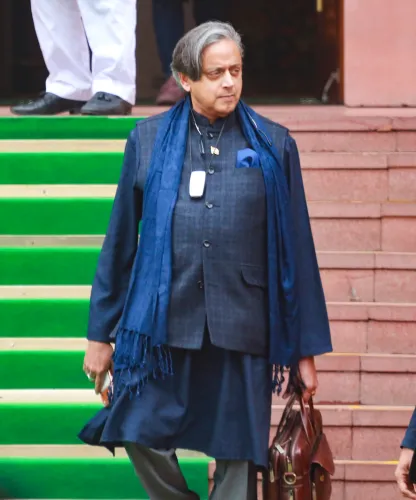
Tharoor Reviews Guha's Gandhi Book for Outlook India

Synopsis
Dr. Shashi Tharoor has reviewed Ramachandra Guha's 'Arguments With Gandhi' for Outlook India, arguing the book rescues the Mahatma from both uncritical reverence and sweeping rejection — a rare balance in contemporary Gandhi scholarship.
Key Takeaways
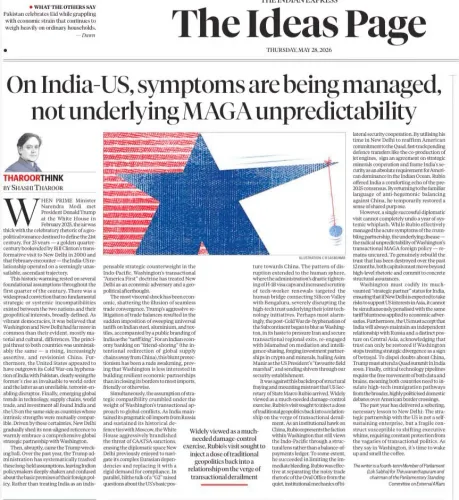
Shashi Tharoor published a review of historian Ramachandra Guha 's book Arguments With Gandhi in Outlook India on 6 November 2026 .
Tharoor describes Guha's work as rescuing Gandhi 'from the unquestioning devotion of his disciples and the sweeping denunciations of his critics.' Guha is one of India's leading modern historians, known for sustained biographical and social histories of the independence era.
The review reflects Tharoor's consistent public role as a commentator bridging politics, history, and literary culture.
Gandhi's legacy remains actively contested in contemporary India, making balanced scholarly interventions especially timely.
Between hagiography and hatchet job, most writing on Mahatma Gandhi has struggled to find solid ground — and Congress MP Dr. Shashi Tharoor argues that historian Ramachandra Guha's latest work, Arguments With Gandhi, finally does.
Tharoor, writing in Outlook India on 6 November 2026, says Guha's book rescues Gandhi 'both from the unquestioning devotion of his disciples and the sweeping denunciations of his critics' — a framing that positions the work as a corrective to two equally distorting traditions.
Guha's Argument: Neither Idol Nor Villain
Ramachandra Guha is among India's most prominent historians of the modern era, known for multi-volume biographical and social histories that engage seriously with the contradictions of India's founding generation. The title Arguments With Gandhi itself signals an adversarial intimacy — not a dismissal, but an honest intellectual reckoning with a figure whose ideas on non-violence, civil disobedience, and social organisation continue to generate fierce disagreement.
Tharoor, himself a prolific author on Indian history and politics, is well-placed to assess such a work. His review frames Guha's method as one of productive dissent — taking Gandhi's thought seriously enough to argue with it rather than either canonise or condemn it.
Tharoor's Own Relationship With Gandhi's Legacy
The review is consistent with a pattern Dr. Tharoor has established over years of public intellectual engagement: offering calibrated, historically grounded takes on India's founding figures that resist both nationalist myth-making and revisionist overreach. For a sitting MP from Thiruvananthapuram and former UN Under-Secretary-General, literary criticism of this kind doubles as a form of political and cultural positioning — signalling where one stands on the contested terrain of India's historical memory.
Gandhi's legacy remains actively disputed in contemporary India, invoked by movements across the ideological spectrum and challenged by those who highlight his complex positions on caste, race, and gender. A book that holds those tensions without collapsing them either way meets a genuine need.
Why This Intervention Matters Now
India's public conversation about its independence-era leaders has grown sharper in recent years, with statues toppled, syllabi revised, and social media arguments spilling into institutional spaces. Into that climate, a historian of Guha's standing bringing a framework of principled disagreement — and a public figure of Tharoor's reach recommending it — carries weight beyond the literary pages.
Whether the book sparks the panel discussions and academic follow-up its subject deserves will be the real measure of its reach. But the conversation, at least, has a credible opening move.
Point of View
Revised, and rejected across India's ideological spectrum. By endorsing Guha's framework of 'principled argument' over either devotion or denunciation, Tharoor signals a liberal-intellectual position: that honest engagement with uncomfortable contradictions is more politically useful than myth or demolition. For a sitting opposition MP, literary interventions of this kind also serve a softer political function — anchoring the Congress party's brand to serious intellectual tradition rather than purely electoral manoeuvre. Whether Guha's book shifts the terms of mainstream Gandhi discourse, or remains a conversation among the already-converted, will be the test of its real-world reach.
NationPress
7 Nov 2026
Frequently Asked Questions
What book did Shashi Tharoor review in Outlook India?
Dr. Shashi Tharoor reviewed 'Arguments With Gandhi' by historian Ramachandra Guha, published in Outlook India on 6 November 2026.
What is 'Arguments With Gandhi' about?
Based on Tharoor's review, Ramachandra Guha's 'Arguments With Gandhi' engages critically and honestly with Mahatma Gandhi's thought, steering between uncritical reverence and sweeping rejection.
Who is Ramachandra Guha?
Ramachandra Guha is one of India's most prominent historians, known for multi-volume works on modern Indian history including detailed studies of Mahatma Gandhi's life and times.
Why does Shashi Tharoor review books on Gandhi and Indian history?
Tharoor, a Congress MP and author himself, regularly publishes literary and historical essays as part of a consistent public-intellectual role that spans politics, history, and culture.
Is Gandhi's legacy still debated in India today?
Yes — Gandhi's positions on non-violence, caste, race, and social organisation continue to generate active debate in academic, political, and media circles across contemporary India.