HP CM Office: Tissa School Gets CBSE Affiliation for Churah Kids
Synopsis
The Himachal Pradesh CMO announced that the government school in Tissa, Chamba district, has been affiliated with CBSE to improve education quality for children in the remote Churah region, with MA-qualified teachers selected to staff the upgraded school.
Key Takeaways
The government school in Tissa, Chamba district has been granted CBSE affiliation to serve students in the Churah region of Himachal Pradesh.
Teachers selected for the school must hold an MA with at least 55% marks and fulfil all prescribed eligibility criteria.
Churah is a remote, largely rural and tribal constituency in Chamba — one of Himachal Pradesh's most geographically isolated districts.
The move aligns with a broader state policy of affiliating government schools in hilly and tribal areas with CBSE to reduce the curriculum gap with urban students.
CBSE affiliation typically demands infrastructure upgrades and ongoing administrative compliance beyond a single notification.
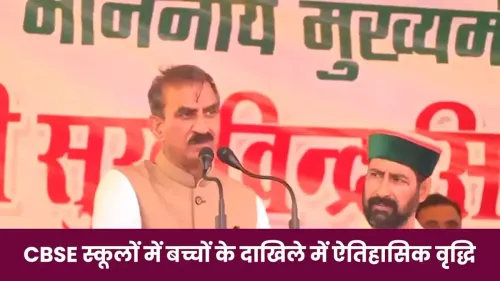
A remote corner of Chamba district just got a direct line to India's national school curriculum. The Chief Minister's Office of Himachal Pradesh announced on Wednesday, November 4, 2026 that the government school in Tissa has been affiliated with the Central Board of Secondary Education (CBSE) — a move aimed squarely at closing the education gap for children in the largely rural and tribal Churah region.
The post, shared on X, states in Hindi: 'चुराह के बच्चों को अच्छी शिक्षा मिले, इसके लिए हमने तीसा के स्कूल को CBSE से संबद्ध किया है' — ('So that children of Churah receive quality education, we have affiliated the Tissa school with CBSE.')
Who will teach at Tissa — and what it takes to qualify
The government didn't stop at the affiliation itself. According to the post, teachers selected for this school are candidates who have scored at least 55% marks in their MA and fulfil all prescribed eligibility criteria. That's a deliberate merit bar — filtering for subject-matter depth, not just a degree on paper.
The selection criteria signal an intent to staff a newly upgraded institution with teachers whose academic credentials match the more rigorous CBSE framework. For parents in Churah — where options have historically been limited — this matters: the difference between a state-board school and a CBSE-affiliated one can shape a child's path to competitive exams and higher education.
Why CBSE affiliation in a hill constituency is a bigger deal than it sounds
Churah is not a city. It is a constituency tucked into the mountains of Chamba — one of Himachal Pradesh's more geographically isolated and economically lagging districts. For decades, remote schools in such areas operated under the state board, which, while functional, left students at a structural disadvantage relative to peers in urban CBSE-affiliated schools when competing for college admissions or central-government entrance tests.
Himachal Pradesh has periodically brought government schools in hilly and tribal areas under CBSE to align them with the national curriculum and correct exactly this disparity. Each such affiliation requires infrastructure upgrades, fresh teacher cadres, and ongoing administrative compliance — commitments that go well beyond a single announcement.
The road the state has signalled
The CMO's framing — explicitly naming children as the beneficiaries and foregrounding teacher quality — positions this as an equity intervention, not mere administrative housekeeping. Whether the state follows through with the infrastructure investment that CBSE affiliation demands, and whether similar upgrades extend to other underserved pockets of Chamba or neighbouring districts, will be the real measure of ambition here.
For now, Churah's children have a new address on the national education map. The classroom of tomorrow, in a district that history mostly left behind — that's the promise on the table.
Point of View
Not a passive administrator. The deliberate 55% MA threshold for teacher selection adds credibility to the equity argument, moving the announcement beyond symbolism. However, CBSE affiliation is only as meaningful as the infrastructure and resource commitments that follow; without sustained budget support, the upgrade risks being a designation on paper. If the state proceeds with similar affiliations across underserved Chamba pockets, it could establish a replicable model for other hilly states grappling with the same urban-rural education divide.
NationPress
4 Nov 2026
Frequently Asked Questions
Which school in Himachal Pradesh has been affiliated with CBSE?
The government school in Tissa , located in Chamba district's Churah region, has been affiliated with CBSE by the Himachal Pradesh government.
What are the teacher eligibility criteria for the Tissa CBSE school?
Candidates must have scored at least 55% marks in their MA and fulfil all other prescribed eligibility qualifications to be selected as teachers at the Tissa school.
Where is Churah located and why does CBSE affiliation matter there?
Churah is a remote, rural and tribal constituency in Chamba district , Himachal Pradesh. CBSE affiliation matters because it aligns local students with the national curriculum, giving them a more competitive footing for college admissions and central entrance exams.
Does Himachal Pradesh affiliate other government schools in hill areas with CBSE?
Yes. Himachal Pradesh has periodically affiliated government schools in hilly and tribal areas with CBSE to reduce the curriculum gap between remote and urban students, as part of a broader equity-in-education approach.
What is CBSE and why is it important for school education in India?
The Central Board of Secondary Education (CBSE) is India's national school education board responsible for curriculum, examinations, and school affiliations. Its standardised curriculum is widely recognised for college admissions and competitive examinations across the country.