Tamil Nadu two-language policy stays firm, TVK rules out three-language shift
Synopsis
Tamil Nadu's new TVK government, barely in office, has drawn its first major line against the Centre — rejecting the three-language formula outright and flagging two years of withheld SSA funds. Education Minister Rajmohan's blunt 'no compromise' signals that Joseph Vijay's administration intends to continue the state's long tradition of resisting New Delhi on language, and is prepared to absorb a financial cost to do so.
Key Takeaways
School Education Minister Rajmohan declared on 19 May that Tamil Nadu's two-language policy (Tamil and English) will not change under the TVK government .
The state will evaluate whether the PM SHRI scheme's conditions align with Tamil Nadu's educational goals before deciding on participation.
Tamil Nadu has not received Sarva Shiksha Abhiyan (SSA) funds for the past two years , according to the Minister.
Rajmohan cited Singapore and Lee Kuan Yew's use of English as a model for Tamil Nadu's bilingual approach.
The Minister stated that women's rights and rights of the soil are core ideological commitments of the TVK government .
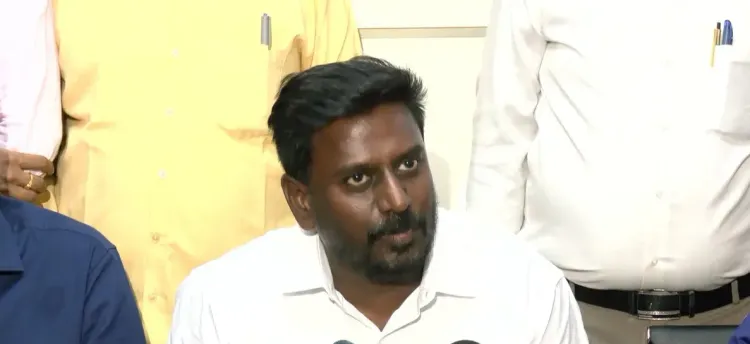
Tamil Nadu's new Tamilaga Vettri Kazhagam (TVK) government, led by Chief Minister Joseph Vijay, has firmly reaffirmed its commitment to the state's decades-old two-language policy, with School Education Minister Rajmohan declaring on Tuesday, 19 May that the Tamil and English formula will remain unchanged under the current administration. The announcement came after Rajmohan's first review meeting with senior officials of the School Education Department in Chennai.
Minister's Position on Language Policy
'English seems to be enough, and TVK will not yield to any form of indirect pressure,' Rajmohan told reporters, adding: 'There is no compromise on the party's principles and ideology.' He described the two-language system as 'TVK's declared ideology' — not merely an administrative arrangement, but a reflection of the state's broader commitment to protecting Tamil culture while equipping students with English for opportunities beyond Tamil Nadu and abroad.
The Minister underlined that Tamil, as the mother tongue, would remain the primary language for communication within the state, while English would serve as the medium to engage with the wider world.
Pushback Against the Three-Language Formula
Rajmohan's remarks come amid renewed pressure from the Union government to implement the three-language formula through centrally sponsored initiatives, including the PM Schools for Rising India (PM SHRI) scheme. Asked whether Tamil Nadu would join PM SHRI in its present form, the Minister said the state would first assess whether the scheme's conditions aligned with Tamil Nadu's educational goals before taking a final decision.
This is consistent with the posture of successive Tamil Nadu governments, which have historically resisted the Centre's three-language formula — a fault line that has periodically sharpened relations between Chennai and New Delhi.
Withheld Central Funds a Flashpoint
'We have not received the Sarva Shiksha Abhiyan (SSA) funds for the past two years, which is a huge tragedy for the students and the education sector,' Rajmohan said, adding that these funds were meant for students and not for officials. He reiterated that despite the funding dispute, the state would not yield to indirect pressure on the language question.
The withholding of SSA funds adds a financial dimension to what is otherwise a political and cultural standoff, with the Minister framing it as a consequence of Tamil Nadu's principled stance rather than administrative failure.
The Singapore Argument
Drawing on an international example, Rajmohan cited Singapore's founding Prime Minister Lee Kuan Yew, who reportedly transformed the country from poverty into a global hub by choosing English — rather than Mandarin or any other language — as the bridge to the world. The Minister invoked this to argue that Tamil Nadu's two-language model is both culturally grounded and pragmatically sound.
Broader Ideology of the TVK Government
Rajmohan also stated that women's rights and the rights of the soil form core pillars of the TVK government's ideology, situating the language policy within a wider framework of cultural self-respect and social equity. The government's stand, he said, was a matter of both identity and practical empowerment for Tamil Nadu's students.
With the Centre's PM SHRI scheme still under evaluation and SSA funds pending, the language dispute between Tamil Nadu and the Union government is likely to remain a defining early test for the TVK administration.
Point of View
Chief Minister Joseph Vijay's administration is signalling that cultural identity politics will anchor its early tenure, much as it did for the DMK and AIADMK before it. The more pointed issue is the SSA funding standoff: two years of withheld central education funds affect real students, and the Minister's conflation of that grievance with the language dispute risks obscuring the urgency of restoring those funds. Tamil Nadu's resistance to the three-language formula has broad popular legitimacy in the state, but the government will need to separate the funding fight from the ideological one if students are not to bear the cost of a political standoff.
NationPress
23 Sept 2026
Frequently Asked Questions
What is Tamil Nadu's two-language policy?
Tamil Nadu's two-language policy mandates that only Tamil and English are taught as languages in state schools, rejecting the addition of Hindi or any third language. It has been a cornerstone of the state's education system for decades and is now reaffirmed by the TVK government under Chief Minister Joseph Vijay.
Why is the Centre pushing for a three-language formula in Tamil Nadu?
The Union government promotes a three-language formula — typically including Hindi — through schemes such as PM SHRI as part of its National Education Policy framework. Tamil Nadu has historically resisted this, viewing it as an imposition of Hindi on a non-Hindi-speaking state.
Will Tamil Nadu join the PM SHRI scheme?
The TVK government has not yet decided. Education Minister Rajmohan said the state will first assess whether PM SHRI's conditions align with Tamil Nadu's educational priorities before taking a final call on participation.
Why has Tamil Nadu not received Sarva Shiksha Abhiyan funds?
Education Minister Rajmohan stated that Tamil Nadu has not received SSA funds for the past two years, calling it 'a huge tragedy for students and the education sector.' He did not detail the specific reason for the withholding but linked it to the broader tension with the Centre over education policy.
Who is Rajmohan and what role does he play in the TVK government?
Rajmohan is the School Education Minister in the newly formed TVK government led by Chief Minister Joseph Vijay in Tamil Nadu. He made the two-language policy declaration on 19 May 2025 after his first review meeting with senior School Education Department officials.