UK-India CETA gets final go-ahead, takes effect July 15

Synopsis
After years of negotiations, the UK-India Comprehensive Economic Trade Agreement has its formal 'Entry Into Force' date: 15 July 2025. With bilateral trade already at £47.9 billion and the deal projected to add £3.3 billion to UK GDP by 2035 and double trade by 2030, this is the most significant economic reset between the two countries in a generation.
Key Takeaways
The UK-India CETA formally received its 'Entry Into Force' clearance on 17 June 2025 and takes effect on 15 July 2025 .
Bilateral trade between India and the UK stood at nearly £47.9 billion in the four quarters ending Q4 2025 , up 10 per cent year-on-year.
The deal is projected to increase the UK's GDP by £3.3 billion by 2035 and double bilateral trade by 2030 .
The UK expects £6 billion in new investment and export wins, creating more than 2,200 British jobs .
India gains enhanced market access in IT/ITeS, Financial Services, Professional Services, and Education Services .
UKIBC Group CEO Kishore Jayaraman called the agreement 'a historic milestone in the bilateral relationship.'
The UK India Business Council (UKIBC) on Wednesday, 17 June welcomed the formal 'Entry Into Force' announcement for the landmark Comprehensive Economic Trade Agreement (CETA) between India and the United Kingdom, confirming the deal will come into effect on 15 July 2025. The agreement marks the culmination of years of bilateral negotiations and is widely regarded as one of the most consequential trade deals for both economies in recent decades.
Scale of Bilateral Trade
Total bilateral trade between India and the UK reached nearly £47.9 billion (approximately $56–60 billion) in the four quarters ending Q4 2025, reflecting a 10 per cent increase over previous years, according to a UKIBC statement. This trajectory underscores the deepening economic interdependence that the CETA is designed to accelerate further.
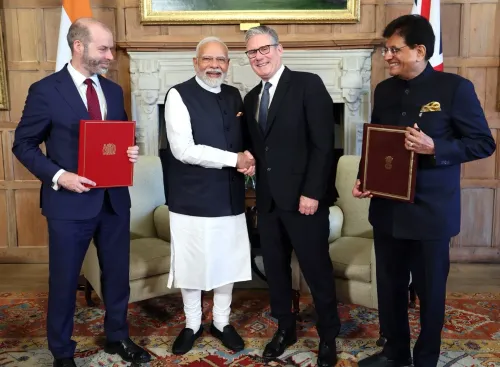
The two governments have repeatedly signalled their intent to build a forward-looking partnership anchored in advanced defence technology, innovation, and trade collaboration. High-level bilateral engagements in recent years — including discussions between Prime Minister Narendra Modi and UK Prime Minister Keir Starmer during Starmer's visit to India in 2025 — have provided political momentum to the process.
Key Benefits for India and the UK
For India, the CETA is projected to open significant new avenues in the services sector. The agreement creates enhanced market access across Information Technology and IT-enabled Services (IT/ITeS), Financial Services, Professional Services — including management consultancy, architectural, and engineering — as well as Other Business Services and Education Services, according to the UKIBC statement.
On the UK side, the deal is expected to bring in nearly £6 billion in new investment and export wins. This is projected to create more than 2,200 British jobs across the country, driven by Indian firms expanding their UK operations and British companies securing fresh business opportunities in India. Tariff reductions under the CETA are expected to boost UK exports to the Indian market.
Projected Economic Impact
The economic implications of the agreement are substantial. The CETA is projected to increase the UK's GDP by £3.3 billion by 2035 and to double bilateral trade by 2030, according to the UKIBC statement. Significant job creation in India is also anticipated as part of this growth trajectory, though specific figures were not detailed in the statement.
What the UKIBC Said
Kishore Jayaraman, Group CEO of the UK-India Business Council, described the agreement as 'a historic milestone in the bilateral relationship.' He noted that 'businesses across both countries have long called for an agreement that reduces barriers, enhances market access, and creates a clear framework for long-term, sustainable growth.'
The UKIBC also indicated it will continue supporting its members in understanding and leveraging the deal's provisions, with a particular focus on digital trade, services, manufacturing, education, and innovation-led collaboration.
What Comes Next
With the Entry Into Force date set for 15 July 2025, businesses on both sides are expected to begin aligning operations with the new trade framework. Industry bodies and member firms of the UKIBC are being briefed on sector-specific provisions, and implementation guidance is anticipated in the weeks ahead.
Point of View
But the harder work begins now. The £3.3 billion GDP uplift and 2030 trade-doubling targets are projections, not guarantees — and both hinge on implementation quality, not just headline signing. India's services sector stands to gain meaningfully, particularly in IT/ITeS, but only if mutual recognition of professional qualifications — historically a sticking point — is executed swiftly. The 2,200 British jobs figure is modest relative to the deal's scale, suggesting the UK's near-term gains are more about export market access than domestic employment. The real test will be whether the agreement's provisions on digital trade and innovation collaboration translate into ground-level business activity, or remain aspirational language in a formal document.
NationPress
18 Sept 2026
Frequently Asked Questions
What is the UK-India CETA?
The UK-India Comprehensive Economic Trade Agreement (CETA) is a landmark bilateral free trade deal between India and the United Kingdom. It is set to come into force on 15 July 2025 and covers goods, services, digital trade, and investment, with the goal of doubling bilateral trade by 2030.
When does the UK-India trade deal take effect?
The agreement officially takes effect on 15 July 2025, following the formal 'Entry Into Force' announcement made on 17 June 2025.
How much is UK-India bilateral trade currently?
Bilateral trade between India and the UK reached nearly £47.9 billion (approximately $56–60 billion) in the four quarters ending Q4 2025, representing a 10 per cent increase over previous years.
What are the economic benefits of the UK-India CETA?
The deal is projected to increase the UK's GDP by £3.3 billion by 2035 and double bilateral trade by 2030. The UK also expects £6 billion in new investment and export wins, creating more than 2,200 British jobs. India gains enhanced market access in IT/ITeS, financial, professional, and education services.
Which sectors in India benefit most from the CETA?
India's services sector is the primary beneficiary, with the agreement opening enhanced market access in IT and IT-enabled Services (IT/ITeS), Financial Services, Professional Services such as management consultancy and engineering, and Education Services in the UK market.