Union Ministers Review Assam-Arunachal Flood Situation in Guwahati
Synopsis
Union Ministers Shivraj Singh Chouhan and Kiren Rijiju visited flood-hit Assam and Arunachal Pradesh and chaired a review meeting in Guwahati on 1 July 2026, assuring coordinated relief, rescue, and rehabilitation measures with state governments.
Key Takeaways
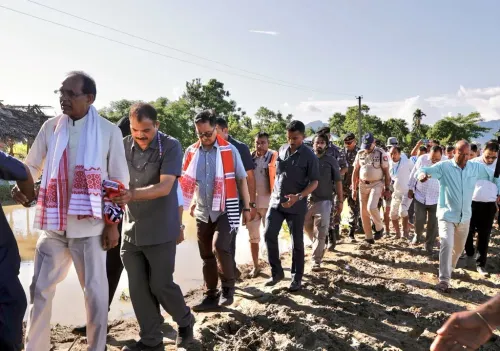
Union Ministers Shivraj Singh Chouhan and Kiren Rijiju assessed the flood situation in Assam and Arunachal Pradesh on 1 July 2026 .
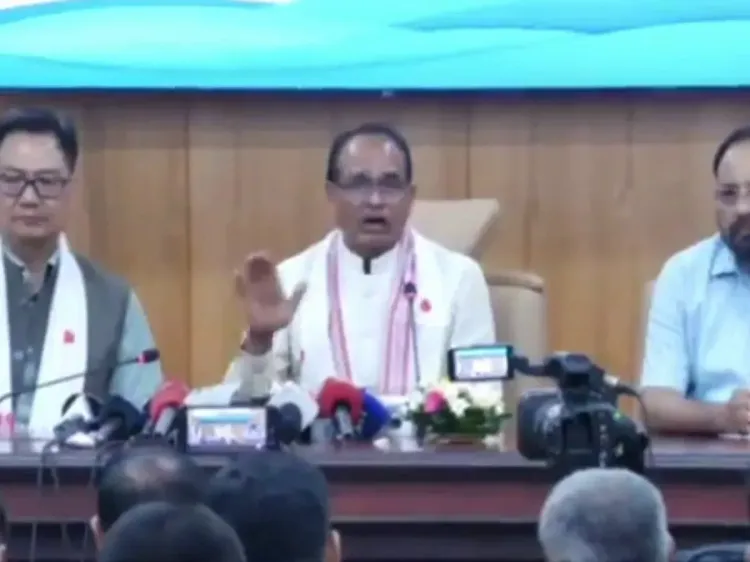
A high-level review meeting was chaired by the two ministers in Guwahati following the ground assessment.
The ministers assured that all necessary measures would be taken to strengthen relief, rescue, and rehabilitation efforts.
The central government pledged to work in close coordination with the state governments of Assam and Arunachal Pradesh.
Assam state ministers Pijush Hazarika and Keshab Mahanta were among those present at the meeting.
Follow-up announcements on central assistance and NDRF deployments are anticipated as the monsoon season progresses.
The Chief Minister's Office of Assam announced on Wednesday, 1 July 2026, that Union Ministers Shri Shivraj Singh Chouhan and Shri Kiren Rijiju chaired a high-level review meeting in Guwahati following their on-ground assessment of the flood situation in Assam and Arunachal Pradesh. The ministers addressed the media after the meeting, assuring that all necessary measures would be taken to strengthen relief, rescue, and rehabilitation efforts in close coordination with the state governments concerned.
Context
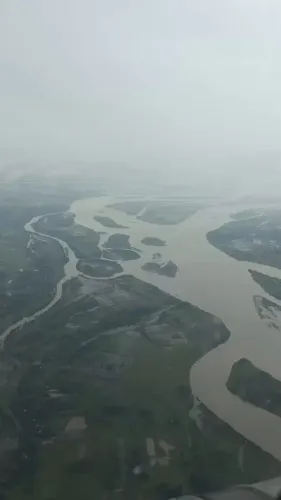
The monsoon season of 2026 has once again brought severe flooding to the Brahmaputra basin, affecting communities across Assam and Arunachal Pradesh. The two Union Ministers conducted an aerial or ground assessment of flood-hit areas before convening the review in Guwahati, the capital of Assam and a traditional hub for central-state coordination on Northeast India's disaster response.
Speaking to the media after the meeting, the ministers said that relief, rescue, and rehabilitation operations would be reinforced, with the central government working in 'close coordination' with the state administrations. Senior Assam state ministers, including Pijush Hazarika and Keshab Mahanta, were also part of the discussions, signalling a joint central-state response mechanism.
Policy Backdrop
Flood management in Assam is governed under the Disaster Management Act, 2005, which established the National Disaster Response Force (NDRF) and created structured funding channels through the State Disaster Response Fund (SDRF) and the National Disaster Response Fund (NDRF). Central releases to Assam under these heads have occurred nearly every monsoon season, making coordinated review meetings of this kind a recurring but critical feature of disaster governance in the Northeast.
The Brahmaputra and its numerous tributaries are among the most flood-prone river systems in South Asia. Structural interventions such as embankment reinforcement, river dredging, and basin-level planning have been discussed at successive central-state reviews, though long-term solutions remain a work in progress. The deployment of NDRF battalions to Assam ahead of and during the monsoon has been standard practice for nearly two decades.
Stakeholders and Impact
The most immediate stakeholders are the flood-affected residents of Assam and Arunachal Pradesh, whose livelihoods, homes, and agricultural land face annual disruption during the monsoon. State disaster management authorities in both states bear the operational burden of coordinating rescue boats, relief camps, and medical assistance across often remote and inundated terrain.
Shivraj Singh Chouhan, a long-serving BJP leader and former Chief Minister of Madhya Pradesh, brings senior Cabinet-level weight to the review. Kiren Rijiju, a Union Minister from Arunachal Pradesh himself, has been closely associated with Northeast India affairs across multiple portfolios. Their joint presence in Guwahati underscores the political priority the Centre has attached to this year's flood response.
What's Next
Following the review meeting, stakeholders will watch for formal announcements on additional central financial assistance, fresh NDRF battalion deployments, or accelerated progress on Brahmaputra basin infrastructure projects. The assurance of 'all necessary measures' given to the media leaves room for a range of follow-up actions in the coming days and weeks.
With the monsoon season typically peaking through July and August, the coordination established at this meeting will be tested in real time. Any significant escalation in flood damage or displacement could prompt further high-level intervention from the Centre.
Point of View
Not a routine administrative matter. The choice of Guwahati as the venue and the inclusion of state-level ministers reinforces a pattern of visible central-state coordination that serves both governance and political optics in an electorally significant region. However, the assurance of 'all necessary measures' without specific commitments is a familiar formulation at such reviews, and the real test will come in whether structural, long-term investments in Brahmaputra basin management follow the immediate relief push. Analysts will watch whether this meeting translates into fresh SDRF or NDRF releases and any acceleration of embankment or dredging projects that have long been discussed but unevenly implemented.
NationPress
2 Jul 2026
Frequently Asked Questions
Why did Union Ministers visit Assam in July 2026?
Union Ministers Shivraj Singh Chouhan and Kiren Rijiju visited Assam and Arunachal Pradesh to assess the flood situation during the 2026 monsoon season and chaired a review meeting in Guwahati to coordinate relief and rehabilitation efforts.
What was decided at the Guwahati flood review meeting?
The ministers assured that all necessary measures would be taken to strengthen relief, rescue, and rehabilitation operations, with the central government working in close coordination with the state governments of Assam and Arunachal Pradesh.
Who attended the flood review meeting in Guwahati?
Union Ministers Shivraj Singh Chouhan and Kiren Rijiju chaired the meeting. Assam state ministers Pijush Hazarika and Keshab Mahanta were also in attendance.
How does the central government fund flood relief in Assam?
Flood relief in Assam is primarily funded through the State Disaster Response Fund (SDRF) and the National Disaster Response Fund (NDRF), established under the Disaster Management Act, 2005. The Centre releases funds to states based on assessed need.
Why does Assam flood every year?
Assam floods annually because the Brahmaputra river and its tributaries carry enormous volumes of water during the monsoon season. The river's braided, shifting channels and the region's heavy rainfall make large-scale inundation a near-certain annual event.