CM Yogi: UP First State to Classify Human-Wildlife Conflict as Disaster
Synopsis
Uttar Pradesh has formally classified human-wildlife conflict as a disaster category, enabling structured relief for affected communities under the Disaster Management Act framework — a first-of-its-kind move among Indian states, announced by CM Yogi Adityanath on 19 July 2026.
Key Takeaways
Uttar Pradesh has classified human-wildlife conflict as a formal disaster category, a move announced by CM Yogi Adityanath on 19 July 2026 .
The classification is intended to provide structured, time-bound relief and assistance to communities affected by such conflicts — comparable to relief for natural calamities.
The policy is anchored in the Disaster Management Act, 2005 , which allows state governments to notify additional disaster categories.
Key beneficiaries are farmers and rural communities living near forest areas and protected zones such as Dudhwa Tiger Reserve .
Detailed compensation guidelines, budget provisions, and claim procedures are yet to be publicly released by the state government.
The move could serve as a model for other Indian states grappling with rising human-wildlife conflict incidents.
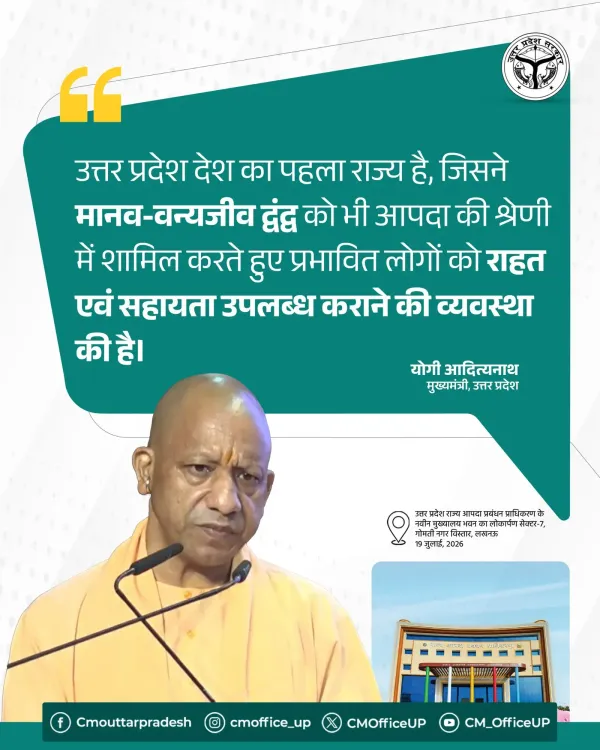
The Chief Minister's Office of Uttar Pradesh announced on Sunday, 19 July 2026, that Uttar Pradesh has become the first state in India to formally classify human-wildlife conflict as a disaster category, enabling structured relief and assistance for affected communities.
Quoting Chief Minister Yogi Adityanath, the official CMO post stated: 'Uttar Pradesh desh ka pehla rajya hai, jisne manav-vanyajeev dwandwa ko bhi aapda ki shreni mein shamil karte hue prabhavit logon ko rahat evam sahayata uplabdh karane ki vyavastha ki hai' — ('Uttar Pradesh is the first state in the country to have included human-wildlife conflict in the category of disaster and made arrangements to provide relief and assistance to affected people.')
Context
Uttar Pradesh is home to significant forest tracts and protected areas, including the Dudhwa Tiger Reserve along its northern belt. Communities in forest-fringe villages — particularly farmers — have long faced threats from wild animals straying into human settlements, resulting in crop damage, livestock loss, and in severe cases, human casualties. Until now, compensation for such incidents was handled under the Wildlife Protection Act, 1972, a framework critics have described as slow and inadequate for routine, recurring conflicts.Policy Backdrop
The Disaster Management Act, 2005, empowers state governments to notify additional categories of disasters beyond those defined at the national level, and to extend structured relief to affected populations through state disaster management authorities. By invoking this provision, Uttar Pradesh is positioning human-wildlife conflict on the same administrative footing as floods, droughts, and earthquakes — unlocking time-bound, standardised compensation mechanisms. The Uttar Pradesh State Disaster Management Authority is the nodal body expected to oversee relief distribution and claim processing under the new classification. Across India, rising incidents of human-wildlife conflict have been linked to habitat loss and the expansion of human settlements into buffer zones. Several states already offer ex-gratia payments for crop damage or casualties under wildlife or revenue frameworks, but a formal disaster classification represents a more comprehensive institutional commitment — one that mandates structured procedures rather than discretionary grants.Stakeholders and Impact
The most direct beneficiaries are farmers and rural communities living near protected areas and forest corridors in Uttar Pradesh. Under a disaster classification, affected individuals would be entitled to relief comparable to that provided during natural calamities — including compensation for crop loss, injury, and death — with defined timelines and eligibility criteria. Wildlife conservation advocates note that formalising relief can also reduce retaliatory killings of animals by communities that previously felt unprotected by the state. The policy could therefore serve twin goals: human welfare and wildlife protection.What's Next
Attention will now turn to the release of detailed compensation guidelines, budget provisions, and claim procedures by the UP government. The scale of financial commitment, the categories of loss covered, and the administrative machinery for swift claim settlement will determine the policy's real-world impact. If implemented effectively, the model could prompt other states with high human-wildlife conflict zones — such as Uttarakhand, Madhya Pradesh, and Maharashtra — to adopt similar notifications under their own state disaster frameworks.Point of View
More structured disaster relief machinery. It reflects a broader pattern of state governments innovating within the Disaster Management Act, 2005, to address emerging welfare gaps that central frameworks do not adequately cover. The political optics are also notable: the announcement positions UP as a pioneer on a rural welfare issue with direct resonance among farming communities in forest-fringe areas — a constituency that matters electorally. Whether the policy delivers on the ground will depend almost entirely on the compensation scales set and the speed of claim settlement, which remain to be detailed.
NationPress
18 Oct 2026
Frequently Asked Questions
What has Uttar Pradesh done regarding human-wildlife conflict?
Uttar Pradesh has formally classified human-wildlife conflict as a disaster category, enabling affected residents to receive structured relief and compensation similar to what is provided during natural calamities such as floods or droughts.
Is UP the first state in India to classify human-wildlife conflict as a disaster?
The Chief Minister's Office of Uttar Pradesh has claimed it is the first state in India to make this classification, though independent verification of this claim is pending as detailed government notifications have not yet been publicly released.
Who will benefit from UP's human-wildlife conflict disaster classification?
Farmers and rural communities living near forests and protected areas in Uttar Pradesh — who suffer crop damage, livestock loss, or injuries due to wild animals — are the primary intended beneficiaries of the new policy.
What law allows UP to classify human-wildlife conflict as a disaster?
The Disaster Management Act, 2005 , empowers state governments to notify additional categories of disasters beyond the national list and to provide relief to affected populations through state disaster management authorities.
What happens next after UP's human-wildlife conflict disaster classification?
The state government is expected to release detailed compensation guidelines, budget allocations, and claim procedures. Other states with significant human-wildlife conflict zones may also consider adopting similar classifications under their own disaster management frameworks.