CM Yogi: UP gave escort allowance to 13,000+ disabled children
Synopsis
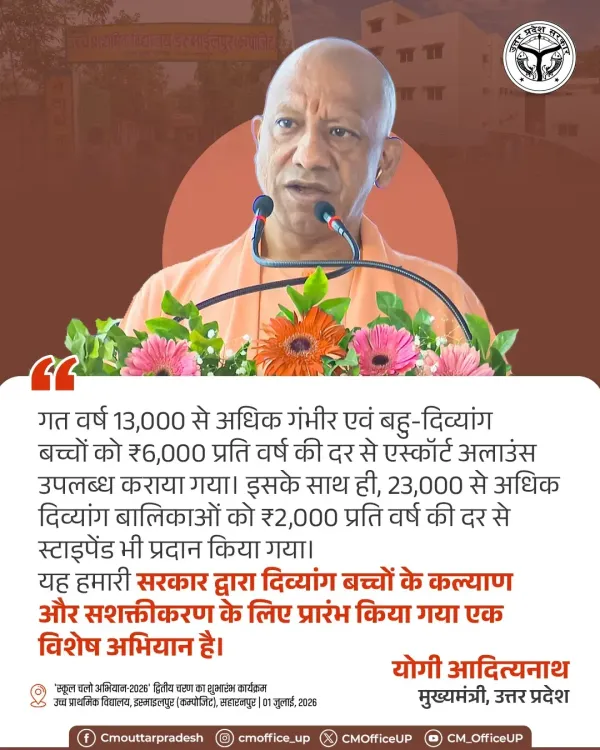
The Chief Minister's Office of Uttar Pradesh announced that over 13,000 severely disabled children received a ₹6,000 annual escort allowance and more than 23,000 disabled girls received a ₹2,000 annual stipend under a state-run special welfare campaign attributed to CM Yogi Adityanath.
Key Takeaways
The Chief Minister's Office of Uttar Pradesh announced the figures on 1 July 2026 , attributing the initiative to CM Yogi Adityanath .
More than 13,000 severely and multi-disabled children received an escort allowance of ₹6,000 per year in the past year.
Over 23,000 disabled girls were provided a stipend of ₹2,000 per year under the same campaign.
The schemes are framed as a 'special campaign' for the welfare and empowerment of children with disabilities in Uttar Pradesh .
Both measures align with the obligations placed on states under the Rights of Persons with Disabilities Act, 2016 , which recognises 21 disability categories.
The Chief Minister's Office of Uttar Pradesh announced on Wednesday, 1 July 2026 that the state government provided an escort allowance of ₹6,000 per year to more than 13,000 severely and multi-disabled children in the past year, alongside a stipend of ₹2,000 per year to over 23,000 disabled girls, under what it described as a special campaign for the welfare and empowerment of children with disabilities.
Context
The post, attributed to Chief Minister Yogi Adityanath, states in Hindi: 'यह हमारी सरकार द्वारा दिव्यांग बच्चों के कल्याण और सशक्तीकरण के लिए प्रारंभ किया गया एक विशेष अभियान है' — meaning, 'This is a special campaign initiated by our government for the welfare and empowerment of disabled children.' The announcement highlights two distinct financial support streams: an escort allowance targeting severely and multi-disabled children, and a stipend directed specifically at disabled girls.
The escort allowance of ₹6,000 per annum is designed to cover the cost of accompanying carers or escorts who help severely disabled children access education and essential services. The stipend of ₹2,000 per annum for disabled girls serves as an additional incentive for their continued schooling and participation in public life.
Policy Backdrop
Both schemes operate within the framework of the Rights of Persons with Disabilities Act, 2016, a central legislation that expanded recognised disability categories from 7 to 21 and placed a binding obligation on state governments to provide financial allowances, educational support, and rehabilitation services. Uttar Pradesh, as India's most populous state, carries one of the largest disability welfare mandates of any state in the country.
The 2016 Act replaced the earlier Persons with Disabilities Act of 1995 and introduced a more inclusive definition of disability, bringing conditions such as autism, cerebral palsy, and acid-attack injuries under its ambit. State-level escort allowances and girl-child stipends have since become a standard instrument through which states operationalise the Act's directives on financial inclusion for persons with disabilities.
Stakeholders and Impact
The primary beneficiaries are two distinct groups: severely and multi-disabled children — who often face the highest barriers to mobility and school attendance — and disabled girls, who face compounded disadvantages of disability and gender. Direct cash transfers of this nature, deposited into beneficiary accounts, aim to reduce dependence on intermediaries and ensure funds reach families directly.
Uttar Pradesh's large population base means that even modest per-beneficiary amounts translate into significant aggregate state expenditure and coverage when measured against national benchmarks for disability welfare. The state's programmes in this space are frequently cited as part of the broader national pattern of supplementing central disability schemes with localised allowances.
What's Next
Attention will now turn to the Uttar Pradesh state budget for 2026-27 to assess whether allocations for disability welfare schemes are being expanded, and whether the per-beneficiary allowance rates — unchanged at ₹6,000 and ₹2,000 respectively — will be revised upward to keep pace with inflation. Any announcement on widening beneficiary coverage or adding new disability categories will be a key indicator of the programme's trajectory under the Yogi Adityanath government.
Point of View
Particularly ahead of budget cycles. By disaggregating beneficiaries into 'severely disabled children' and 'disabled girls,' the communication also signals a gender-sensitive framing of disability policy — a relatively recent shift in how state governments present such programmes. The relatively modest per-beneficiary amounts (₹6,000 and ₹2,000 annually) raise questions about adequacy, but the scale of coverage across a state of Uttar Pradesh's size gives these figures political and administrative weight. Whether the 2026-27 budget translates this rhetoric into enhanced allocations will be the real test of policy intent.
NationPress
30 Sept 2026
Frequently Asked Questions
What is the escort allowance for disabled children in Uttar Pradesh?
The Uttar Pradesh government provides an escort allowance of ₹6,000 per year to severely and multi-disabled children to help cover the cost of carers or escorts who assist them in accessing education and essential services.
How many disabled children received the escort allowance in UP last year?
According to the Chief Minister's Office of Uttar Pradesh, more than 13,000 severely and multi-disabled children received the ₹6,000 annual escort allowance in the past year.
What stipend does Uttar Pradesh give to disabled girls?
The UP government provides a stipend of ₹2,000 per year to disabled girls, with over 23,000 such beneficiaries covered in the past year under the state's special disability welfare campaign.
What law governs disability welfare schemes in Indian states?
The Rights of Persons with Disabilities Act, 2016 is the central legislation that mandates state governments to provide financial allowances, educational support, and rehabilitation services, recognising 21 categories of disability.
What is CM Yogi Adityanath's disability welfare policy in UP?
Under CM Yogi Adityanath, Uttar Pradesh has implemented direct cash transfer schemes for disabled children, including an annual escort allowance for severely disabled children and a stipend for disabled girls, framed as part of a special empowerment campaign.