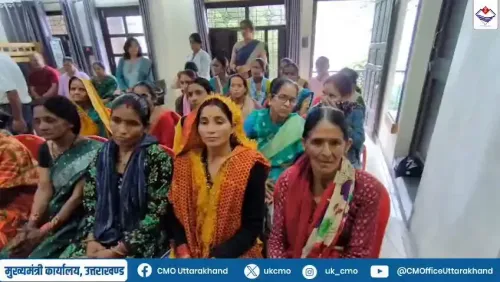
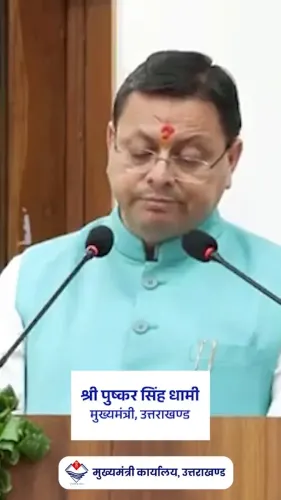
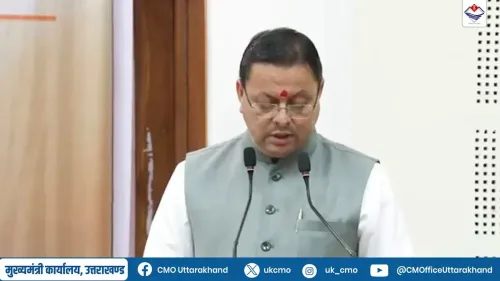
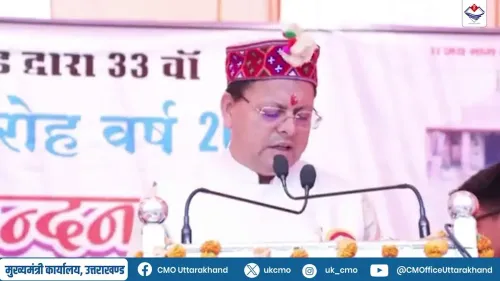
Uttarakhand govt schemes empower women in Champawat
Synopsis
The Chief Minister's Office of Uttarakhand spotlighted welfare schemes empowering women in Champawat district on October 14, 2026, framing rural self-reliance as a core governance outcome in a region long shaped by male out-migration.
Key Takeaways
The Chief Minister's Office of Uttarakhand highlighted women's empowerment through state welfare schemes on October 14, 2026 .
The post specifically named Champawat , a Kumaon hill district with significant rural terrain and male out-migration.
Uttarakhand has run women-focused self-help group and livelihood programmes since state formation in 2000 .
State schemes align with national frameworks such as the National Rural Livelihoods Mission (NRLM) , with state-specific hill adaptations.
The Champawat focus signals district-level scheme uptake is being used as a visible governance benchmark.
Expansion to other Uttarakhand districts remains a key development to watch.
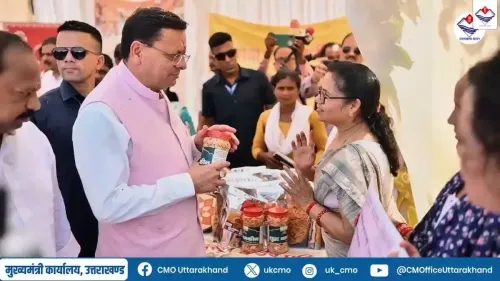
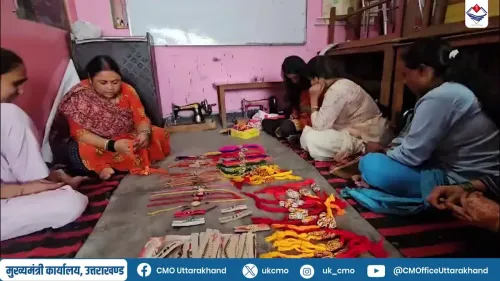
In the hills of Champawat, women are no longer waiting on the sidelines of the economy — they are driving it. The Chief Minister's Office of Uttarakhand highlighted on Wednesday, October 14, 2026, how the state government's welfare schemes are turning rural women into self-reliant earners.
The post, shared in Hindi, stated: 'Uttarakhand sarkar ki kalyankari yojanaon se mahilaen ban rahi hain aatmnirbhar' ('Through the welfare schemes of the Uttarakhand government, women are becoming self-reliant'). The spotlight on Champawat — a Kumaon hill district defined by rugged terrain and deep rural pockets — signals a deliberate effort to showcase ground-level change in one of the state's more remote corners.
Why Champawat, and why now
Champawat sits in a region where male out-migration has long reshaped the household economy, leaving women to manage farms, families, and finances simultaneously. That demographic reality has made women-centric livelihood programmes not a luxury but a structural necessity in Uttarakhand's hill districts for over two decades.
Since the state's formation in 2000, Uttarakhand has built a network of self-help groups and livelihood initiatives designed to plug the gap left by migrating men. These dovetail with national frameworks like the National Rural Livelihoods Mission (NRLM), while incorporating state-specific components tailored to hill conditions — seasonal agriculture, handicrafts, and local enterprise.
Self-reliance as a state policy direction
Across India's hill states, financial inclusion and skill-building for women have emerged as a direct policy response to migration-driven household change. Uttarakhand's approach follows that broader pattern — channelling welfare spending toward productive capacity rather than passive assistance. Self-help groups, in particular, have served as the delivery vehicle for credit access, vocational training, and market linkages for rural women across all 13 districts of the state.
The government's decision to frame this specifically around Champawat suggests district-level progress is being tracked and amplified — a sign that scheme uptake in remote areas is being treated as a visible governance benchmark, not just a bureaucratic line item.
Whether this momentum extends to formal expansion announcements in other hill districts will be the real measure of intent. For now, the message from Dehradun is clear: Champawat's women are not a welfare statistic — they are a headline.
Point of View
Tying state achievement to a federal ideological thread. District-level amplification, if backed by verifiable beneficiary data, could become a template for how hill-state governments make welfare outcomes legible to urban voters.
NationPress
14 Oct 2026
Frequently Asked Questions
What welfare schemes is the Uttarakhand government running for women?
Uttarakhand runs multiple women-focused self-help group and livelihood programmes aligned with the National Rural Livelihoods Mission (NRLM), targeting rural women across its 13 districts, including Champawat, to build financial inclusion and vocational skills.
Why is Champawat highlighted for women empowerment in Uttarakhand?
Champawat is a remote Kumaon hill district where male out-migration is high, leaving women as primary household earners. Government welfare schemes here are designed to convert that burden into economic self-reliance.
What is the role of self-help groups in Uttarakhand's women empowerment push?
Self-help groups (SHGs) serve as the primary delivery mechanism for credit access, skill training, and market linkages for rural women across Uttarakhand, functioning as community-level institutions for economic uplift.
How long has Uttarakhand been running women-focused livelihood programmes?
Since the state's formation in 2000, Uttarakhand has implemented women-centric livelihood and SHG programmes to address economic gaps created by significant male out-migration from hill districts.
Is Uttarakhand's women empowerment approach linked to any national scheme?
Yes, Uttarakhand's state-level women welfare programmes are aligned with the National Rural Livelihoods Mission (NRLM) while incorporating hill-specific adaptations such as seasonal agriculture support and handicraft promotion.