Uttarakhand trains forest staff to tackle wildlife conflict
Synopsis
The Chief Minister's Office of Uttarakhand announced on 20 June 2026 that forest personnel are being trained to handle encounters with wild animals, spotlighting Haridwar district, which borders Rajaji National Park and is a hotspot for human-elephant and leopard conflict.
Key Takeaways
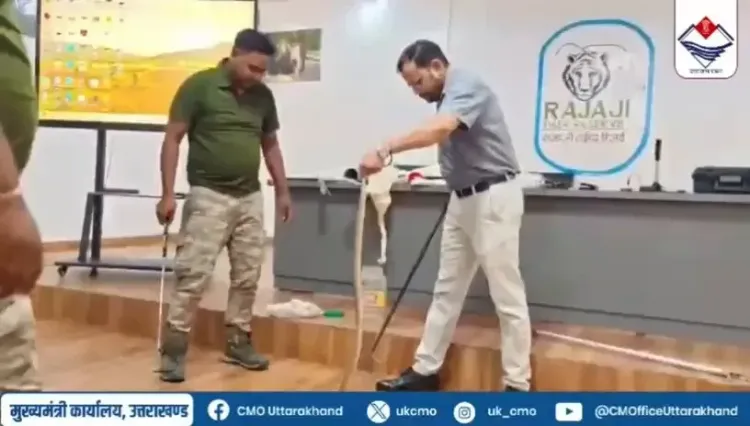
The Chief Minister's Office of Uttarakhand announced on 20 June 2026 that forest workers are being trained to manage human-wildlife conflict.
Haridwar district, which borders Rajaji National Park , is a key focus area for the training initiative.
Uttarakhand records one of the higher incidences of human-wildlife conflict among Himalayan states, driven by habitat fragmentation.
The training aligns with the Wildlife (Protection) Act, 1972 and the national Project Elephant programme launched in 1992 .
The Uttarakhand Forest Department oversees the programme, which targets frontline forest guards and benefits communities living near forest boundaries.
The Chief Minister's Office of Uttarakhand announced on Saturday, 20 June 2026 that forest personnel across the state are being trained to handle encounters with wild animals, with Haridwar district highlighted as a key focus area. The initiative underscores the state government's push to equip frontline forest workers with skills to manage human-wildlife conflict in one of India's most conflict-prone Himalayan states.
Context
The CMO's post, shared in Hindi, stated: 'Uttarakhand mein vanya jeevon se bachav ke liye vankarmiyon ko kiya ja raha hai prashikshit' ('Forest workers in Uttarakhand are being trained to protect against wild animals'). The announcement comes as Haridwar district — which borders Rajaji National Park — continues to record recurring incidents of human-elephant and leopard conflict along its forest fringes.
Rajaji National Park forms a critical corridor within the Terai Arc landscape, a stretch of protected and community forests running across the foothills of the Himalayas. Expanding settlements and linear infrastructure such as roads and railways have fragmented wildlife habitats, pushing animals closer to human habitation.
Policy Backdrop
Capacity-building for forest personnel has been a recurring administrative response to human-wildlife conflict in Uttarakhand since the early 2000s. The legal foundation for such training lies in the Wildlife (Protection) Act, 1972, which mandates the protection of wild species and empowers state governments to train and deploy forest staff accordingly.
At the national level, Project Elephant, launched in 1992, has long emphasised staff training in conflict-prone landscapes as a core strategy. Uttarakhand's current initiative aligns with this broader framework, reflecting a pattern of state-level implementation of centrally guided conservation priorities.
Stakeholders and Impact
Forest guards and frontline forest workers are the primary beneficiaries of the training, gaining skills to respond to wildlife encounters without escalating conflict. Equally, villagers living near forest boundaries in Haridwar and adjoining districts stand to benefit from better-prepared personnel who can intervene swiftly and safely.
Uttarakhand records one of the higher incidences of human-wildlife conflict among Himalayan states, making such capacity-building programmes critical for both conservation outcomes and community safety. The Uttarakhand Forest Department, the state agency responsible for managing forests and wildlife sanctuaries, oversees the training effort.
What's Next
Observers will watch whether the state government releases data on the scope, duration, and funding of this training programme, as well as any subsequent figures on conflict incidents in Haridwar and neighbouring districts. State budget allocations for forest department training in the coming fiscal cycle will be a key indicator of how sustained this initiative proves to be.
If the programme demonstrates measurable impact, it could serve as a model for other conflict-heavy districts in Uttarakhand, and potentially inform approaches adopted by other Himalayan states grappling with similar challenges.
Point of View
State governments respond with visible capacity-building measures for frontline staff. The emphasis on Haridwar is telling — the district's proximity to Rajaji National Park has made it a persistent flashpoint, and the state appears to be signalling targeted attention to the corridor. What remains to be seen is whether this round of training is backed by sustained budgetary commitment or remains a periodic, reactive measure. Broader structural drivers — habitat fragmentation from linear infrastructure — will continue to test the limits of training-only responses.
NationPress
21 Jun 2026
Frequently Asked Questions
Why are Uttarakhand forest workers being trained for wildlife safety?
The Uttarakhand government is training forest workers to better manage human-wildlife conflict, particularly in districts like Haridwar that border protected areas such as Rajaji National Park, where encounters with elephants and leopards are frequent.
Which area in Uttarakhand has the most human-wildlife conflict?
Haridwar district, which lies adjacent to Rajaji National Park and the Terai Arc landscape, is among the most conflict-prone areas in Uttarakhand, recording recurring incidents involving elephants and leopards.
What is Rajaji National Park and why is it significant?
Rajaji National Park is a protected area in Uttarakhand that forms part of the Terai Arc landscape. It borders human settlements in Haridwar and is a key habitat for elephants, leopards and other wildlife, making it central to human-wildlife conflict discussions in the state.
What national scheme supports wildlife conflict management in India?
Project Elephant, launched in 1992, is a centrally sponsored scheme that emphasises staff training and conflict mitigation in elephant-range states. Uttarakhand's training initiative aligns with this broader national framework.
What law governs wildlife protection and forest staff training in India?
The Wildlife (Protection) Act, 1972 provides the legal foundation for protecting wild species and empowers state governments to train and deploy forest personnel to manage human-wildlife conflict across India.