CM Uttarakhand: Women Run Outlets on Char Dham Route
Synopsis
The Chief Minister's Office of Uttarakhand spotlighted women in Rudraprayag operating restaurants and retail outlets on the Char Dham Yatra route, calling it a move toward self-reliance and echoing the state's broader push to channel pilgrimage tourism revenue toward local women.
Key Takeaways
The Uttarakhand CMO on 12 June 2026 highlighted women-run restaurants and outlets on the Char Dham Yatra route in Rudraprayag .
Rudraprayag lies on the Kedarnath corridor, one of the four Char Dham pilgrimage sites drawing millions of visitors annually.
The initiative aligns with the National Rural Livelihood Mission (expanded 2011 ) which supports women's self-help groups and micro-enterprises in hill districts.
The Char Dham Mahamarg Vikas Pariyojana ( 2016 ) improved road access to all four shrines, boosting viability of roadside businesses.
The state's broader goal is to reduce out-migration and raise female labour-force participation in pilgrimage-dependent districts.
Scaling women-run facilities to other Char Dham districts and any new credit or training schemes remain key items to watch for the 2026 season .
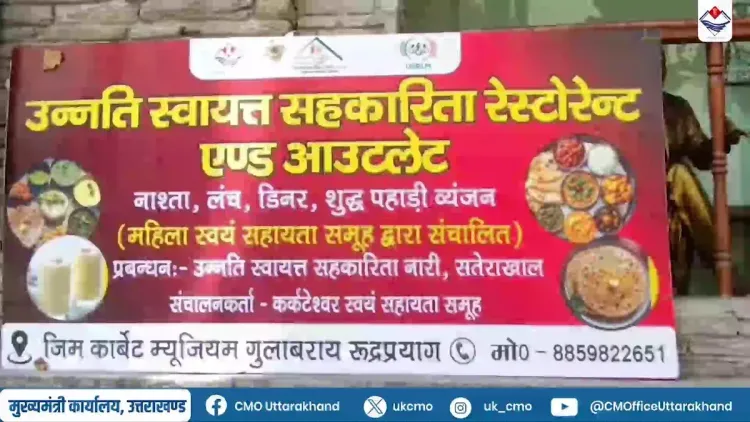
The Chief Minister's Office of Uttarakhand on Friday, 12 June 2026 highlighted women entrepreneurs operating restaurants and retail outlets along the Char Dham Yatra route in Rudraprayag, framing their ventures as a step toward self-reliance and economic independence.
The post, shared in Hindi, stated: 'Rudraprayag mein Chardham Yatra marg par restaurant aur outlet sanchalan se mahilaon ne badhaaya aatmanirbharta ki or kadam' — ('Women in Rudraprayag have taken steps toward self-reliance by operating restaurants and outlets on the Char Dham Yatra route.')
Context
Rudraprayag is a district in Uttarakhand that sits directly on the pilgrimage corridor leading to Kedarnath, one of the four sacred shrines of the Char Dham circuit. The annual Char Dham Yatra — covering Yamunotri, Gangotri, Kedarnath and Badrinath — draws millions of pilgrims each season, generating concentrated economic activity along mountain highways. Local women operating food and retail businesses on this corridor are positioned to capture a share of that seasonal revenue.
Policy Backdrop
The state government's push aligns with two longer-running national frameworks. The National Rural Livelihood Mission, expanded in 2011, has supported women's self-help groups in forming micro-enterprises across Uttarakhand's hill districts. Separately, the Char Dham Mahamarg Vikas Pariyojana, approved in 2016, upgraded road infrastructure to all four pilgrimage sites, improving access and footfall for roadside businesses. Together, these initiatives created conditions for women-led enterprises to become viable along the yatra corridors.
Uttarakhand has consistently sought to direct religious tourism revenues toward local communities, particularly women, as a strategy to reduce seasonal out-migration from mountain districts. Female labour-force participation in districts dependent on pilgrimage traffic has been a stated priority for the state administration.
Stakeholders and Impact
The primary beneficiaries are rural women in Rudraprayag and surrounding areas who gain income, business experience, and financial independence through outlet operations during the yatra season. Pilgrimage tourists benefit from locally run food and retail services along the route. The broader district economy gains from reduced dependence on external vendors and increased circulation of income within the community.
Women-run outlets on pilgrimage routes also carry a social dimension: they signal a shift in the role of women in hill economies from subsistence agriculture to active commercial participation in one of the state's largest revenue-generating sectors.
What's Next
Attention will now turn to whether the Uttarakhand government announces formal schemes — including training, credit access, or infrastructure support — to scale women-run facilities to other Char Dham districts ahead of and during the 2026 yatra season. The government's ability to institutionalise these efforts, rather than leaving them as informal seasonal arrangements, will determine the long-term livelihood impact for women across the pilgrimage belt.
Point of View
Not merely a byproduct. Framing outlet operations as 'steps toward self-reliance' connects routine livelihood activity to the broader national 'Aatmanirbhar Bharat' vocabulary, lending political weight to what might otherwise be a local welfare story. The challenge for the government is converting such visibility into durable policy — credit lines, formal licensing, and off-season support — so that women's gains are not limited to the pilgrimage months. If institutionalised, this model could become a replicable template for other pilgrimage states managing the tension between mass religious tourism and local economic inclusion.
NationPress
15 Sept 2026
Frequently Asked Questions
What are women doing on the Char Dham Yatra route in Rudraprayag?
Women in Rudraprayag are operating restaurants and retail outlets along the Char Dham Yatra pilgrimage route, earning income during the busy pilgrimage season and moving toward financial self-reliance.
What is the Char Dham Yatra and why does it matter economically?
The Char Dham Yatra is an annual Hindu pilgrimage to four sacred shrines — Yamunotri, Gangotri, Kedarnath and Badrinath — in Uttarakhand. It draws millions of pilgrims each season, making the route corridors a significant source of local commercial activity.
How is the Uttarakhand government supporting women's livelihood on pilgrimage routes?
The state has encouraged women to operate food and retail businesses on pilgrimage corridors, supported by frameworks like the National Rural Livelihood Mission which backs women's self-help groups, and improved road access under the Char Dham Mahamarg Vikas Pariyojana.
What is the Char Dham Mahamarg Vikas Pariyojana?
The Char Dham Mahamarg Vikas Pariyojana is a road-upgrade project approved in 2016 to improve highway connectivity to all four Char Dham pilgrimage sites in Uttarakhand, boosting access for both pilgrims and local businesses along the route.
Why does Uttarakhand focus on women's empowerment in pilgrimage districts?
Hill districts in Uttarakhand face high rates of male out-migration, leaving women as the primary residents. The state government has prioritised raising female labour-force participation, and pilgrimage corridors with guaranteed seasonal footfall offer a practical setting for women-run micro-enterprises.