Vaishnaw Highlights 12 Years of Northeast Connectivity Push
Synopsis
Union Minister Ashwini Vaishnaw on 20 June 2026 marked twelve years of the central government's Northeast connectivity drive, framing the agenda as 'rail, road, air and opportunity' under the BJP's Act East Policy launched in 2014.
Key Takeaways
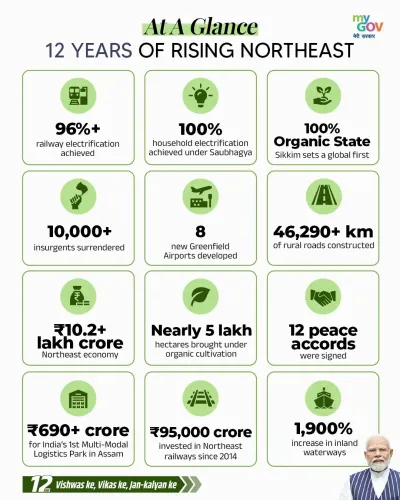
Union Minister Ashwini Vaishnaw posted on 20 June 2026 to mark #12YearsOfRisingNorthEast .
The post frames the government's agenda as a four-pillar push: rail, road, air, and economic opportunity .
The Act East Policy , launched in 2014 , designated Northeast India as India's gateway to ASEAN economies.
The PM-DevINE scheme, introduced in 2016-17 , expanded multimodal and social infrastructure funding across all eight Northeast states .
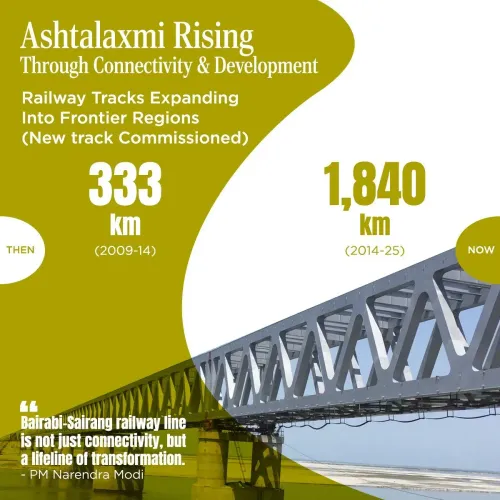
Broad-gauge rail conversions, new highways, and greenfield airports in Arunachal Pradesh and Nagaland are among ongoing projects under the agenda.
The 2026-27 Union Budget allocations for Northeast infrastructure will be a key indicator of continued central government commitment.
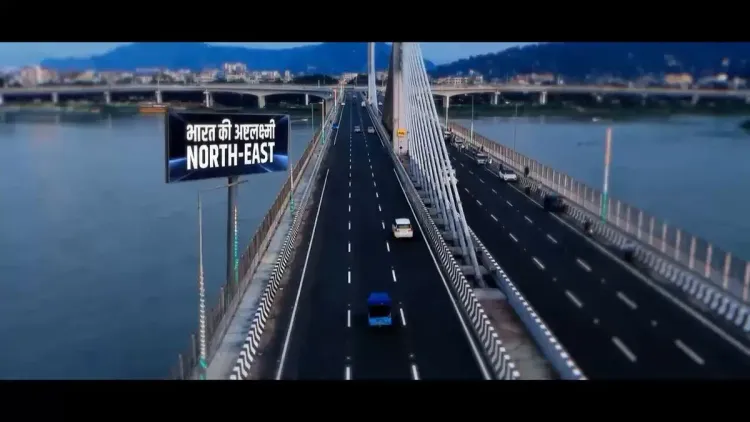
Union Minister Ashwini Vaishnaw on Saturday, 20 June 2026 marked twelve years of the central government's Northeast connectivity drive, posting a four-word framework — 'By rail. By road. By air. By opportunity.' — that encapsulates the multimodal infrastructure agenda the BJP-led government has pursued in the region since 2014.
Context
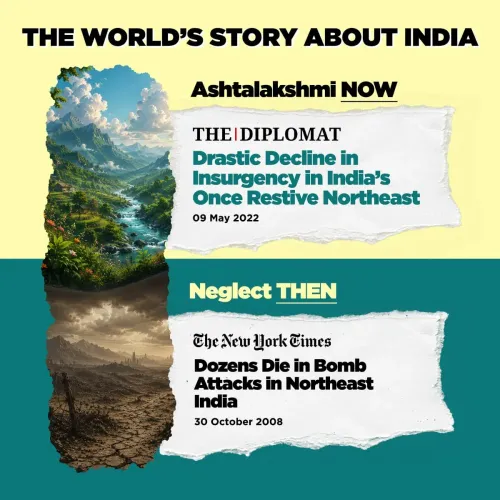
The post, tagged #12YearsOfRisingNorthEast, arrives as the central government marks a dozen years of its Act East Policy, the strategic framework formally unveiled in 2014 that designated Northeast India as the country's land bridge to Southeast Asia. The eight-state region — sharing borders with China, Myanmar, Bangladesh, and Bhutan — had long been characterised by infrastructure deficits that limited both economic integration and strategic access.
Vaishnaw, who holds the Railways portfolio among others, is among the senior ministers most directly responsible for the physical infrastructure side of this agenda. His framing — rail, road, air, and 'opportunity' — mirrors the government's stated goal of converting connectivity investments into livelihood gains for Northeast residents.
Policy Backdrop
The Act East Policy reoriented India's engagement with ASEAN economies by treating the Northeast as a transit and trade corridor rather than a peripheral zone. Successive Union Budgets from 2014 onwards earmarked rising capital outlays for rail gauge-conversion, national highway expansion, and greenfield airports across the region.
The Prime Minister's Development Initiative for North East Region (PM-DevINE), introduced in the 2016-17 budget cycle, further broadened the funding architecture to cover multimodal and social infrastructure together. The Ministry of Development of North Eastern Region coordinates these schemes across all eight states, working in tandem with the Railways and Road Transport ministries.
Broad-gauge rail conversions, connectivity to state capitals previously unreached by rail, and new air routes under the regional connectivity scheme have all formed part of this twelve-year build-out. The minister's video post, shared with the campaign hashtag, is consistent with the government's practice of marking policy anniversaries with audio-visual summaries of progress.
Stakeholders and Impact
Northeast residents — spanning communities across Assam, Arunachal Pradesh, Manipur, Meghalaya, Mizoram, Nagaland, Sikkim, and Tripura — are the primary beneficiaries cited in government communications around this agenda. Improved rail and road links reduce travel times, lower freight costs, and open access to national markets for agricultural and handicraft producers.
Regional traders stand to gain from smoother cross-border corridors that the Act East Policy envisions connecting India with Myanmar and beyond. The 'opportunity' dimension in Vaishnaw's post gestures at this economic dividend, positioning physical infrastructure as a precondition for investment and employment growth in a region historically underserved by private capital.
What's Next
Parliamentary scrutiny of 2026-27 Union Budget allocations for Northeast rail and highway projects will be a near-term indicator of how the government sustains momentum beyond the anniversary milestone. Completion timelines for ongoing broad-gauge conversions and greenfield airports in Arunachal Pradesh and Nagaland remain closely watched by regional stakeholders and strategic analysts alike.
As the government enters the second year of the current Lok Sabha term, the Northeast connectivity narrative is likely to remain central to the BJP's governance messaging — both for domestic audiences in the region and as a signal to ASEAN partners of India's seriousness about its eastern land corridors.
Point of View
Using the hashtag #12YearsOfRisingNorthEast to anchor the BJP's governance record in a region where electoral and strategic stakes are both high. The 'opportunity' framing is significant — it signals an attempt to move the Northeast narrative beyond physical infrastructure toward economic dividend, a harder metric to demonstrate but a more compelling one for voters. The post fits a broader pattern of the central government using multimodal connectivity as a combined security, economic, and diplomatic instrument, positioning the Northeast as a fulcrum of the Act East Policy rather than a recipient of welfare transfers. As the 2026-27 budget cycle unfolds, the gap between anniversary messaging and on-ground project completion timelines will determine how durable this narrative proves.
NationPress
20 Jun 2026
Frequently Asked Questions
What is the #12YearsOfRisingNorthEast hashtag about?
The hashtag marks twelve years since 2014 of the central government's infrastructure and connectivity push in Northeast India under the Act East Policy and related schemes.
What has Ashwini Vaishnaw said about Northeast connectivity?
On 20 June 2026, Vaishnaw posted that the Northeast is now connected 'by rail, by road, by air, by opportunity,' summarising the BJP government's multimodal infrastructure agenda in the region.
What is the Act East Policy and how does it relate to Northeast India?
The Act East Policy, launched in 2014, designates Northeast India as India's strategic gateway to ASEAN economies, driving investment in rail, road, air, and digital connectivity across the eight-state region.
Which states are covered under Northeast India connectivity projects?
The eight Northeast states — Assam, Arunachal Pradesh, Manipur, Meghalaya, Mizoram, Nagaland, Sikkim, and Tripura — are covered under central government connectivity and development schemes.
What is PM-DevINE and how does it fund Northeast infrastructure?
PM-DevINE, introduced in the 2016-17 budget cycle, is a central scheme under the Ministry of Development of North Eastern Region that funds multimodal and social infrastructure projects across all eight Northeast states.