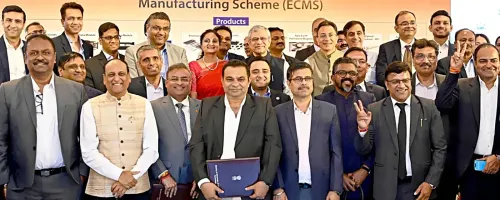
Vaishnaw Eyes No. 2 Export Spot for Electronics at Pune Visit
Synopsis
Union Minister Ashwini Vaishnaw visited Ranjangaon, Pune on 17 June 2026 and announced that electronics is now India's third-largest export category, setting a new national target of making it the second-largest — a milestone built on the PLI scheme and years of manufacturing policy reform.
Key Takeaways
Union Minister Ashwini Vaishnaw declared electronics India's third-largest export category during a visit to Ranjangaon, Pune on 17 June 2026 .
The minister set the next national ambition as making electronics the second-largest export category of India.
The PLI Scheme for Large Scale Electronics Manufacturing , launched in 2020 with an outlay of Rs 38,325 crore , has been a primary driver of this export growth.
Mobile phone exports crossed $10 billion within three years of the PLI scheme's notification.
Manufacturing clusters in Tamil Nadu , Uttar Pradesh , and Maharashtra have led the sector's rise.
The India Semiconductor Mission and potential PLI revisions for components are the key policy levers to watch going forward.
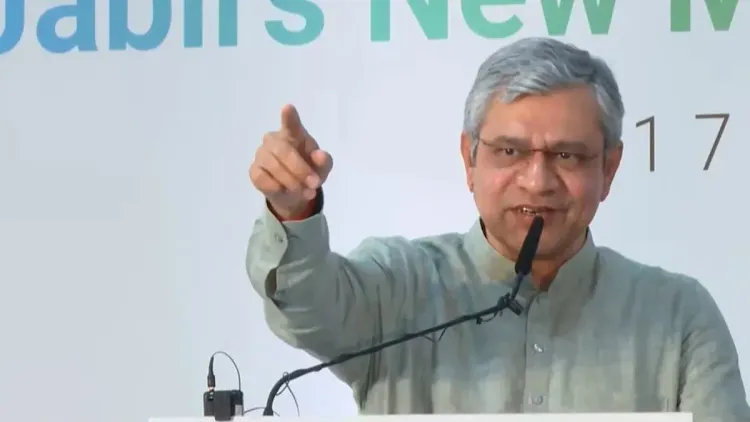
Union Minister Ashwini Vaishnaw on Wednesday, 17 June 2026, declared that electronics has become India's third-largest export category and set the next national target as making it the second-largest, during a visit to Ranjangaon, Pune.
Context
Speaking from Ranjangaon MIDC, one of Maharashtra's key electronics and auto-component manufacturing hubs, Vaishnaw framed the announcement as a milestone and a forward-looking challenge in the same breath. The minister, who holds charge of the Ministry of Electronics and Information Technology (MeitY) alongside Railways and Information and Broadcasting, posted on X: 'Electronics has emerged as India's third-largest export category. Next target: Making electronics second-largest export category of India.'
Ranjangaon's industrial corridor has hosted several electronics manufacturing units that have benefited from both state-level incentives and central government schemes, making it a symbolic location for such an announcement.
Policy Backdrop
The rise of electronics exports is closely tied to the Production Linked Incentive (PLI) Scheme for Large Scale Electronics Manufacturing, notified in 2020 with an outlay of Rs 38,325 crore. The scheme targeted mobile phones, components, and IT hardware, and within three years of its launch, mobile phone exports alone crossed $10 billion.
The broader policy shift — from tariff-based import substitution to output-linked incentives — has been a defining feature of electronics industrial policy since 2014. The National Policy on Electronics 2019 had originally set a target of $400 billion in electronics manufacturing by 2025, anchoring the long-term ambition that Vaishnaw's statement now extends further.
Manufacturing clusters in Tamil Nadu, Uttar Pradesh, and Maharashtra have been the primary engines of this export growth, elevating electronics from a marginal line item to a position behind only engineering goods and petroleum products in India's export basket.
Stakeholders and Impact
Electronics manufacturers and component exporters stand to be the most immediate beneficiaries if policy support is sustained or expanded. The push to move from third to second place in the export ranking would require significant scaling of component manufacturing, which currently remains a weak link in India's electronics value chain.
The India Semiconductor Mission, which is overseeing the rollout of approved semiconductor fabrication and packaging projects, is expected to play a critical role in deepening the domestic value chain — a prerequisite for sustaining high export growth in electronics.
What's Next
Policy watchers will be tracking whether the government follows the minister's statement with upward revisions to PLI incentives for components, or introduces new design-linked incentive structures to encourage higher-value electronics exports. Any announcement on the semiconductor mission's project timelines could also signal how quickly India can reduce component import dependence. Vaishnaw's visit to a manufacturing hub like Ranjangaon suggests the government is actively engaging with ground-level industry stakeholders as it calibrates the next phase of the electronics export push.
Point of View
However, a structurally harder task than the previous leap, because it requires India to build a components ecosystem, not just assemble finished goods. The minister's presence in Maharashtra, a state with competitive assembly and component capacity, may also be read as an implicit endorsement of that state's manufacturing ecosystem ahead of any future PLI revision. Whether the ambition is matched by fresh fiscal commitments or institutional acceleration of the semiconductor mission will determine if this target is a policy directive or a political aspiration.
NationPress
16 Sept 2026
Frequently Asked Questions
What is India's current electronics export ranking?
According to Union Minister Ashwini Vaishnaw's statement on 17 June 2026, electronics has become India's third-largest export category, after engineering goods and petroleum products.
What is the PLI scheme for electronics and how has it helped exports?
The Production Linked Incentive (PLI) Scheme for Large Scale Electronics Manufacturing was launched in 2020 with an outlay of Rs 38,325 crore. It incentivised mobile phone and IT hardware production and helped push mobile phone exports past $10 billion within three years.
Why did Ashwini Vaishnaw visit Ranjangaon Pune?
Vaishnaw visited Ranjangaon MIDC, an industrial hub near Pune hosting electronics and auto-component manufacturers, where he made the announcement about India's electronics export achievement and the next target.
What is India's target for electronics exports?
Minister Vaishnaw stated that the next target is to make electronics India's second-largest export category. The National Policy on Electronics 2019 had earlier set a broader manufacturing target of $400 billion by 2025.
What is the India Semiconductor Mission and why does it matter for electronics exports?
The India Semiconductor Mission oversees the rollout of approved semiconductor fabrication and packaging projects in India. It is considered critical to deepening the domestic electronics value chain and reducing component import dependence, which is necessary for sustained high-value export growth.