Vaishnaw Unveils Mobile Phone Manufacturing Scheme (MPMS)
Synopsis
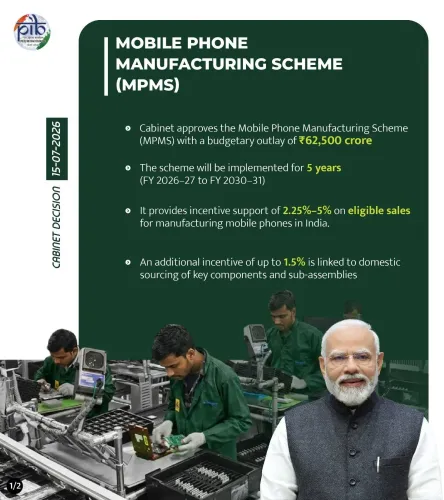
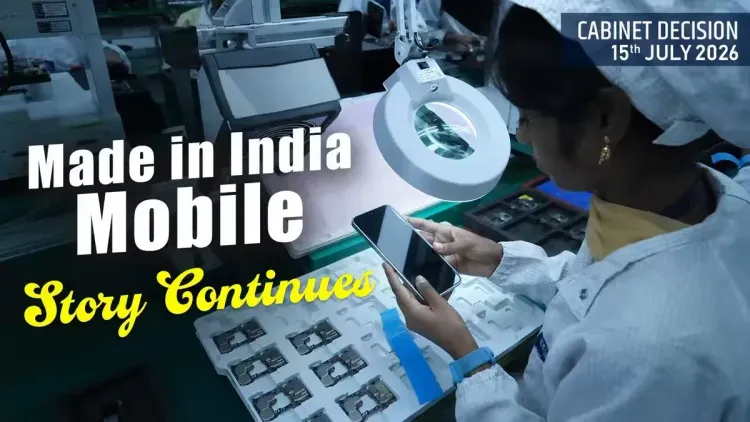
Union Minister Ashwini Vaishnaw on 16 July 2026 announced the Mobile Phone Manufacturing Scheme (MPMS), a new policy framework to boost competitiveness, scale, domestic value addition, and Indian mobile brand development — building on India's decade-long electronics manufacturing push under Make in India and the PLI regime.
Key Takeaways
Union Minister Ashwini Vaishnaw announced the Mobile Phone Manufacturing Scheme (MPMS) on 16 July 2026 .
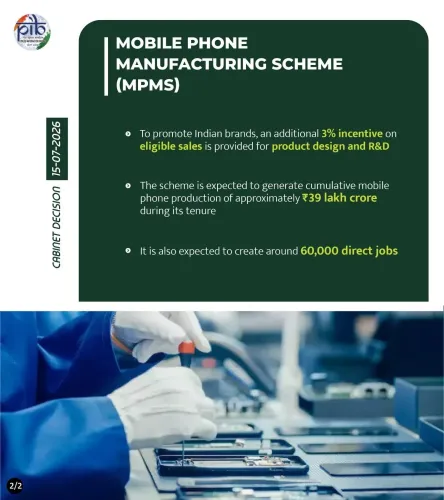
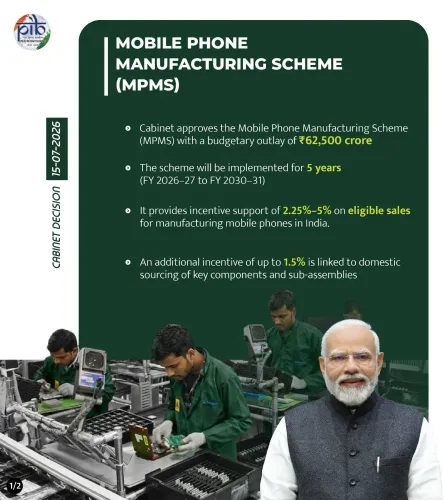
The scheme has four stated objectives: improving competitiveness, achieving scale, increasing domestic value addition, and building Indian mobile brands.
MPMS extends India's electronics manufacturing policy lineage that includes the Make in India initiative (2014) and the PLI Scheme for Large Scale Electronics Manufacturing (notified April 2020).
Key beneficiaries include electronics manufacturers, domestic mobile brands, and the broader components supply chain.
Detailed scheme guidelines, incentive structures, and eligibility criteria are yet to be publicly released.
Future linkages with India's semiconductor policy and Union Budget allocations will be closely watched by industry.
Union Minister Ashwini Vaishnaw announced the Mobile Phone Manufacturing Scheme (MPMS) on Thursday, 16 July 2026, outlining a new policy framework aimed at strengthening India's position in global mobile phone production. The scheme targets four core objectives: improving competitiveness, achieving scale, increasing domestic value addition, and building Indian mobile brands.
Context
Vaishnaw, who holds charge of the Ministries of Electronics and Information Technology, Railways, and Information and Broadcasting, posted the announcement on X alongside a video elaborating on the scheme's contours. The MPMS is positioned as the next step in India's electronics manufacturing push, moving beyond assembly toward deeper integration of the supply chain and the cultivation of homegrown mobile brands.
Policy Backdrop
India's effort to build a domestic mobile manufacturing ecosystem dates to the Make in India initiative launched in 2014, which sought to attract global investment and reduce dependence on imports. The Production Linked Incentive (PLI) Scheme for Large Scale Electronics Manufacturing, notified in April 2020, was a landmark step: it offered financial incentives tied to incremental sales, drawing global assemblers and domestic players to set up or expand operations in India.
Successive PLI iterations have progressively raised the bar, nudging manufacturers to go beyond final assembly and invest in components, sub-assemblies, and design. The MPMS appears to continue this trajectory, with an explicit emphasis on domestic value addition — a metric that measures how much of a product's worth is generated within India rather than imported as finished parts.
Stakeholders and Impact
The scheme's primary beneficiaries are expected to be electronics manufacturers — both global original equipment manufacturers with India operations and domestic mobile brands seeking scale and recognition. For Indian brands in particular, an explicit policy focus on brand-building marks a notable shift: earlier incentive programmes were largely agnostic to brand ownership, rewarding output volumes regardless of whether the seller was an Indian or foreign label.
Component makers, logistics providers, and the broader electronics supply chain stand to gain if the scheme successfully attracts fresh investment. Consumer electronics workers and the states hosting manufacturing clusters — including Tamil Nadu, Uttar Pradesh, and Andhra Pradesh — are also indirect stakeholders in how the policy is eventually structured and rolled out.
What's Next
The announcement sets the strategic direction but detailed scheme guidelines, eligibility criteria, incentive structures, and disbursement timelines are yet to be publicly released. Analysts and industry bodies will watch closely for linkages with India's nascent semiconductor policy and any component-level incentives that could address the persistent gap in domestic value addition. Future Union Budget and Cabinet announcements are expected to provide the fiscal scaffolding for MPMS. The scheme's success will ultimately be measured by whether Indian brands can achieve global competitiveness — a goal that has remained elusive despite years of assembly-focused incentives.
Point of View
More structurally significant goal. Vaishnaw's framing of 'Indian mobile brand' as an explicit policy objective is notable, suggesting the government wants Indian names, not just Indian factories, competing globally. This fits a broader pattern of the current administration using industrial policy to pursue strategic autonomy in technology supply chains. Whether MPMS delivers on that ambition will depend on the depth of incentives in the fine print and their alignment with India's semiconductor and component ecosystem plans.
NationPress
16 Jul 2026
Frequently Asked Questions
What is the Mobile Phone Manufacturing Scheme (MPMS)?
The Mobile Phone Manufacturing Scheme (MPMS) is a new Indian government policy announced by Union Minister Ashwini Vaishnaw on 16 July 2026, aimed at improving competitiveness, achieving scale, increasing domestic value addition, and building Indian mobile brands.
How is MPMS different from the PLI scheme for mobile phones?
While the PLI Scheme for Large Scale Electronics Manufacturing (notified April 2020) primarily incentivised incremental sales volumes, the MPMS explicitly targets domestic value addition and the creation of Indian mobile brands, indicating a shift from assembly-focused to deeper manufacturing and brand-building goals.
Who will benefit from the Mobile Phone Manufacturing Scheme?
Electronics manufacturers — both global companies with India operations and domestic mobile brands — are the primary intended beneficiaries. Component makers, logistics providers, and states hosting manufacturing clusters are also expected to gain from increased investment flows.
When will the MPMS scheme guidelines be released?
As of the announcement on 16 July 2026, detailed scheme guidelines, eligibility criteria, and incentive structures have not yet been publicly released. Further details are expected through Cabinet decisions or Union Budget announcements.
What is domestic value addition in mobile phone manufacturing?
Domestic value addition refers to the proportion of a product's economic value that is generated within India — through local components, design, and manufacturing — rather than imported as finished parts or sub-assemblies. Raising this metric is a key goal of the MPMS.