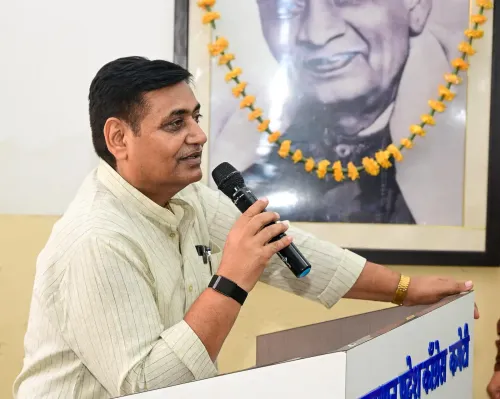
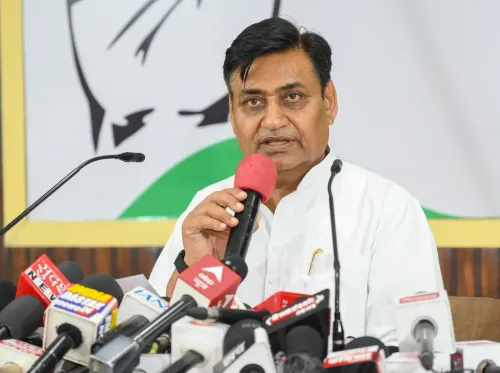
Vishvendra Singh blasts Rajasthan Congress leadership after civic poll loss
Synopsis
A senior Congress leader has gone public with a scathing attack on his own party's state president and district chiefs after the Bharatpur-Deeg civic poll defeat — naming names, alleging ticket rigging, and demanding heads roll. It is a rare, open display of factional warfare that exposes just how fragile the Rajasthan Congress organisation remains since its 2023 assembly loss.
Key Takeaways
Former minister Vishvendra Singh publicly blamed the Bharatpur and Deeg district Congress presidents for the party's Urban Local Body election defeat.
Singh alleged that district chiefs sidelined loyal workers and distributed tickets to personally favoured candidates.
PCC President Govind Singh Dotasra was accused of shielding the district-level leaders rather than taking action after the loss.
Singh warned that the Congress cannot rebuild in the Bharatpur-Deeg region as long as the current district leadership remains in place.
The episode has reignited factional tensions within the Rajasthan Pradesh Congress Committee following the party's 2023 assembly election defeat.
Senior Indian National Congress leader and former minister Vishvendra Singh has launched a sharp public attack on the Rajasthan Pradesh Congress Committee (PCC) leadership, holding the party's state and district-level organisation responsible for the Congress' poor showing in the Urban Local Body (ULB) elections in the Bharatpur-Deeg region. The remarks, made on 30 September, have reignited factional tensions within the state unit at a politically sensitive moment.
The Social Media Salvo
Singh posted a strongly worded message on social media under the pointed headline 'The Ruin of Bharatpur-Deeg Congress — Who is Responsible?', taking direct aim at the district presidents of Bharatpur and Deeg, as well as PCC President Govind Singh Dotasra. He alleged that the two district chiefs had systematically sidelined loyal party workers and awarded election tickets to personally favoured candidates, a move he argued cost the Congress dearly at the ballot box.
Singh further claimed that the civic poll results were a direct reflection of public dissatisfaction with these internal decisions — framing the defeat not as an ideological loss but as an organisational failure driven by individual gatekeeping.
Dotasra in the Crosshairs
Singh's sharpest criticism was directed at Dotasra, whom he accused of shielding the district-level leaders rather than holding them accountable after the electoral setback. He questioned why corrective action had not been taken against the Bharatpur and Deeg district presidents despite the outcome, arguing that their continued presence in their current roles would make it extremely difficult for the Congress to rebuild its base in the region.
This comes amid a broader pattern of post-election recrimination within the Rajasthan Congress, which has struggled to find organisational coherence since losing the state assembly in 2023. Bharatpur-Deeg, which Singh described as politically important for the party, has historically been a competitive zone where organisational strength matters as much as candidate selection.
Ticket Distribution and Internal Accountability
At the heart of Singh's grievance is the question of how election tickets were distributed ahead of the civic polls. He alleged that the district presidents bypassed experienced grassroots workers in favour of candidates with personal loyalty to the leadership — a charge that, if accurate, points to a breakdown in the party's internal democratic processes.
The controversy over ticket distribution is not new to the Rajasthan Congress. Critics within the party have repeatedly argued that centralised control over candidate selection, without adequate consultation with local units, has weakened the organisation at the ward and booth level — precisely where civic elections are won or lost.
What Happens Next
Singh has called on the state leadership to take visible corrective action in the wake of the ULB results. Whether Dotasra responds publicly or moves to address the internal dissent through organisational changes remains to be seen. The episode has, however, placed the question of accountability — and the Congress' path to recovery in Rajasthan — squarely back in the spotlight ahead of future electoral cycles.
Point of View
Which typically routes grievances through internal channels. That he chose to go public suggests those channels have failed him, or that he calculates the reputational cost of silence outweighs the risk of dissent. More broadly, the Rajasthan Congress has yet to produce a credible post-2023 recovery narrative; internal ticket disputes in civic polls are a symptom of a deeper leadership vacuum that Dotasra has not visibly filled. Without a structured mechanism for candidate selection and worker grievance redressal, the party risks repeating the same organisational dysfunction at every subsequent election in the state.
NationPress
30 Sept 2026
Frequently Asked Questions
Why did Vishvendra Singh criticise the Rajasthan Congress leadership?
Vishvendra Singh criticised the Rajasthan Congress leadership following the party's defeat in the Urban Local Body elections in the Bharatpur-Deeg region. He alleged that district-level presidents sidelined loyal workers, distributed tickets to favoured candidates, and that PCC President Govind Singh Dotasra failed to hold them accountable.
Who is Govind Singh Dotasra and why is he being targeted?
Govind Singh Dotasra is the President of the Rajasthan Pradesh Congress Committee (PCC), the state unit of the Indian National Congress. Singh accused Dotasra of protecting the Bharatpur and Deeg district presidents despite the civic poll losses, and of failing to take corrective organisational action after the defeat.
What was the 'Ruin of Bharatpur-Deeg Congress' post about?
It was a social media post by Vishvendra Singh that directly blamed the Bharatpur and Deeg district Congress presidents and PCC chief Dotasra for the party's poor performance in the Urban Local Body elections. Singh alleged organisational complacency, biased ticket distribution, and a failure of leadership accountability.
How significant is Bharatpur-Deeg for the Rajasthan Congress?
Singh described Bharatpur-Deeg as a politically important zone for the Congress. The region's civic poll results are seen as a bellwether for the party's organisational health at the grassroots level, making the defeat — and the internal recriminations that followed — particularly significant for the state unit's recovery efforts.
What action has Singh demanded from the party?
Singh has called on the Rajasthan Congress state leadership to take visible corrective action, including holding the Bharatpur and Deeg district presidents accountable. He argued that the party's ability to rebuild in the region depends on changes in the district-level leadership.