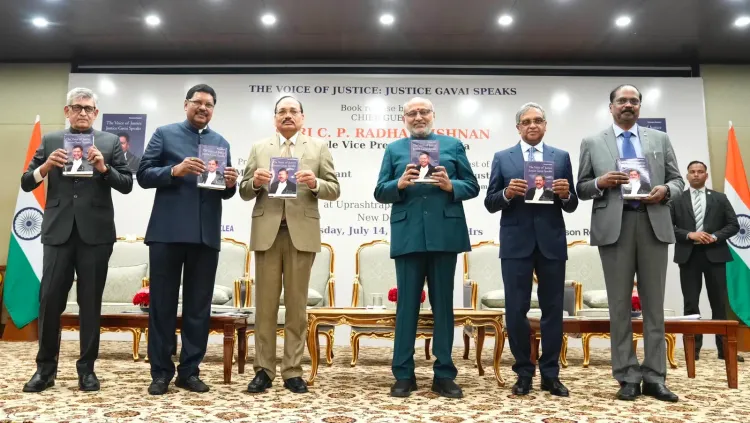
VP Radhakrishnan releases book on former CJI BR Gavai's judicial legacy
Synopsis
Vice President Radhakrishnan's release of 'The Voice of Justice' is more than a ceremonial book launch — it is a public reaffirmation of judicial restraint and pro bono access to justice at a time when the relationship between constitutional institutions is under close public scrutiny. The volume, drawn from former CJI BR Gavai's own words, now enters the national legal conversation as a reference point for constitutional discipline.
Key Takeaways
Radhakrishnan released 'The Voice of Justice: Justice Gavai Speaks' on 14 July in New Delhi .
The book compiles speeches, lectures and reflections of former Chief Justice of India B.
Sivakumar and published by Thomson Reuters in association with the Commonwealth Legal Education Association (CLEA) .
Radhakrishnan called for lawyers to represent the poorest citizens on a pro bono basis at regular intervals.
The Vice President described the Constitution of India as a living document that has balanced rights with duties over seventy-five years .
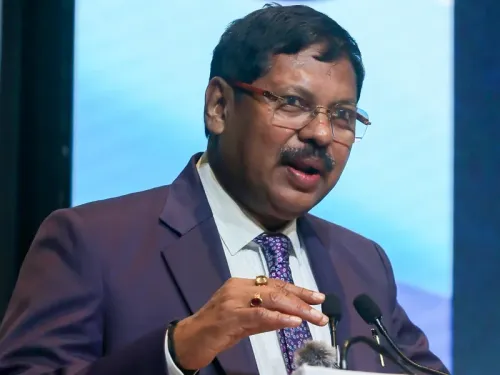
Vice President C. P. Radhakrishnan on Tuesday, 14 July released 'The Voice of Justice: Justice Gavai Speaks' in New Delhi, a volume compiling the speeches, lectures and reflections of former Chief Justice of India B. R. Gavai. The release underscored the twin imperatives of restraint and authority in a constitutional democracy.
What the Book Contains
Edited by S. Sivakumar and published by Thomson Reuters in association with the Commonwealth Legal Education Association (CLEA), the book brings together Justice Gavai's judicial thought across constitutionalism, rule of law, social justice and democratic governance. Radhakrishnan described it as 'an important constitutional document reflecting judicial thought shaped by experience, constitutional discipline and public responsibility.'
What the Vice President Said
Radhakrishnan lauded Justice Gavai's career as reflecting 'an abiding commitment to constitutional values, institutional balance and access to justice.' He stressed that the judiciary occupies a vital place in preserving constitutional governance and in sustaining citizens' faith in the rule of law.
The Vice President noted that institutional integrity, constitutional discipline, public trust and commitment to democratic values are what sustain both strong institutions and justice itself. He added that constitutional governance must remain responsive to the aspirations of ordinary citizens and to evolving social realities.
Call for Pro Bono Legal Service
Radhakrishnan made a pointed appeal to members of the legal fraternity to represent the poorest of the poor on a pro bono basis at regular intervals, so that justice remains genuinely accessible to all. He observed that empowering marginalised communities is essential to ensuring dignity, opportunity and hope for every individual.
The Constitution as a Living Document
Referring to the book's treatment of the Constitution of India, Radhakrishnan said it rightly presents the Constitution as a living and evolving document that has balanced continuity with change, authority with accountability, and rights with duties over the past seventy-five years. He noted that Parliament's power to amend the Constitution enables the nation to meet the needs of changing times, while the Constitution itself remains the foundation of democratic stability and national unity.
The volume is expected to strengthen constitutional discourse and legal scholarship, offering practitioners and scholars alike a window into the judicial philosophy of one of India's recent chief justices.
Point of View
Presided over by the Vice President, is a signal of institutional solidarity at a moment when judicial independence and executive accountability are live debates. Radhakrishnan's pro bono appeal is well-intentioned but familiar — successive governments and bar associations have made similar calls without a binding framework to back them up. The real measure of Justice Gavai's legacy will be how his rulings on access to justice and marginalised communities are applied by the courts that follow him, not how well his speeches are received in a ceremonial hall.
NationPress
13 Oct 2026
Frequently Asked Questions
What is 'The Voice of Justice: Justice Gavai Speaks'?
It is a book compiling the speeches, lectures and reflections of former Chief Justice of India B. R. Gavai, covering constitutionalism, rule of law, social justice and democratic governance. It was edited by S. Sivakumar and published by Thomson Reuters in association with the Commonwealth Legal Education Association (CLEA).
Who released the book and when?
Vice President C. P. Radhakrishnan released the book on 14 July in New Delhi. He described it as an important constitutional document reflecting judicial thought shaped by experience and public responsibility.
What did VP Radhakrishnan say about the legal fraternity?
Radhakrishnan appealed to lawyers to represent the poorest citizens on a pro bono basis at regular intervals, arguing that justice must be genuinely accessible to all, not just those who can afford legal representation.
What is the significance of the book for constitutional scholarship?
The volume is expected to strengthen constitutional discourse and legal scholarship in India by offering insights into the judicial philosophy of a recent Chief Justice. Radhakrishnan said it presents the Constitution as a living, evolving document that has balanced continuity with change over seventy-five years.
Who is former CJI B. R. Gavai?
B. R. Gavai served as Chief Justice of India and is noted for his commitment to constitutional values, institutional balance and access to justice. His judicial journey, as reflected in the book, spans landmark contributions to India's higher judiciary.