WII trains UP, Bihar forest staff to protect Gangetic Dolphins
Synopsis
India's river dolphin count stands at just 6,327, and the Wildlife Institute of India is now training forest teams across UP and Bihar to sharpen their monitoring skills under a second national estimation cycle — one that now extends to estuarine zones including the Sundarbans, tracking Irrawaddy dolphins too.
Key Takeaways
The Wildlife Institute of India (WII) held capacity-building workshops in Uttar Pradesh and Bihar for Gangetic Dolphin conservation.
India's total river dolphin population was estimated at 6,327 in a WII study spanning 2021–2023 .
Uttar Pradesh hosts approximately 2,397 dolphins; Bihar approximately 2,220 .
India launched the 2nd rangewide estimation cycle in January 2026 , expanding coverage to estuarine habitats including the Sundarbans and Odisha .
The Bihar workshop was held in Saharsa ; the UP workshop at Dudhwa National Park , covering forest ranges across four districts .
Gangetic Dolphins remain endangered despite being India's national aquatic animal , threatened by poaching, unscientific fishing, and illegal sand mining.
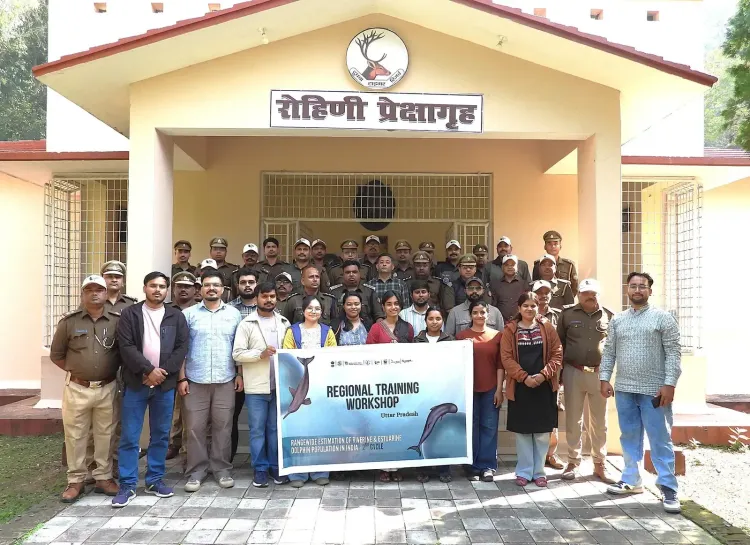
The Wildlife Institute of India (WII) has conducted a series of regional capacity-building workshops across Uttar Pradesh and Bihar under the 'Range-wide Estimation of Riverine and Estuarine Dolphins (2nd Cycle)' project, aimed at strengthening scientific monitoring and conservation of the critically endangered Gangetic Dolphin — India's national aquatic animal. The workshops, supported by the Ministry of Forests, Environment and Climate Change and the forest departments of both states, trained frontline personnel in standardised dolphin population estimation and riverine habitat assessment.
Population Count and Conservation Stakes
A WII study conducted between 2021 and 2023 estimated India's total river dolphin population at 6,327. Of these, Uttar Pradesh accounted for approximately 2,397 individuals, while Bihar recorded around 2,220. Despite holding protected status as India's national aquatic animal, Gangetic Dolphins remain endangered, facing persistent threats from poaching, unscientific fishing practices, and illegal sand mining along riverine corridors.
Second Estimation Cycle Expands Scope
India launched the second rangewide dolphin estimation in January 2026, broadening its geographic and species coverage to include estuarine habitats such as the Sundarbans and Odisha's coastal waters, where Irrawaddy dolphins are also found. This marks a significant methodological expansion over the first cycle, recognising that dolphin conservation cannot be addressed in riverine isolation alone.
Bihar Workshop: Kosi, Mahananda and Bagmati River Ranges
The Bihar leg of the workshop was held in Saharsa, drawing forest officials from divisions spanning the Kosi, Mahananda, and Bagmati river systems. Bharat Chintapalli, Saharsa Divisional Forest Officer, participated and shared field experiences drawn from wildlife and forest law enforcement across his jurisdiction. According to the WII, participants received training spanning 'classroom insights to hands-on technical mastery', covering precision data collection and the operation of specialised survey instruments.
UP Workshop at Dudhwa National Park
In Uttar Pradesh, the workshop was held at Dudhwa National Park, with forest personnel from multiple ranges across four districts in attendance. Training encompassed dolphin monitoring methodology, associated biodiversity assessment, and riverine habitat monitoring techniques. The WII described the aim as building capacity and strengthening collaborative conservation across one of India's most iconic but threatened aquatic species.
Why Accurate Estimation Matters
'Proper estimation of their numbers and assessment of the threats faced by them are essential to enable effective conservation efforts,' a forest department official said. This comes amid growing alarm over river ecosystem degradation in the Indo-Gangetic plain, where sand mining and industrial discharge continue to shrink viable dolphin habitat. Notably, this is the second structured attempt to arrive at a range-wide population baseline — a foundation without which targeted protection measures remain guesswork.
Point of View
327 is a number that should prompt urgency, not reassurance — it represents a species clinging on in a river system under extraordinary anthropogenic pressure. The WII's training initiative is methodologically sound, but capacity-building alone cannot arrest sand mining or poaching without stronger enforcement mandates and state-level accountability. The expansion to estuarine zones in the second estimation cycle is overdue; Irrawaddy dolphins in the Sundarbans have been comparatively invisible in conservation discourse. What is still missing is a publicly accessible, real-time threat-mapping framework that links field data to enforcement action — something no workshop can substitute.
NationPress
20 Nov 2026
Frequently Asked Questions
What is the WII's Range-wide Estimation of Riverine and Estuarine Dolphins project?
It is a national scientific initiative by the Wildlife Institute of India to estimate the population of river and estuarine dolphins across India. The second cycle, launched in January 2026, expands beyond river systems to cover estuarine habitats such as the Sundarbans and Odisha, and also includes Irrawaddy dolphins.
How many Gangetic Dolphins are there in India?
According to a WII study conducted between 2021 and 2023, India's total river dolphin population is estimated at 6,327. Uttar Pradesh accounts for approximately 2,397 and Bihar for around 2,220.
Why are Gangetic Dolphins endangered despite being India's national aquatic animal?
Gangetic Dolphins face constant threats from poaching, unscientific fishing methods, and illegal sand mining along river corridors, all of which degrade their habitat and food sources. Protected status has not been sufficient to fully counteract these human-driven pressures.
Where were the WII dolphin conservation workshops held?
The Bihar workshop was held in Saharsa, covering forest ranges along the Kosi, Mahananda, and Bagmati rivers. The Uttar Pradesh workshop was held at Dudhwa National Park, with participants from multiple ranges across four districts.
What skills did forest personnel gain from the workshops?
Participants were trained in standardised dolphin population estimation, riverine habitat assessment, precision data collection, and the operation of specialised survey instruments, covering both classroom instruction and hands-on field techniques.