The Opposition's Unsettling Celebration of the Women's Reservation Bill Defeat
Synopsis
On April 17, the Lok Sabha witnessed an unusual scene as opposition members celebrated the defeat of the women's reservation bill. Despite its potential to reshape women's representation in Indian politics, the bill's rejection was met with applause, raising critical questions about priorities and the future of gender equality in governance.
Key Takeaways
The women's reservation bill aimed to increase women's representation in Parliament.
The opposition celebrated the bill's defeat as a political victory.
Concerns were raised about the bill's linkage to delimitation and its impact on Southern states.
Women remain underrepresented in India's highest decision-making bodies.
Every delay in reform incurs a cost to women's voices in governance.
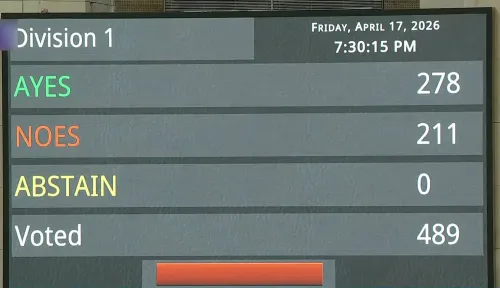
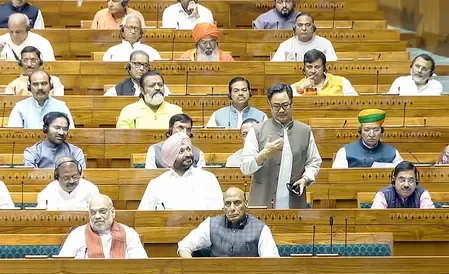
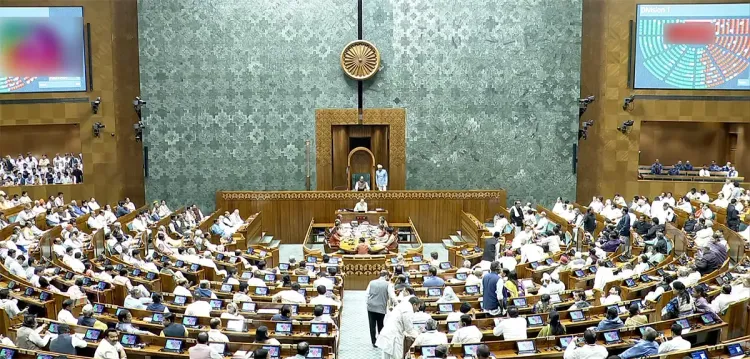
New Delhi, April 19 (NationPress) The evening of April 17 marked a significant moment in the Lok Sabha as the results of the women's reservation bill were revealed. The atmosphere was charged—desks reverberated, slogans filled the chamber, and the 230 opposition members rose in unison, celebrating. It was a peculiar sight, almost unsettling. This was a bill widely regarded as a potential turning point for India's political arena, yet its rejection was met with cheers instead of dismay.
This reaction was disconcerting. A proposal that could have transformed the political landscape of India—finally opening the door for women's representation in Parliament—had just been defeated. Yet, the jubilance of the opposition overshadowed the gravity of the situation. It seemed more like a moment driven by raw emotion than a calculated political strategy.
On one hand, the jubilation was understandable. For the first time in over a decade, Prime Minister Narendra Modi's government faced a decisive legislative defeat in the Lok Sabha. For Rahul Gandhi and the opposition, this was a chance to reclaim political territory—an opportunity to challenge what the government had branded as a hallmark reform.
However, when politics becomes merely a tally of victories and losses, it often overlooks the people it is intended to serve. In that instant, the broader implications of the bill faded into the background. This wasn't just another legislative proposal; it embodied a vision that had been postponed for years. The commitment to reserving seats for women has lingered in India's legislative discourse like an unfinished thought—discussed, debated, delayed, revived, and now, once more, halted.
Leaders of the opposition, including Rahul Gandhi, M.K. Stalin, Akhilesh Yadav, and Mamata Banerjee, have articulated their opposition. They argue that linking the bill to delimitation raises critical structural issues. Their contention is that any amendment of constituencies, based on population changes, could disrupt the political equilibrium among states, disproportionately affecting those that have managed population growth more effectively, particularly in the South.
The opposition's concerns were not mere rhetoric. M.K. Stalin, in a dramatic display, burned a copy of the bill and instructed his MPs to don black attire as a sign of dissent. His argument focused on the fear that population-based delimitation would penalize Southern states by diminishing their political presence in Parliament. Mamata Banerjee also condemned this linkage, labeling it a "conspiracy" that could be used to manipulate electoral lists and facilitate initiatives like the National Register of Citizens.
The government, however, countered these fears robustly. Union Home Minister Amit Shah dismissed them as a fabricated narrative intended to undermine the reform. He attempted to soothe concerns with statistics, highlighting that the five Southern states—Karnataka, Andhra Pradesh, Telangana, Tamil Nadu, and Kerala—currently hold 129 Lok Sabha seats, making up 23.76% of the total 543. He argued that even with a hypothetical 50% increase in seats, their representation would remain proportional, reaching 195 seats and thus maintaining their political significance.
On the surface, this argument seems valid. However, politics is rarely resolved solely through theoretical discussions. The opposition, led by Rahul Gandhi, remained skeptical. Akhilesh Yadav went further, stating that even if the BJP promised a woman Prime Minister, he would remain doubtful.
While the opposition may have scored a temporary tactical victory by defeating the bill, they overlooked a pivotal moment. Beyond procedural disagreements and political maneuvering lies a fundamental truth—women continue to be significantly underrepresented in India's highest decision-making bodies.
The statistics tell a compelling story. From just 22 women in the first Lok Sabha to 78 in the 17th—the highest ever—the progress is evident, yet it unfolds at a pace that raises questions. The current assembly, with around 75 female members, still falls short of mirroring a nation where women account for nearly half the population.
The proposed reform, particularly if linked to a future increase in seats, could have significantly altered this dynamic. With the Lok Sabha potentially expanding to over 800 members, nearly 272 seats could have been designated for women. This is not a minor adjustment; it represents a structural transformation—one that could redefine participation, reshape policy priorities, and change the very fabric of representation.
This is precisely why this moment carries more weight than a standard legislative defeat. It concerns not just what was cast aside but what has been postponed once again. It also raises uncomfortable inquiries for the Congress-led opposition.
Indian politics has never been devoid of powerful women leaders. From Indira Gandhi to J. Jayalalithaa, individual triumphs have been recognized. Yet, these instances exist alongside a system that remains fundamentally skewed. The success of a few does not compensate for the absence of many.
This disconnect is likely why the opposition's celebration in the Lok Sabha felt dissonant. It appeared detached from the broader objective. Governments will rise and fall. Victories will be claimed, and losses accepted. However, certain ideas demand a political discourse that transcends immediate gains—one that acknowledges when the stakes extend beyond electoral advantages.
In this context, it seems the Rahul Gandhi-led opposition has missed the mark.
Reforms of this magnitude require more than mere legislative numbers; they demand political collaboration and trust. The unavoidable question now is—should a reform of this scale become collateral damage in a wider political contest?
The scene of April 17—even as desks thumped and slogans resonated—will eventually fade into the archives of parliamentary history. However, the discomfort it evokes should not diminish, for beneath the clamor lies a quieter truth—an opportunity lost once more.
India is not short of capable women leaders. It lacks enough of them in decision-making circles. Until this changes, every delay incurs a cost—not measured in votes or victories, but in voices that remain unheard.
The real sorrow of April 17 is not that the government lost a bill. Regrettably, the country lost an opportunity that women across India have been waiting for. The echoes of the opposition's desk-thumping will linger for a long time.
(Deepika Bhan can be contacted at deepika.b@ians.in)
Point of View
The broader implications for women's representation are alarming and warrant serious reflection and action from all political entities.
NationPress
15 Oct 2026
Frequently Asked Questions
What was the women's reservation bill?
The women's reservation bill aimed to reserve a certain percentage of seats in Parliament for women, thereby increasing their representation in Indian politics.
Why did the opposition celebrate the defeat of the bill?
The opposition, led by Rahul Gandhi, viewed the bill's defeat as a tactical victory against the Modi government, marking a rare legislative setback for the ruling party.
What are the concerns surrounding the bill?
Opponents of the bill argued that linking it to delimitation could disadvantage certain states, particularly those in the South, by altering the balance of political representation.
How many women currently serve in the Lok Sabha?
As of the latest session, approximately 75 women are members of the Lok Sabha, which is significantly less than half of the total membership, representing the gender disparity in Indian politics.
What could the proposed reform have achieved?
The proposed reform could have reserved nearly 272 seats for women in an expanded Lok Sabha, significantly improving their representation and influence in governance.