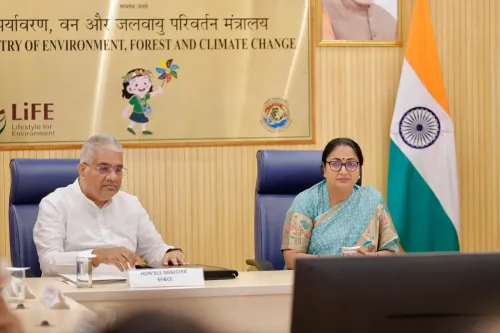
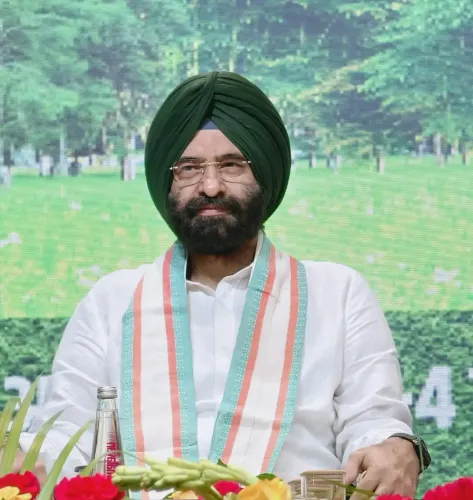
Yadav Outlines Dust-Free Delhi Plan on World Environment Day
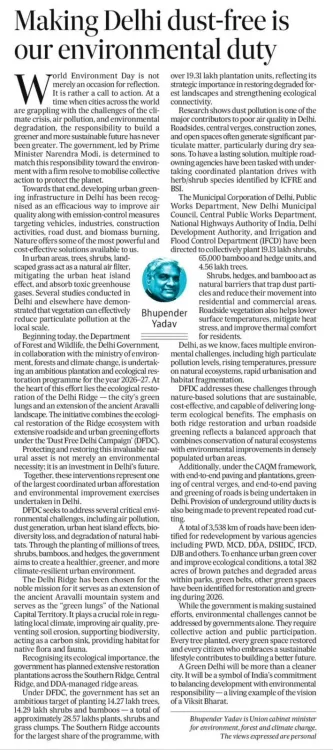
Synopsis
On World Environment Day 2026, Union Environment Minister Bhupender Yadav announced a government plan to make Delhi dust-free, linking the initiative to PM Modi's climate agenda and the broader National Clean Air Programme targeting particulate pollution in 131 Indian cities.
Key Takeaways
Union Environment Minister Bhupender Yadav posted on World Environment Day, 5 June 2026 , outlining a plan to build a 'dust-free Delhi.' The minister cited PM Narendra Modi 's government as 'determined to match environmental responsibility with a firm resolve to mobilise collective action.' Dust from roads and construction sites is a major contributor to PM10 particulate pollution in Delhi year-round.
The National Clean Air Programme (NCAP) , launched in 2019, targets a 30–40 per cent reduction in particulate pollution across 131 non-attainment cities including Delhi.
The Commission for Air Quality Management in NCR (est.
2021) and the Graded Response Action Plan (GRAP) (first notified 2017) form the existing regulatory backbone for Delhi-NCR air quality.
Enforcement of dust-control norms at construction sites and on roads ahead of the 2026–27 winter season will be the critical test of the plan.
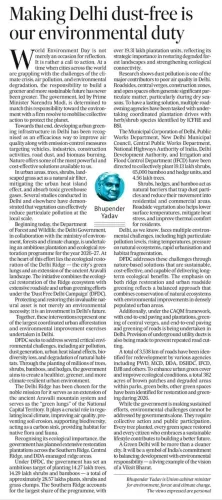
Union Environment Minister Bhupender Yadav used World Environment Day, 5 June 2026, to announce a focused plan to tackle dust pollution in Delhi, writing that the government under Prime Minister Narendra Modi is committed to matching environmental responsibility with collective action to protect the planet.
Context
In his post, Minister Yadav stated: 'The government, led by PM Shri Narendra Modi ji, is determined to match the environmental responsibility with a firm resolve to mobilise collective action to protect the planet.' He added that he had written on 'how we plan to build a dust-free Delhi,' framing the initiative as part of the broader #NowForClimate agenda.
World Environment Day is observed annually on 5 June — a date established by the United Nations in 1972 — and is widely used by governments to announce or highlight environmental commitments. Yadav's choice to anchor a Delhi-specific dust-control plan to this occasion signals the administration's intent to treat urban air quality as a flagship climate deliverable.
Policy Backdrop
Delhi's air quality crisis is among the most documented in the world, with dust from roads, construction sites, and open land contributing substantially to PM10 particulate levels year-round. The problem is distinct from — though compounded by — seasonal factors such as stubble burning and vehicle emissions.
The central government has built a layered regulatory architecture to address this. The National Clean Air Programme (NCAP), launched in January 2019, set a target of 30–40 per cent reduction in particulate pollution across 131 non-attainment cities, with Delhi among the most closely watched. The Commission for Air Quality Management in NCR and Adjoining Areas, established by statute in 2021, provides a permanent regional coordination body. The Graded Response Action Plan (GRAP), first notified in 2017 and revised periodically, imposes staged emergency measures when air quality deteriorates sharply in Delhi-NCR.
Despite these frameworks, enforcement gaps — particularly at construction sites and on unpaved roads — have limited progress, and dust control has emerged as a year-round priority rather than a seasonal one.
Stakeholders and Impact
Delhi's roughly 3.3 crore residents are the most direct stakeholders, with public-health costs of chronic particulate exposure running into thousands of premature deaths annually according to established epidemiological studies. Municipal corporations, the Delhi government, and central agencies share overlapping jurisdiction over roads and construction regulation, making coordination the central operational challenge.
The construction industry — a major source of fugitive dust — faces the prospect of tighter site-level norms and penalties. Any new dust-control framework would also affect road project contractors operating under central and state tenders across the National Capital Region.
The minister's framing of 'collective action' deliberately widens the circle of responsibility beyond government agencies to include industry, civic bodies, and citizens — a rhetorical approach consistent with how India has positioned its climate commitments internationally, including the 2070 net-zero target.
What's Next
Attention will now turn to the specifics of the dust-control plan outlined in Yadav's linked article — including whether it introduces new enforcement mechanisms, funding allocations, or revisions to existing GRAP thresholds ahead of the 2026–27 winter pollution season. Implementation timelines and the division of responsibility between central agencies and Delhi's municipal bodies will be the key markers of follow-through.
With the winter smog season typically beginning in October, the months following this announcement represent the practical window for new dust-mitigation norms to be notified, tested, and enforced at scale.
Point of View
Voter-legible deliverable (cleaner Delhi air) to the Modi government's international climate brand. The 'dust-free Delhi' framing is strategically distinct from the harder-to-communicate stubble-burning or vehicle-emission debates, offering a more actionable and less politically contentious target. It also signals that the Centre is willing to own Delhi's air quality problem more directly, a shift that has implications for the long-running jurisdictional friction between central agencies and the Delhi government. Whether the plan delivers measurable change before the 2026–27 winter will determine whether this announcement is remembered as a policy milestone or a seasonal ritual.
NationPress
20 Sept 2026
Frequently Asked Questions
What is the dust-free Delhi plan announced by Bhupender Yadav?
On World Environment Day 2026, Union Environment Minister Bhupender Yadav outlined a government plan to reduce dust pollution in Delhi, focusing on sources such as construction sites and unpaved roads that contribute significantly to PM10 particulate levels. The detailed specifics were shared in an article linked in his post.
What is the National Clean Air Programme and how does it relate to Delhi?
The National Clean Air Programme (NCAP) was launched in January 2019 with a target of achieving a 30–40 per cent reduction in particulate pollution across 131 non-attainment cities in India, with Delhi being one of the most closely monitored. It requires city-specific clean air action plans and is a central plank of India's urban air quality policy.
What is GRAP and how does it work in Delhi?
The Graded Response Action Plan (GRAP), first notified in 2017, is a set of staged emergency measures that are activated in Delhi-NCR when air quality crosses defined thresholds. It imposes progressively stricter restrictions — from dust-control advisories to construction bans and vehicle restrictions — as pollution levels worsen.
Why is dust a major air pollution problem in Delhi?
Unlike seasonal sources such as stubble burning, dust from roads, construction sites, and open land contributes to Delhi's PM10 particulate pollution throughout the year. Enforcement gaps at construction sites and on unpaved roads have historically limited the effectiveness of existing regulations.
What is World Environment Day and why is it significant for policy announcements?
World Environment Day is observed every year on 5 June, a date established by the United Nations in 1972 to promote global environmental awareness. Governments routinely use the occasion to announce or highlight environmental commitments, making it a high-visibility platform for policy signalling.