Bhupender Yadav pushes mangrove restoration at Bhuj workshop, MISHTI covers 27,652 hectares
Synopsis
With 27,652 of 29,250 target hectares restored and a new GIS monitoring portal launched, Gujarat's MISHTI mangrove push is in its final stretch — and Environment Minister Bhupender Yadav's Bhuj workshop signals the Centre is watching closely. The felicitation of a community conservation committee for a site already declared India's first inland Biodiversity Heritage Site adds a rare grassroots dimension to what is usually a top-down green programme.
Key Takeaways
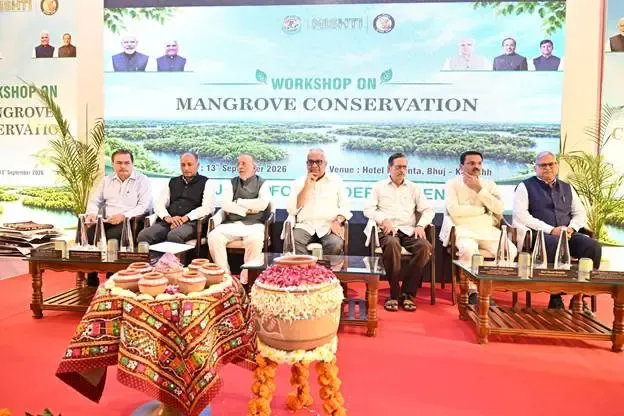
Union Environment Minister Bhupender Yadav addressed a mangrove conservation workshop in Bhuj, Kachchh on 13 September 2026 .
Gujarat has restored 27,652 hectares of mangroves under MISHTI against a 2023–27 target of 29,250 hectares .
12,450 hectares of restoration has been achieved in the ecologically challenging Kori Creek region alone.
Yadav launched the Mangrove GIS (MGIS) Portal and released the Mangroves Atlas of Gujarat to strengthen science-based monitoring.
The Guneri Inland Mangrove Village Biodiversity Management Committee was felicitated; the site was declared Gujarat's first Biodiversity Heritage Site in January 2025 .
Union Environment Minister Bhupender Yadav on Sunday, 13 September 2026, called for science-driven, community-led restoration and technology-enabled monitoring of mangroves at a national workshop held in Bhuj, Kachchh, Gujarat. Stressing the ecological significance of these coastal ecosystems for biodiversity, fisheries, and shoreline protection, Yadav reviewed India's progress under the flagship MISHTI (Mangrove Initiative for Shoreline Habitats and Tangible Incomes) programme.
MISHTI Progress in Gujarat
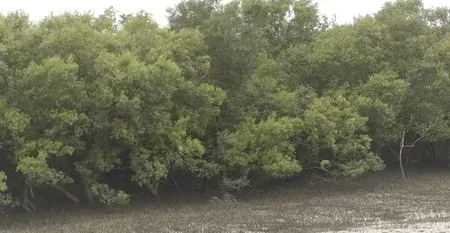
Gujarat has emerged as a frontrunner under MISHTI, with 27,652 hectares of mangrove cover restored against a 2023–27 target of 29,250 hectares. Of this, 12,450 hectares lie within the ecologically demanding Kori Creek region, where site-specific restoration methods tailored to Kachchh's conditions have been deployed. Yadav noted that these interventions also include seaweed cultivation, biodiversity enhancement, and sustainable livelihood generation for coastal communities.
New Tools for Science-Based Decision-Making
On the occasion, Yadav released the Coffee Table Book on Kachchh Mangroves and the Mangroves Atlas of Gujarat, and formally launched the Mangrove GIS (MGIS) Portal. The portal is designed to strengthen satellite-aided monitoring and spatial tracking of mangrove habitats across the state, enabling faster, data-driven conservation responses.
State Government's Commitment Reaffirmed
The workshop was also addressed by Arjun Modhwadia, Gujarat's Cabinet Minister for Forest, Environment, Climate Change and Science and Technology, and Trikambhai Chhanga, Minister of State for Higher and Technical Education, both of whom reaffirmed the state's commitment to coastal ecosystem restoration under MISHTI. Senior officials from the Union Ministry of Environment, Forest and Climate Change, the Gujarat Forest Department, scientists, conservationists, and local community representatives were also in attendance.
Guneri Inland Mangroves: A Community Conservation Model
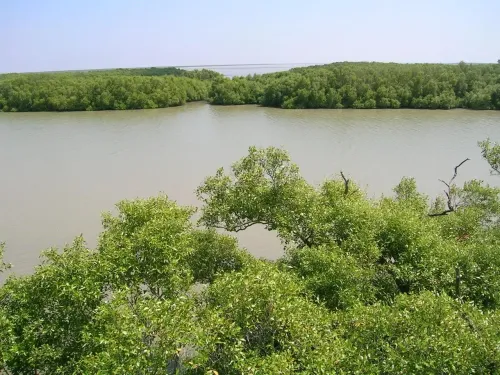
Yadav felicitated the Guneri Inland Mangrove Village Biodiversity Management Committee for its sustained community-led conservation of the Guneri inland mangroves — a rare ecosystem that thrives away from the coastline. The site was declared Gujarat's first Biodiversity Heritage Site in January 2025, underscoring its scientific and ecological rarity. The recognition points to the growing role of grassroots conservation bodies in plugging gaps that state machinery alone cannot address.
Broader Context
India's mangrove cover has been growing steadily, with the country recording an increase in recent national forest surveys. The MISHTI programme, launched as part of the Union Budget 2023–24, specifically targets the restoration of mangroves along the Indian coastline, with participating states receiving financial and technical support. Gujarat, with its extensive coastline, remains one of the programme's most critical theatres. This workshop signals a push to accelerate the final stretch before the 2027 target deadline.
Point of View
When programme funding and political attention typically wane. The MGIS Portal is a meaningful step toward credible monitoring, yet its utility depends on real-time data inputs that have historically lagged in forest department reporting. The Guneri Biodiversity Heritage Site recognition is the most substantive signal here: it institutionalises community stewardship in law, not just in rhetoric, which is harder to reverse. Whether the model scales to other coastal states with far weaker institutional capacity remains the unanswered question.
NationPress
14 Sept 2026
Frequently Asked Questions
What is the MISHTI programme for mangrove restoration?
MISHTI — Mangrove Initiative for Shoreline Habitats and Tangible Incomes — is a Union government scheme launched under Budget 2023–24 to restore and protect mangrove ecosystems along India's coastline. Participating states, including Gujarat, receive financial and technical support for site-specific restoration, biodiversity enhancement, and coastal livelihood development.
How much mangrove cover has Gujarat restored under MISHTI?
Gujarat has restored 27,652 hectares of mangrove cover under MISHTI, against a 2023–27 target of 29,250 hectares — making it one of the most advanced states under the programme. Of this, 12,450 hectares are in the ecologically demanding Kori Creek region of Kachchh.
What is the Mangrove GIS (MGIS) Portal launched in Bhuj?
The MGIS Portal is a satellite-aided geographic information system launched by Environment Minister Bhupender Yadav to enable spatial tracking and real-time monitoring of mangrove habitats across Gujarat. It is intended to support science-based decision-making and improve the speed of conservation responses.
What is the Guneri Inland Mangrove Biodiversity Heritage Site?
The Guneri inland mangroves are a rare ecosystem in Kachchh that thrive away from the coastline, conserved through community-led efforts by the Guneri Inland Mangrove Village Biodiversity Management Committee. The site was declared Gujarat's first Biodiversity Heritage Site in January 2025, giving it formal legal protection.
Why are mangroves important for coastal communities?
Mangroves provide critical ecological services including coastal biodiversity support, nursery habitats for fisheries, and natural protection of shorelines against erosion and storm surges. They also support livelihoods through fisheries and, increasingly, seaweed cultivation, making their conservation directly relevant to millions of coastal residents.