How Will AI Transform Diagnostic Practices in Healthcare? Insights from Dr. Jitendra Singh
Synopsis
Discover how AI is revolutionizing medical diagnostics through insights from Union Minister Dr. Jitendra Singh. Learn about the future of patient-specific treatments and the importance of interdisciplinary collaboration in healthcare.
Key Takeaways
AI can improve the accuracy of medical diagnostics.
Traditional diagnostics often rely on physician judgement.
AI can analyze extensive patient data to identify crucial findings.
Collaboration across disciplines is essential for modern healthcare.
India's disease patterns are evolving due to lifestyle changes.
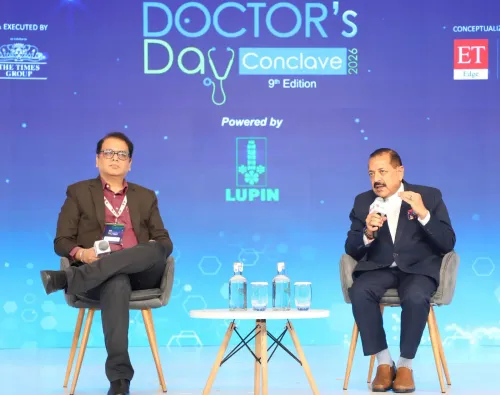
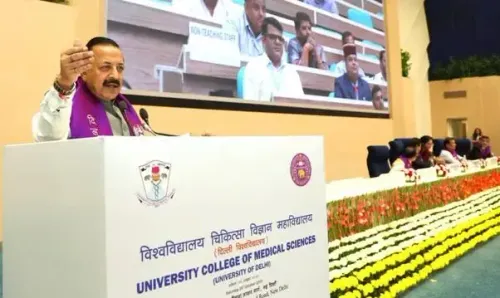
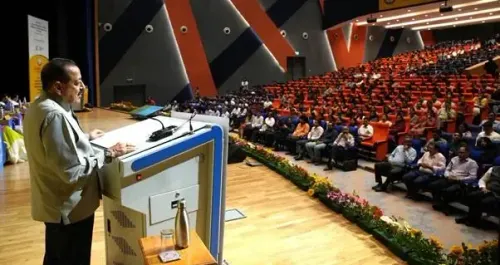
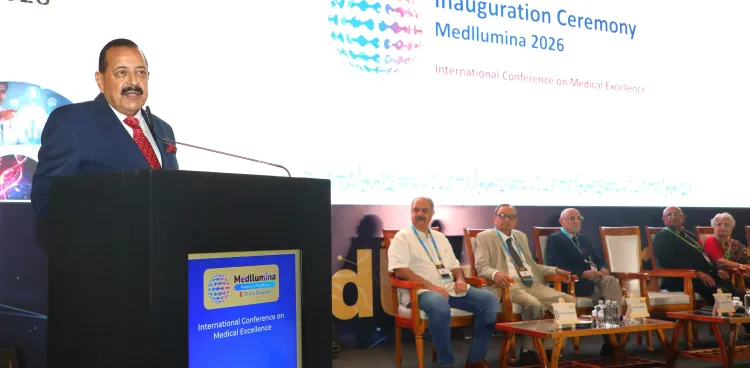
New Delhi, Feb 21 (NationPress) On Saturday, Union Minister of State (Independent Charge) for Science and Technology, Dr. Jitendra Singh, emphasized that artificial intelligence (AI) is poised to eliminate subjectivity in medical diagnostics, enabling healthcare professionals to provide more accurate and personalized treatment in the near future.
During the “Medllumina 2026: International Multi Specialty Medical Conference,” Dr. Singh highlighted that AI-driven tools will dramatically decrease the likelihood of human error in clinical decision-making.
He elaborated that traditional diagnostic practices often depend heavily on a physician's judgement and experience.
For instance, a pathologist reviewing a cancer biopsy slide with the naked eye may overlook a small but crucial cluster of affected cells.
“Conversely, an AI-supported system can meticulously scan the slide and pinpoint the exact area requiring attention. This minimizes the risk of oversight and enhances precision,” he stated.
“AI technologies can also review a patient’s entire medical history during clinical assessments and flag significant findings that may be overlooked. This will fortify diagnostic processes and lead to improved treatment results,” the Minister remarked.
Stressing the importance of interdisciplinary cooperation, Dr. Singh noted that contemporary medicine transcends individual fields.
“With the emergence of super-specialization, physicians frequently operate within narrow domains. Venues such as multi-specialty conferences facilitate discussions across various disciplines, including medical technology, engineering, and advanced data sciences,” Dr. Singh articulated.
Reflecting on the evolution of medical science over recent decades, he stated that healthcare has transitioned from traditional bedside learning to cutting-edge imaging and molecular technologies.
“From ultrasound and CT scans to MRI and genomics, diagnostic resources have advanced significantly,” the Minister acknowledged.
He also pointed out that while past medical expertise primarily relied on extensive reading and clinical exposure, AI systems now serve as robust support tools that enhance, rather than replace, physicians’ judgement.
Dr. Singh further highlighted shifts in disease patterns in India. Ailments that were previously restricted to specific regions, such as diabetes in southern states or thyroid issues in the Himalayan areas, have now become widespread across the nation due to lifestyle changes and the narrowing rural-urban divide.
Point of View
It is evident that the integration of artificial intelligence into healthcare is not merely an innovation but a necessary evolution. Dr. Jitendra Singh's insights illuminate the potential for AI to enhance diagnostic precision, which is critical in today's rapidly changing medical landscape. The emphasis on interdisciplinary collaboration further underscores the importance of diverse expertise in advancing healthcare outcomes. This approach holds promise for addressing the complex challenges faced within the medical field today.
NationPress
16 Sept 2026
Frequently Asked Questions
How will AI change medical diagnostics?
AI is expected to reduce subjectivity in diagnostics, enhance accuracy, and improve treatment outcomes by analyzing comprehensive patient data.
What role does interdisciplinary collaboration play in healthcare?
Interdisciplinary collaboration fosters innovation and dialogue among various medical fields, enhancing the overall quality of patient care.
Are AI tools replacing doctors?
No, AI tools are designed to support and enhance doctors' judgement, not replace them.
What changes are observed in disease patterns in India?
There is a growing prevalence of diseases that were once region-specific, now affecting broader populations due to lifestyle changes.
What advancements in diagnostics have occurred recently?
Significant advancements include improved imaging technologies and molecular diagnostics, enhancing the accuracy of medical evaluations.