CAS Star's decade-long photonics bet pays off in China's AI boom
Synopsis
CAS Star founder Mi Lei spent over a decade quietly backing photonics firms when few investors cared. Now, as AI clusters overwhelm copper interconnects, one portfolio company's shares have surged more than elevenfold — and the firm's 200-plus photonics bets are suddenly the hottest trade in Chinese tech.
Key Takeaways
CAS Star , affiliated with the Chinese Academy of Sciences , has more than 200 photonics-related companies across a portfolio of roughly 600 firms.
Founder Mi Lei holds a doctorate in optics and has backed photonics from the firm's inception, more than a decade ago.
Yuanjie Technology , a Shaanxi -based laser-chipmaker backed by CAS Star around 2019 , has seen its shares rise more than elevenfold over the past year.
Copper interconnects in AI data centres are hitting limits in signal loss, heat, and power consumption, driving demand for optical alternatives.
The photonics sector spans sensing, communications, computing, storage, and display — with data-centre light-source products emerging as the near-term growth driver.
US export controls on advanced chips are accelerating China 's domestic push into photonic and optical technologies, adding a geopolitical dimension to the investment thesis.
CAS Star, a Shanghai-based venture capital firm founded by Mi Lei and affiliated with the state-run Chinese Academy of Sciences (CAS), is reaping the rewards of a photonics investment thesis that stretches back more than a decade — a strategy now validated by the surging global demand for optical interconnects inside AI data centres.
Why photonics now matters to AI
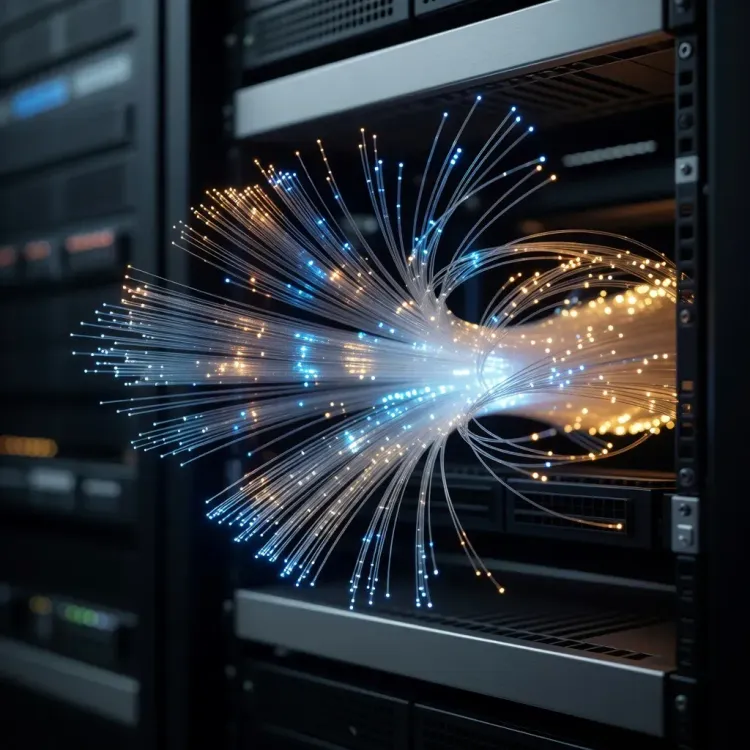
Training large-scale AI models requires tens of thousands of specialised computing chips to exchange data continuously. For years, that data travelled through copper cables — but copper interconnects are hitting a hard physical ceiling: signal degradation, excessive heat, and soaring power consumption all throttle chip performance. Optical links, which transmit data using light rather than electricity, offer dramatically lower signal loss and have become central to modern data-centre architecture.
The shift is not incremental. As AI clusters scale to unprecedented sizes, the industry's reliance on photonic components — spanning light sources, transceivers, and fibre — has accelerated sharply, turning a niche scientific discipline into a high-stakes commercial race.
The CAS Star portfolio play
Mi Lei, who holds a doctorate in optics from the Xi'an Institute of Optics and Precision Mechanics under CAS, began backing photonics companies from the firm's inception. Today, more than 200 of CAS Star's roughly 600 portfolio companies operate across the broader photonics sector, covering sensing, communications, computing, storage, and display.
'New technologies can drive industrial upgrading,' Mi said from his Shanghai office — notably named 'Wallfacer', a reference to the elite strategists in Liu Cixin's award-winning sci-fi trilogy The Three-Body Problem, whose minds serve as humanity's last refuge from alien surveillance. 'Our role is to push scientific research towards commercialisation,' he added.
Market reaction: an elevenfold share surge
Yuanjie Technology, a Shaanxi-based laser-chipmaker that CAS Star invested in around 2019, has seen its shares surge more than elevenfold over the past year, fuelled by surging revenue from data-centre light-source products, according to market data. The stock's trajectory illustrates how China's equity investors are rapidly repricing optical component makers as essential AI infrastructure plays.
The broader photonics sector in China — encompassing companies such as Zhongji Innolight and Yangtze Optical Fibre and Cable — has attracted intensifying investor attention as domestic AI model developers and hyperscalers expand their data-centre footprints.
The competitive backdrop
The race to commercialise photonic computing and interconnects is global. US-based startups including Lightelligence are pursuing silicon photonics for in-chip optical computing, while established Western component suppliers compete for data-centre contracts. China's advantage, analysts note, lies in a deep domestic supply chain and state-linked research institutions — precisely the network CAS Star was built to exploit.
Export controls on advanced semiconductors have also accelerated Beijing's push to develop indigenous optical and photonic technologies, adding a geopolitical tailwind to what was already a compelling commercial opportunity.
What's next
With AI infrastructure investment showing no sign of cooling, photonics firms in CAS Star's portfolio are positioned at the intersection of two powerful forces: the physical limits of copper-based computing and China's drive for semiconductor self-sufficiency. Investors and industry watchers will be monitoring whether portfolio companies can scale manufacturing to meet hyperscaler demand — and whether Mi Lei's early conviction translates into further landmark exits.
Point of View
Or if silicon photonics from US rivals commoditises light-source components faster than expected, the valuation multiples now being assigned to Chinese optical firms could compress sharply.
NationPress
21 Oct 2026
Frequently Asked Questions
What is CAS Star and why is it significant in photonics?
CAS Star is a Shanghai-based venture capital firm founded by Mi Lei and affiliated with the Chinese Academy of Sciences. It has invested in photonics for over a decade and now holds stakes in more than 200 photonics-related companies across sensing, communications, computing, storage, and display.
Why are optical interconnects replacing copper in AI data centres?
Copper cables transmit data using electricity, which causes signal loss, generates excessive heat, and increases power consumption at the scale required by large AI model training. Optical interconnects use light instead, offering lower signal loss and becoming central to modern data-centre design.
How much have Yuanjie Technology shares risen?
Yuanjie Technology, a Shaanxi-based laser-chipmaker backed by CAS Star around 2019, has seen its shares surge more than elevenfold over the past year, driven by rising revenue from data-centre light-source products.
How does the US-China chip war affect China's photonics sector?
US export controls on advanced semiconductors have accelerated Beijing's push to develop indigenous optical and photonic technologies. This geopolitical pressure adds a policy tailwind to the commercial opportunity already created by AI data-centre demand, benefiting firms in CAS Star's portfolio.
Who are the main competitors to Chinese photonics firms?
US-based companies including Lightelligence are pursuing silicon photonics for in-chip optical computing, while established Western component suppliers compete for global data-centre contracts. China's advantage lies in a deep domestic supply chain and state-linked research institutions.