China's CRAFT project activates world's largest fusion superconducting magnet

Synopsis
China's CRAFT 'artificial sun' project has activated the world's largest superconducting magnet assembly for a fusion reactor, with final tests reportedly surpassing international benchmarks — a development that could redefine the global race to deliver practical fusion energy.
Key Takeaways
China 's Comprehensive Research Facility for Fusion Technology (CRAFT) has successfully completed final tests on the world's largest superconducting magnet for a nuclear fusion reactor, as reported on 28 June 2026 .
The magnet assembly includes two coils: the CRAFT toroidal field coil (magnetic cage) and a central solenoid (igniter), both developed by the Institute of Plasma Physics, Chinese Academy of Sciences .
Performance results reportedly surpass international engineering benchmarks, including those associated with the multinational ITER project based in France .
The CRAFT facility targets plasma temperatures above 100 million degrees Celsius (over 180 million degrees Fahrenheit) — hotter than the sun's core — confined inside a tokamak chamber.
China already operates the Experimental Advanced Superconducting Tokamak (EAST) and is now scaling up with domestically developed, world-record-class fusion infrastructure.
China has successfully completed final tests on the world's largest superconducting magnet assembly for a nuclear fusion reactor, a landmark milestone for the Comprehensive Research Facility for Fusion Technology (CRAFT) — the country's flagship 'artificial sun' programme. Researchers at the Institute of Plasma Physics, Chinese Academy of Sciences, confirmed the achievement on Saturday, 28 June 2026, with state news agency Xinhua reporting that the results surpass international engineering benchmarks.
What the magnet assembly comprises
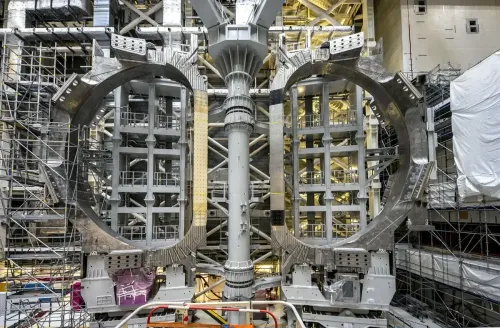
The assembly consists of two distinct coils: the CRAFT toroidal field coil, which functions as a magnetic cage to contain superheated plasma, and a central solenoid that serves as the igniter for the fusion reaction. Together, they form the core magnetic infrastructure of the reactor. The toroidal field coil generates a powerful magnetic field strong enough to prevent the reactor vessel from melting as internal plasma temperatures climb to hundreds of millions of degrees Celsius.
Why it matters
The CRAFT facility is engineered to sustain plasma at temperatures exceeding 100 million degrees Celsius (over 180 million degrees Fahrenheit) — hotter than the core of the sun — trapped inside a doughnut-shaped metal chamber known as a tokamak. Achieving stable magnetic confinement at those extremes has long been the central engineering obstacle to practical fusion energy. Clearing this hurdle positions China among the leading nations in the race to deliver commercially viable fusion power.
The competitive backdrop
China already operates the Experimental Advanced Superconducting Tokamak (EAST), which has set multiple plasma-confinement duration records. Globally, the International Thermonuclear Experimental Reactor (ITER) — a multinational project involving China, France, Russia, Japan, the Soviet Union's successor states, and others — is under construction in France and represents the largest international fusion collaboration. The CRAFT magnet's performance reportedly eclipsing ITER-class benchmarks signals that China is now developing independent, domestically superior fusion infrastructure rather than relying solely on multilateral frameworks.
Key figures behind the project
Scientists including Song Yuntao, Qin Jinggang, and Wu Yu are among the researchers associated with the Institute of Plasma Physics, Chinese Academy of Sciences driving the CRAFT programme. The project represents years of accumulated expertise from China's earlier fusion experiments and a deliberate escalation in both scale and ambition.
What's next
With the superconducting magnet assembly now validated, the CRAFT project moves closer to full reactor integration and sustained plasma experiments. The next critical phase will involve demonstrating prolonged plasma confinement at target temperatures — a prerequisite before any fusion facility can be considered a viable electricity-generation prototype. Observers will be watching whether China can translate this engineering success into a working demonstration reactor ahead of competing programmes worldwide.
Point of View
China is hedging against the slow pace and political complexity of multinational fusion projects, effectively running a parallel track. This mirrors its approach in semiconductors and space: participate in global frameworks while simultaneously developing sovereign, superior capabilities. What mainstream coverage underplays is the compounding effect: each record set by EAST or CRAFT feeds engineering talent and materials science expertise back into China's broader deep-tech industrial base, with implications well beyond energy policy.
NationPress
28 Jun 2026
Frequently Asked Questions
What is China's CRAFT fusion project?
The Comprehensive Research Facility for Fusion Technology (CRAFT) is China's large-scale national fusion research programme, designed to create and sustain plasma at temperatures exceeding 100 million degrees Celsius inside a tokamak reactor. It is often described as an 'artificial sun' project because it replicates the nuclear fusion process that powers stars. The facility is operated by the Institute of Plasma Physics, Chinese Academy of Sciences .
Why is the CRAFT superconducting magnet a breakthrough?
The CRAFT toroidal field coil is the world's largest superconducting magnet assembly for a fusion reactor, and its final tests reportedly surpassed international performance benchmarks as of 28 June 2026 . Magnetic confinement is the central engineering challenge in fusion: the magnet must generate a field powerful enough to contain plasma hundreds of millions of degrees hot without the reactor vessel melting. Clearing this hurdle is a prerequisite for any viable fusion power demonstration.
How does CRAFT compare to the international ITER project?
The International Thermonuclear Experimental Reactor (ITER) , under construction in France with participation from China , Russia , Japan , and other nations, has long set the global benchmark for fusion magnet engineering. China's CRAFT magnet assembly reportedly eclipses ITER-class performance standards, suggesting China is now developing independent fusion capabilities that rival or exceed the world's largest multilateral fusion programme.
Who are the key researchers behind China's fusion programme?
The CRAFT project is led by scientists at the Institute of Plasma Physics, Chinese Academy of Sciences , with researchers including Song Yuntao , Qin Jinggang , and Wu Yu associated with the programme. The institute also operates the Experimental Advanced Superconducting Tokamak (EAST) , which has set multiple world records for plasma confinement duration.
What happens next for China's fusion energy ambitions?
With the superconducting magnet validated, the CRAFT project will advance toward full reactor integration and sustained plasma confinement experiments at target temperatures above 100 million degrees Celsius . Success in those trials would bring China significantly closer to a working fusion demonstration reactor. The pace of progress will be a key indicator of whether China can lead the global transition to fusion-based electricity generation.