China-Russia youth space camp to launch in Penang by late 2027
Synopsis
A Russian cosmonaut trainer, China's Shanghai Science and Technology Museum, and a Malaysian organiser are co-developing a week-long youth space camp in Penang's rainforest — framed as 'people's diplomacy' — targeting children aged 7–17 across Southeast Asia, with a launch targeted for late 2027 at the earliest.
Key Takeaways
Timofey Egorov of the Yuri Gagarin Cosmonaut Training Centre near Moscow is co-developing the camp alongside the Shanghai Science and Technology Museum and Malaysian initiator Winfred Khoo .
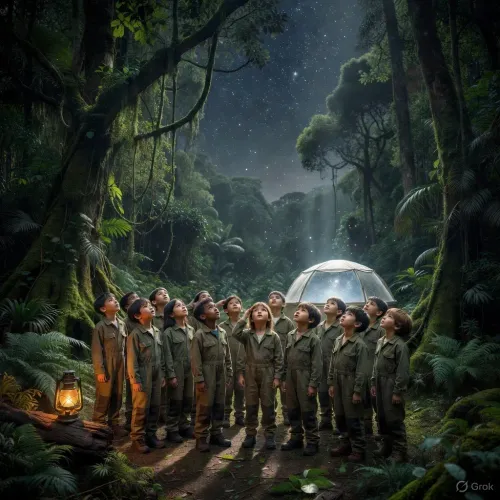
The week-long camp will be held in Penang's rainforest eco-park and is targeted for launch in late 2027 at the earliest.
The programme is open to youth aged 7 to 17 from across Southeast Asia .
Curriculum covers physical exercises, space and natural sciences, and ethical education; organisers describe it as an initiative in 'people's diplomacy.' Egorov presented the project at the Commonwealth of World Chinatowns conference in Penang in September 2026 .
The initiative runs parallel to broader China–Russia space cooperation, including the proposed International Lunar Research Station .
A trilateral initiative involving a Russian astronaut trainer, Chinese science educators, and a Malaysian project lead is developing an international youth space camp targeting children across Southeast Asia, with the programme set to debut in Penang, Malaysia at the earliest in late 2027. The week-long residential camp will be hosted inside Penang's rainforest eco-park and is designed for participants aged seven to 17.
What the programme involves
The camp curriculum blends physical training, space and natural sciences immersion, and ethical education aimed at building what organisers describe as positive personality traits in young participants. The stated goal is to inspire the next generation of spacefarers, scientists, and globally minded citizens from across the region. Organisers frame the initiative as a vehicle for what they call 'people's diplomacy.'
Who is behind the initiative
Timofey Egorov, a trainer at the Yuri Gagarin Cosmonaut Training Centre located just outside Moscow, is co-developing the programme alongside the Shanghai Science and Technology Museum and Malaysian project initiator Winfred Khoo. Egorov described the project as an exercise in 'people's diplomacy' during a presentation at the Commonwealth of World Chinatowns conference held this month in Penang. He also highlighted Russia's longstanding tradition of conducting youth space camps in natural settings.
Why it matters
The camp emerges against a backdrop of intensifying state-led space competition, with both China and Russia advancing flagship projects including the Tiangong space station and the jointly proposed International Lunar Research Station. Channelling that momentum into civilian youth education — particularly across Southeast Asia, a region underrepresented in global space talent pipelines — marks a notable soft-power dimension to both nations' space strategies. Penang, a Malaysian state recognised for its multicultural heritage, provides a symbolically significant host location for the multilateral effort.
The competitive backdrop
The initiative arrives as the United States-led International Space Station partnership faces an uncertain post-2030 future, widening the window for alternative international space cooperation frameworks. China and Russia have been methodically building parallel scientific and diplomatic networks, and youth education programmes represent a long-horizon investment in that architecture. Grassroots camps of this nature, while modest in scale, historically serve as early recruiting grounds for national space agencies.
What's next
Organisers have not yet confirmed a precise launch date beyond 'late 2027 at the earliest,' suggesting the programme remains in its foundational development phase. The involvement of the Shanghai Science and Technology Museum — a state-affiliated institution — signals potential for institutional backing that could accelerate the timeline. Observers will be watching whether the camp attracts formal government endorsement from Malaysia, China, or Russia, which would significantly raise its regional profile and funding prospects.
Point of View
Both Beijing and Moscow extend influence into Southeast Asia at a fraction of the cost of hardware diplomacy. What mainstream coverage tends to underplay is the institutional weight the Shanghai Science and Technology Museum brings — as a state-affiliated body, its participation signals that this is not purely a grassroots venture. The timing is also deliberate: as the ISS partnership frays and ASEAN nations search for credible multilateral science frameworks, a China-Russia co-branded programme fills a visible vacuum. The real test will be whether Malaysia's government formally endorses the camp, which would transform it from a soft-power experiment into a durable regional education asset.
NationPress
24 Sept 2026
Frequently Asked Questions
What is the China-Russia youth space camp in Malaysia?
It is a planned week-long international youth space camp to be held in Penang's rainforest eco-park, co-developed by Russian cosmonaut trainer Timofey Egorov, the Shanghai Science and Technology Museum, and Malaysian initiator Winfred Khoo. The programme targets children aged 7 to 17 from across Southeast Asia and combines physical training, space science education, and ethical development.
When will the Penang space camp open?
The camp is scheduled to launch in late 2027 at the earliest, according to organisers. No precise date has been confirmed, indicating the project is still in its development phase.
Who is Timofey Egorov and what is his role?
Timofey Egorov is a trainer at the Yuri Gagarin Cosmonaut Training Centre near Moscow and one of the key architects of the camp programme. He presented the initiative at the Commonwealth of World Chinatowns conference in Penang in September 2026, describing it as an exercise in 'people's diplomacy.'
Why is the camp being held in Penang, Malaysia?
Penang was chosen partly for its rainforest eco-park, which aligns with the camp's nature-immersion ethos inspired by Russia's tradition of outdoor youth space camps. The Malaysian state is also recognised for its multicultural heritage, making it a symbolically fitting venue for a multilateral initiative.
How does this camp connect to broader China-Russia space cooperation?
The camp complements larger state-level projects such as China's Tiangong space station and the jointly proposed China-Russia International Lunar Research Station. Youth education initiatives like this one historically serve as long-horizon talent pipelines and soft-power instruments, extending both nations' influence in regions like Southeast Asia that are underrepresented in global space programmes.