China achieves lunar laser link but trails NASA's 2013 speeds

Synopsis
China became only the second nation to achieve two-way laser communication with the moon — but its 100 Mbps downlink speed is six times slower than NASA's 2013 benchmark of 622 Mbps, a gap that has space experts puzzled.
Key Takeaways
China has achieved two-way laser communication between Earth and the moon , becoming only the second nation after the United States to do so.
The experiment recorded a downlink of 100 Mbps and an uplink of 1.25 Mbps , according to the Chinese Academy of Sciences .
NASA 's 2013 Lunar Laser Communications Demonstration achieved 622 Mbps downlink and 20 Mbps uplink — roughly 6x and 16x faster respectively.
The satellite used in the experiment reached lunar orbit after a launch mishap in 2024 .
Space historian Jonathan McDowell said China 'has not yet reached the data rates the US can achieve' and could not explain the gap.
Research team head Yang Lei emphasised laser communication's speed advantage over conventional methods in a Xinhua interview.
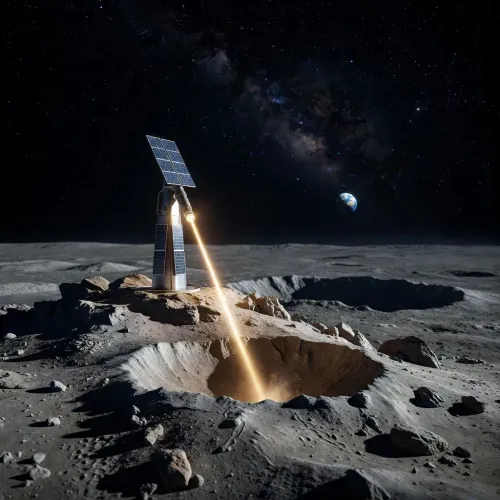
China has become only the second country after the United States to establish two-way laser communication between Earth and the moon, a milestone achieved by a team led by the Chinese Academy of Sciences using telescopes in Yunnan province. However, the data rates recorded fall significantly short of those demonstrated by NASA more than a decade ago, raising questions among space experts about the performance gap.
The numbers behind the milestone
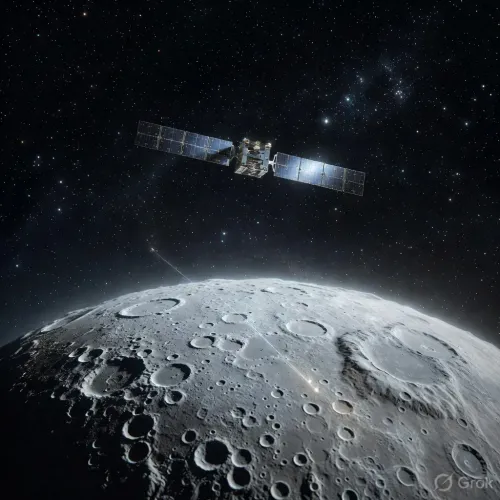
According to the Chinese Academy of Sciences, the experiment recorded a downlink speed of 100 megabits per second (Mbps) and an uplink speed of 1.25 Mbps. The signals were relayed through an experimental satellite currently orbiting the moon — one that reached lunar orbit following a launch mishap in 2024. The achievement makes China only the second nation to demonstrate bidirectional laser communication at lunar distances.
Why it matters — and where it falls short
The performance gap with NASA's benchmark is substantial. NASA's 2013 Lunar Laser Communications Demonstration achieved download speeds of 622 Mbps and upload speeds of 20 Mbps — roughly six times faster on downlink and 16 times faster on uplink than China's current results. That 2013 demonstration remains the reference standard for deep-space optical communications, and China's figures, while historic, sit well below it.
Expert reaction
Jonathan McDowell, a London-based space historian and former Harvard astronomer, acknowledged the significance of the feat while noting the disparity. 'It sounds like China has not yet reached the data rates the US can achieve,' he said, adding that he did not know what accounted for the gap. Yang Lei, a deep-space laser communications expert and head of the research team, highlighted the broader speed advantage of laser communications over conventional radio-frequency methods in an interview with state news agency Xinhua last week.
The competitive backdrop
Laser — or optical — communications are considered a critical enabler for future deep-space missions, offering far higher bandwidth than traditional microwave links with lower power requirements. Both NASA and China are investing in the technology as part of broader lunar and deep-space exploration programmes, including China's planned Chang'e-7 mission and the Queqiao-2 relay satellite infrastructure. The gap in demonstrated performance suggests China's optical communications hardware and ground-station infrastructure still require significant development to match US capabilities.
What's next
The Chinese Academy of Sciences has not publicly outlined a timeline for achieving higher data rates, and the reasons for the current performance ceiling remain unexplained by the research team. As both nations accelerate lunar programmes ahead of planned crewed missions later this decade, closing the laser communications gap will be a key technical benchmark to watch.
Point of View
Pointing to deficits in either ground-station aperture, detector sensitivity, or onboard transmitter power that Yang Lei's team has not addressed publicly. This fits a broader pattern in the US-China space technology race: China achieves symbolic firsts while quietly trailing on engineering depth, a dynamic visible in everything from reusable launch vehicles to deep-space communications. Mainstream coverage tends to treat the milestone at face value; the more revealing question is whether the 2024 launch mishap that stranded the satellite in a non-optimal orbit is partly responsible for the degraded link budget. The answer matters enormously as both nations race toward crewed lunar landings where high-bandwidth Earth links are a safety-critical requirement.
NationPress
2 Sept 2026
Frequently Asked Questions
Has China achieved laser communication with the moon?
Yes. China has established two-way laser communication between Earth and the moon , making it only the second country after the United States to do so. The experiment was led by the Chinese Academy of Sciences using telescopes in Yunnan province and an experimental satellite in lunar orbit.
How does China's lunar laser speed compare to NASA's?
China 's system achieved a downlink of 100 Mbps and an uplink of 1.25 Mbps , while NASA 's 2013 demonstration reached 622 Mbps downlink and 20 Mbps uplink. That makes NASA 's decade-old system roughly six times faster on downloads and 16 times faster on uploads.
Why is lunar laser communication important?
Laser — or optical — communication offers far higher bandwidth than conventional radio-frequency links at lower power, making it critical for future deep-space and crewed lunar missions. High data rates enable real-time video, scientific data transfer, and reliable command links across the roughly 384,000 km Earth-moon distance.
What satellite did China use for the lunar laser experiment?
The experiment used an experimental satellite currently orbiting the moon that reached lunar orbit after a launch mishap in 2024 . The Chinese Academy of Sciences led the project, which also involved ground telescopes in Yunnan province .
What did experts say about China's lunar laser achievement?
Jonathan McDowell , a London -based space historian and former Harvard astronomer, said the two experiments were broadly comparable but noted that ' China has not yet reached the data rates the US can achieve,' while admitting he did not know what caused the gap. Research team head Yang Lei highlighted laser communication's inherent speed advantages over other methods.