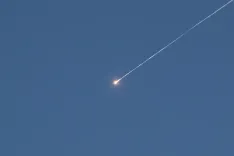
Chinese satellite Gande-1 films SpaceX Falcon 9 debris hitting moon
Synopsis
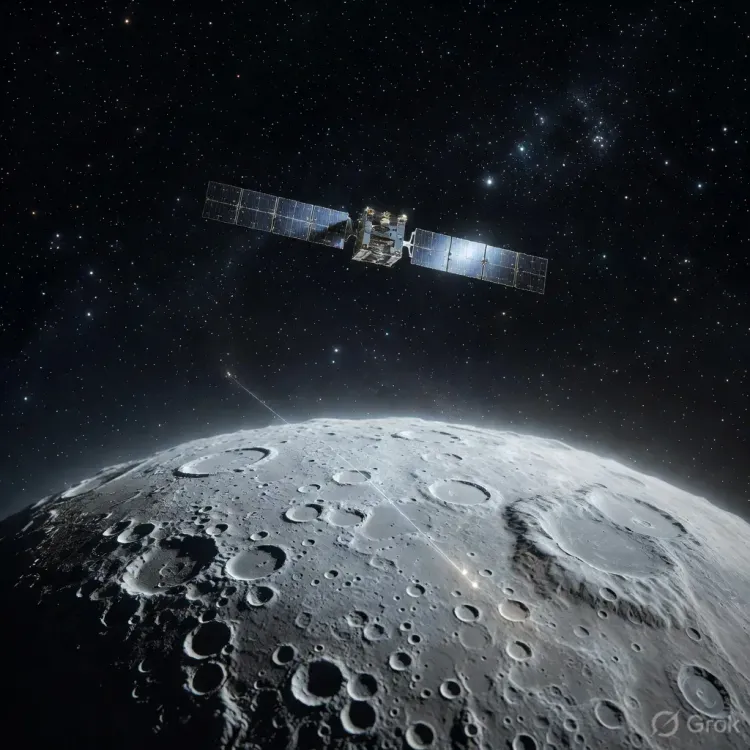
China's newly launched Gande-1 01 debris-monitoring satellite filmed a SpaceX Falcon 9 upper stage crashing into the moon near the Einstein crater — the first space-based recording of a lunar impact, and a live proof-of-concept for Beijing's planned orbital surveillance constellation.
Key Takeaways
China's Gande-1 01 satellite, launched July 24, 2026 , captured video of a SpaceX Falcon 9 upper stage striking the moon on August 6, 2026 .
The debris, roughly the size of a bus, impacted near the Einstein crater on the near side of the moon.
No visible plume was detected in the footage, consistent with observations from other scientists and telescopes.
ATmoto Technology (also known as Aotian Technology ), a Beijing -based aerospace firm, developed the satellite and called the event an 'excellent window' to test its space situational awareness system.
Gande-1 01 is China's first dedicated space debris monitoring satellite and part of a constellation planned for completion by 2030 .
China's Gande-1 01 space debris monitoring satellite captured footage of a SpaceX Falcon 9 upper-stage rocket crashing into the moon on Wednesday, August 6, 2026, marking the first time a space-based surveillance system has recorded a lunar debris impact in real time. The event doubled as a live operational test for Beijing-based aerospace firm ATmoto Technology (also known as Aotian Technology), the satellite's developer.
What the footage shows
The images appear to capture the moment of impact but show no visible plume — an observation consistent with reports from other scientists and ground-based telescopes that monitored the event simultaneously. The debris, described as roughly the size of a bus, struck the lunar surface near the Einstein crater on the edge of the near side of the moon.
China's first dedicated debris-monitoring satellite
Gande-1 01 was launched on July 24, 2026, making it China's first satellite dedicated to space debris monitoring. It is the inaugural unit of a planned constellation that the country intends to complete by 2030. The satellite's successful tracking of an unscheduled lunar impact so soon after launch underscores the rapid maturation of China's space situational awareness capabilities.
Why it matters
ATmoto Technology described the Falcon 9 impact as an ‘unplanned’ space event that nonetheless served as an ideal proving ground. “The impact of the Falcon 9 upper-stage debris on the moon was an ‘unplanned’ space event, but it became an excellent window to test the operational capabilities of the space-based situational awareness system,” the company said in a social media post on Wednesday. The successful demonstration positions ATmoto — and by extension China's broader space surveillance programme — as a credible player in the emerging market for commercial space traffic management.
The competitive backdrop
Space debris tracking has become a strategic priority as low-Earth orbit grows increasingly congested with satellites from SpaceX, national agencies, and commercial operators. Nations including the United States, members of the European Space Agency, and Japan have invested heavily in ground-based radar and optical networks; China's move to field a dedicated orbital monitoring constellation represents a significant leap in capability. The planned 2030 completion timeline suggests Beijing is treating space situational awareness as infrastructure, not a one-off demonstration.
What's next
Analysts will watch whether the Gande-1 constellation attracts commercial clients seeking independent debris-tracking data, and whether footage from the mission is shared with international bodies such as NASA or the United Nations Office for Outer Space Affairs. The Lunar Reconnaissance Orbiter is expected to image the fresh impact crater, which could allow cross-validation of Gande-1 01's data and establish a benchmark for the satellite's accuracy.
Point of View
Including SpaceX, beyond Earth orbit. As commercial launch cadences accelerate and lunar traffic grows, space situational awareness is fast becoming a geopolitical asset: whoever controls the data controls the narrative in future debris-liability disputes. What mainstream coverage underplays is the commercial angle: a credible orbital monitoring constellation could generate revenue from satellite insurers, launch operators, and governments unwilling to rely solely on US Space Command tracking data. The 2030 completion target aligns neatly with China's broader lunar ambitions, suggesting Gande-1's architecture was designed with cislunar surveillance — not just low-Earth orbit — in mind from the outset.
NationPress
20 Sept 2026
Frequently Asked Questions
What did China's Gande-1 satellite capture?
China's Gande-1 01 satellite captured footage of a SpaceX Falcon 9 upper-stage rocket crashing into the moon near the Einstein crater on August 6, 2026 . The footage showed no visible plume at the moment of impact, which is consistent with observations from other scientists and ground-based telescopes.
Where did the Falcon 9 debris hit the moon?
The Falcon 9 upper stage struck the lunar surface near the Einstein crater , located on the edge of the side of the moon visible from Earth. The debris was approximately the size of a bus.
Who built the Gande-1 01 satellite?
ATmoto Technology , also known as Aotian Technology , a Beijing -based aerospace company, developed Gande-1 01 . The satellite was launched on July 24, 2026 , and is China's first dedicated space debris monitoring satellite.
Why is China building a space debris monitoring constellation?
China is building the constellation to establish an independent space situational awareness capability as orbital congestion increases. The planned network is expected to be completed by 2030 and is designed to track debris and monitor space events from orbit rather than from the ground.
How does this affect the global space debris tracking landscape?
China's successful tracking of an unscheduled lunar impact demonstrates that Beijing now possesses space-based surveillance capabilities that rival or complement those of the United States and European agencies. This could reshape how debris-liability disputes are adjudicated internationally, particularly as commercial launch traffic continues to grow.