China's Long March 7A rocket explodes 85 seconds after launch, destroys ChinaSat-4B
Synopsis
China's Long March 7A — a rocket with just one prior failure in 17 missions — broke apart in a fireball 85 seconds after launch, taking the ChinaSat-4B communications satellite with it. State media sat on the news for three hours and social media footage was scrubbed, raising questions about transparency inside China's space programme at a moment when Xi Jinping is betting heavily on space dominance by 2050.
Key Takeaways
A Long March 7A rocket exploded approximately 85 seconds after launch at the Wenchang Space Launch Site on Hainan island on Monday night .
The rocket was carrying the Zhongxing-4B (ChinaSat-4B) satellite, designed to deliver global radio, television, and communications services.
It was the rocket's 18th mission and only its second failure — the first being its maiden flight in 2020 .
State agency Xinhua confirmed the failure three hours after the explosion, calling it an 'anomaly during flight'.
Private video of the explosion on Xiaohongshu and Douyin was reportedly removed or deprioritised.
An investigation is reportedly underway; no findings have been made public.
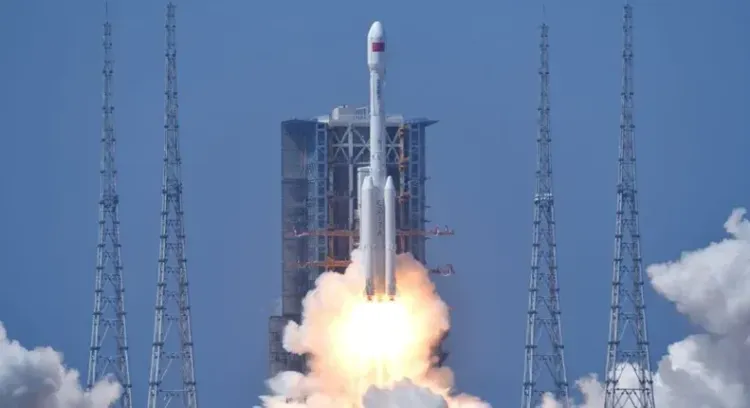
A Chinese Long March 7A rocket exploded into a massive fireball roughly 85 seconds after liftoff on Monday night, destroying the Zhongxing-4B (ChinaSat-4B) communications satellite it was carrying to orbit. The explosion, which occurred at the Wenchang Space Launch Site on Hainan island, marks one of the most significant failures in China's recent space programme history.
What Happened at Wenchang
Video footage from the launch site showed the rocket breaking apart nearly 85 seconds after liftoff, disintegrating into a fireball over the South China coast. State news agency Xinhua confirmed the failure approximately three hours after the incident, describing it only as an 'anomaly during flight' — a notably understated characterisation of what the footage showed.
The ChinaSat-4B satellite was intended to provide radio, television, and broadband communications services to users globally, according to state media. Its loss represents a significant setback for China's commercial and strategic satellite communications ambitions.
A Rare Stumble for a Workhorse Rocket
The Long March 7A, designed by the China Academy of Launch Vehicle Technology — a subsidiary of state-owned China Aerospace Science and Technology Corporation (CASC) — was on its 18th mission when the failure occurred. Prior to this, the rocket had failed only once before, during its maiden flight in 2020, giving it an otherwise strong track record. Analysts describe this as a relatively rare failure for a vehicle considered central to Beijing's orbital launch cadence.
State Media Downplays the Incident
Notably, coverage of the explosion on China's state-controlled media was conspicuously muted. On Chinese social platforms including Xiaohongshu and Douyin, video of the launch was largely restricted to state-affiliated accounts, while footage posted by private users appeared to be removed or deprioritised in search results. The contrast with the typically celebratory coverage of successful Chinese launches was stark, according to reports.
An investigation into the cause of the failure is reportedly underway, though no timeline or responsible body has been publicly identified.
Context: China's Space Race Ambitions
The failure comes at a sensitive moment for Chinese leader Xi Jinping, who has made space supremacy a cornerstone of China's national strategy, with an explicit goal of making China a global leader in space science by 2050. China is locked in an intensifying competition with the United States across multiple fronts — reusable launch vehicles, lunar exploration, and satellite deployment — and high-profile failures carry both technical and geopolitical weight.
This is the second Long March 7A failure in the rocket's operational history, raising questions about quality-control processes within CASC as the programme scales up its launch tempo. Whether the investigation findings will be made public remains uncertain, given Beijing's track record of limited transparency on space programme setbacks.
Point of View
Carrying a commercial communications satellite, chips at that narrative. More critically, the opacity around the investigation means the aerospace community outside China will have little to work with. As Beijing accelerates its launch cadence to compete with SpaceX and US national programmes, quality assurance at CASC deserves scrutiny that state-controlled reporting will not provide.
NationPress
26 Sept 2026
Frequently Asked Questions
What caused the Long March 7A rocket to explode?
The exact cause has not been publicly confirmed. China's state news agency Xinhua said the rocket 'experienced an anomaly during flight' approximately three hours after the explosion. An investigation is reportedly underway, but no findings have been released.
Which satellite was lost in the Long March 7A explosion?
The rocket was carrying the Zhongxing-4B, also known as ChinaSat-4B, a communications satellite intended to provide radio, television, and broadband services globally. The satellite was completely destroyed in the explosion.
How many times has the Long March 7A failed before?
Before this incident, the Long March 7A had failed only once — during its maiden flight in 2020. Monday's explosion was its 18th mission, making this only its second-ever failure.
Why did China's state media take so long to report the explosion?
Xinhua confirmed the failure roughly three hours after it occurred, and coverage on state media was reportedly minimal. Videos of the explosion posted by private users on platforms like Xiaohongshu and Douyin appeared to be removed or deprioritised, suggesting deliberate information management around the incident.
How does this failure affect China's space ambitions?
China under Xi Jinping is targeting global space leadership by 2050 and is in direct competition with the United States on reusable rockets, lunar missions, and satellite launches. A high-profile failure on a key workhorse rocket, combined with limited transparency, could affect confidence in China's commercial launch services and slow its bid to attract international satellite customers.