LandSpace Zhuque-3 beats SpaceX in steel-booster recovery after orbit

Synopsis
China's LandSpace made history on 19 August 2026 by recovering a stainless-steel Zhuque-3 booster after an orbital launch — a feat SpaceX's Super Heavy has yet to achieve — instantly reshaping the global reusable-rocket race.
Key Takeaways
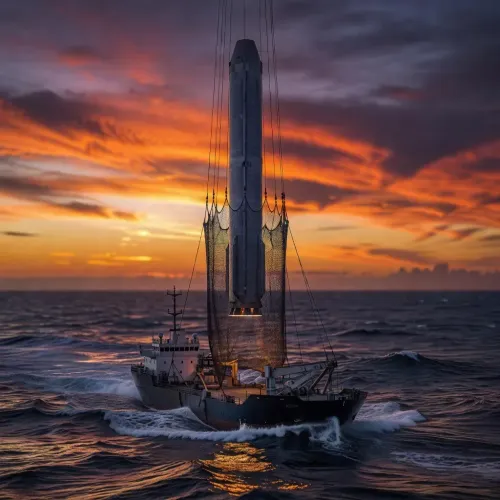
LandSpace recovered the first stage of its Zhuque-3 rocket on 19 August 2026 , marking the world's first stainless-steel booster recovery following an orbital launch.
The 66-metre rocket lifted off from Jiuquan Satellite Launch Centre at 7:35 am and delivered a Honghu-3 internet satellite to its designated orbit.
The first stage landed vertically in Minqin county, Gansu province , roughly 390 km from the launch pad.
LandSpace is now the fourth entity globally — after SpaceX , Blue Origin , and CASC — to recover an orbital launch vehicle.
SpaceX 's comparable Super Heavy booster is still awaiting FAA approval for its first orbital recovery flight.
A previous Zhuque-3 attempt in December 2025 ended with the first stage exploding during descent, making this success a significant engineering turnaround.
LandSpace, China's leading commercial rocket company, became the first entity in history to recover a stainless-steel booster following an orbital launch, when its Zhuque-3 rocket completed a successful mission on Wednesday, 19 August 2026. The feat positions China as a serious contender in the global reusable-rocket race and edges ahead of SpaceX, whose stainless-steel Super Heavy booster is still awaiting US Federal Aviation Administration (FAA) approval for its own orbital recovery flight.
The mission at a glance
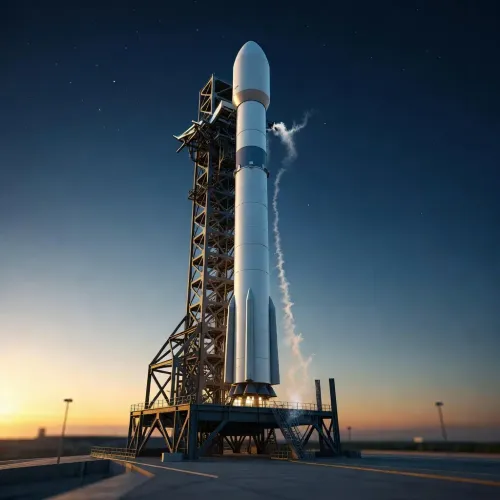
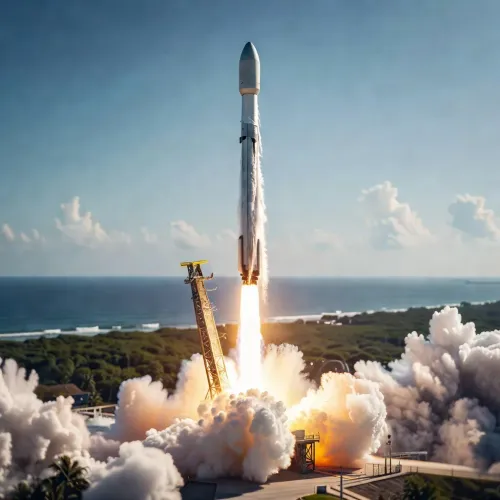
The 66-metre (217-foot) methane-oxygen rocket lifted off from the Jiuquan Satellite Launch Centre in the Gobi Desert at 7:35 am on Wednesday, according to state news agency Xinhua. It successfully delivered a Honghu-3 internet satellite into its designated orbit before its first stage returned to Earth, touching down vertically at a recovery site in Minqin county, Gansu province — approximately 390 km (242 miles) southeast of the launch pad.
The mission makes Zhuque-3 the first Chinese commercial rocket to both reach orbit and have its first stage recovered in a single flight.
Why it matters
LandSpace is now only the fourth entity in the world to recover an orbital launch vehicle, joining SpaceX, Blue Origin, and state-owned China Aerospace Science and Technology Corporation (CASC). Critically, it is the first to do so using a stainless-steel booster after an orbital-class mission — a benchmark SpaceX's Starship programme has yet to formally clear under regulatory constraints.
Reusable rockets dramatically reduce the per-launch cost of placing payloads in orbit, making this milestone strategically significant for China's ambitions in commercial satellite deployment and deep-space logistics.
Learning from December's failure
This was LandSpace's second attempt to achieve the dual objective of orbital delivery and first-stage recovery. During Zhuque-3's maiden flight in December 2025, the second stage successfully reached orbit, but the first stage erupted in a fireball during its final powered descent toward the landing pad. The company clearly resolved the terminal-descent anomaly in the months between attempts.
The competitive backdrop
SpaceX's Super Heavy — also constructed from stainless steel — remains grounded for orbital recovery flights pending FAA clearance, giving LandSpace a narrow but symbolically powerful window to claim the global first. The broader contest involves China's satellite internet programmes, including Qianfan and state-backed Guowang, which are racing to build constellations that rival SpaceX's Starlink.
What's next
The successful recovery opens the door for LandSpace to begin refurbishing and reflying the booster, the key economic argument for reusability. Analysts will watch whether China's regulatory environment allows faster iteration cycles than the FAA-governed US framework, and how quickly LandSpace can scale launch cadence to serve domestic satellite constellation customers.
Point of View
Its regulatory environment — specifically FAA licensing timelines — is now allowing a well-funded Chinese commercial rival to claim a symbolically critical global first. This is less about raw engineering supremacy and more about how bureaucratic friction can cede milestones in a geopolitically charged technology domain. Mainstream coverage tends to frame this as a pure engineering story, but the deeper signal is that China's commercial space sector is maturing fast enough to exploit windows created by Western regulatory lag. For satellite internet competition specifically, a reusable Zhuque-3 gives Qianfan and Guowang a credible, lower-cost domestic launch option — reducing their dependency on state-owned Long March vehicles and intensifying pressure on Starlink's cost model in Asian markets.
NationPress
19 Aug 2026
Frequently Asked Questions
What did LandSpace achieve with the Zhuque-3 rocket on 19 August 2026?
LandSpace became the first company in the world to recover a stainless-steel booster after an orbital launch. The Zhuque-3 rocket delivered a Honghu-3 satellite to orbit and then landed its first stage vertically in Minqin county, Gansu province , on 19 August 2026 .
How does LandSpace's booster recovery compare to SpaceX?
SpaceX 's Super Heavy booster is also made of stainless steel but is still awaiting FAA approval for its first orbital recovery flight, meaning LandSpace technically claimed this global milestone first. SpaceX has previously recovered boosters on suborbital and partial-orbital profiles, but the stainless-steel orbital recovery benchmark now belongs to LandSpace .
Which companies have recovered orbital launch vehicles before LandSpace?
Only three entities had previously recovered orbital launch vehicles: SpaceX , Blue Origin , and the state-owned China Aerospace Science and Technology Corporation (CASC) . LandSpace is now the fourth, and the first private Chinese company to do so.
What happened during Zhuque-3's first launch attempt?
During Zhuque-3 's maiden flight in December 2025 , the second stage successfully reached orbit, but the first stage exploded in a fireball during its final powered descent toward the landing pad. LandSpace resolved the anomaly before the successful August 2026 attempt.
Why is reusable rocket technology important for China's space ambitions?
Reusable rockets sharply reduce per-launch costs, which is critical for deploying large satellite constellations like Qianfan and Guowang — China 's answers to SpaceX 's Starlink . A proven reusable commercial launcher gives Chinese satellite operators a cost-competitive domestic alternative to state-run Long March rockets.