AI cuts Chinese coastguard weapons use to zero in South China Sea war game
Synopsis
Chinese coastguard researchers found their rule-based command system still carries a 0.3% chance of lethal weapons use in disputed waters — so they built an AI that brings that number to zero by reading vessel intentions in real time rather than applying rigid threat labels.
Key Takeaways
A computer war game by China Coast Guard Academy researchers found the existing rule-based system triggers lethal weapons use in 0.3% of simulated disputed-water encounters.
A new AI framework developed by the team, led by Sun Shengzhi , reduces that probability to zero by continuously calculating probabilistic vessel intentions rather than applying binary threat labels.
The findings were published this month in the journal Command Control & Simulation , affiliated with the People's Armed Police Force .
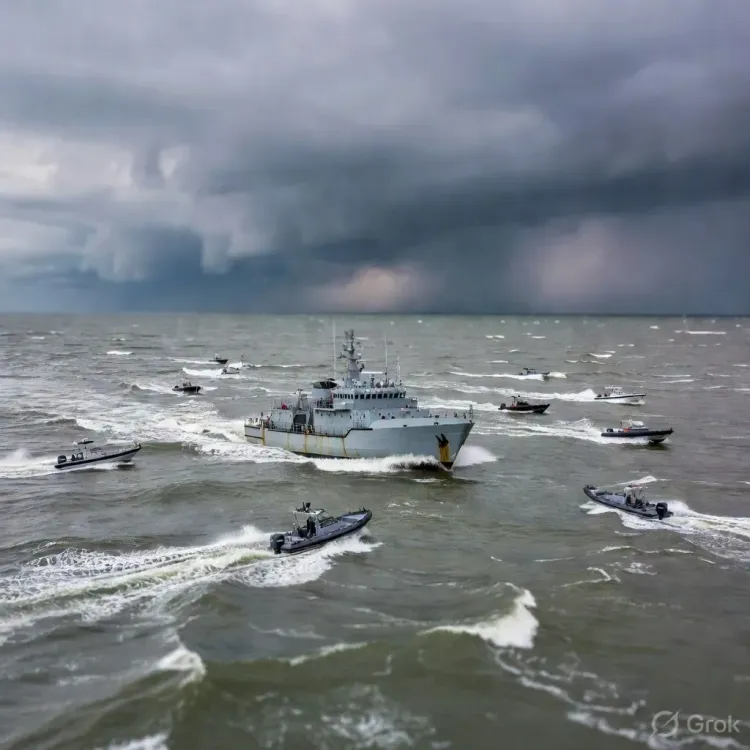
The simulation scenario involved a Chinese coastguard ship protecting fishing vessels against unpredictable small fast-boat movements — a common real-world encounter type in the South China Sea .
The research is currently at the simulation and validation stage, with no confirmed operational deployment timeline.
China's coastguard researchers have developed an artificial intelligence framework that reduces the probability of lethal weapons deployment to zero in simulated disputed-water encounters — down from a baseline of 0.3% under existing rule-based command systems. The findings, published this month, emerged from computer war-game simulations run by researchers affiliated with the China Coast Guard Academy and the People's Armed Police Force, and were detailed in the journal Command Control & Simulation.
What the war game revealed
The simulation placed a Chinese coastguard vessel in one of the most pressure-tested scenarios in modern maritime policing: shielding a cluster of fishing boats while several small, fast vessels circle unpredictably — sometimes closing in, sometimes retreating. Under the existing rule-based command structure, the simulated patrol ship resorted to lethal force in 0.3% of encounters. While that figure may appear negligible in isolation, researchers noted that in the context of the South China Sea — where encounters are frequent and geopolitical stakes are extreme — even that margin is considered unacceptably high by Beijing.
How the AI framework works
Rather than applying binary threat labels, the AI system continuously calculates probability distributions across multiple possible vessel intentions — ranging from routine fishing activity to coordinated harassment operations. According to the research team, the framework 'reads' a vessel's behaviour the way an experienced mariner interprets sea conditions: dynamically, probabilistically, and in real time. The system adjusts the coastguard's tactical response at each moment, avoiding the rigid decision trees that can force a premature escalation under rule-based logic.
Why it matters
The South China Sea has been the site of repeated confrontations between Chinese coastguard vessels and those of the Philippines, Vietnam, and other claimant states, with incidents involving water cannons, laser dazzlers, and vessel collisions drawing international condemnation. An AI-driven de-escalation layer — if deployed operationally — would give Beijing a technical basis to argue its coastguard exercises greater restraint than critics allege. The research was led by Sun Shengzhi and colleagues, according to the published paper.
The competitive backdrop
The development sits within a broader pattern of China integrating AI into military-adjacent domains, from unmanned surface vessels to autonomous logistics. Applying probabilistic intent-recognition to coastguard command-and-control represents a step toward what defence analysts describe as 'cognitive electronic warfare' — systems that manage escalation risk algorithmically rather than relying solely on human judgement under stress. Several US and allied navies are pursuing comparable decision-support tools, though published specifics remain limited.
What's next
The paper stops short of confirming any operational deployment timeline. Researchers indicated the framework is at the simulation and validation stage. Observers will watch whether the system — or its conceptual architecture — surfaces in People's Armed Police Force doctrine updates or in future coastguard equipment procurement cycles. How claimant states and regional navies respond to AI-assisted coastguard operations in disputed waters will be a critical variable to monitor.
Point of View
Not just academic curiosity.
NationPress
29 Aug 2026
Frequently Asked Questions
What did the Chinese coastguard AI war game find?
The war game found that under the existing rule-based command system, simulated Chinese coastguard vessels resort to lethal weapons in 0.3% of disputed-water encounters. Researchers then developed an AI framework that reduces that probability to zero by continuously assessing vessel intentions rather than applying fixed decision rules.
How does the Chinese coastguard AI system work?
Instead of labelling a vessel as simply 'hostile' or 'harmless,' the AI calculates real-time probability distributions across multiple possible intentions — from routine fishing to coordinated harassment. It adjusts the coastguard's tactical response dynamically at each moment, preventing the rigid escalation pathways inherent in rule-based logic.
Who conducted the Chinese coastguard AI research?
The research was led by Sun Shengzhi and colleagues at institutions linked to the China Coast Guard Academy and the People's Armed Police Force . The findings were published this month in the journal Command Control & Simulation .
Why does a 0.3% weapons-use rate matter in the South China Sea?
The South China Sea sees a high volume of coastguard encounters with vessels from rival claimant states including the Philippines and Vietnam . Even a fractional probability of lethal escalation, multiplied across hundreds of annual interactions, represents a meaningful geopolitical risk — which is why Beijing 's researchers treated the baseline figure as unacceptably high.
Is the Chinese coastguard AI system deployed operationally?
According to the published paper, the framework remains at the simulation and validation stage with no confirmed operational deployment timeline. Whether it will be integrated into People's Armed Police Force doctrine or coastguard equipment procurement is the key development to watch.