Physicist Guo Yanliang quits top European quantum lab for Beijing
Synopsis
Champion debater and quantum physicist Guo Yanliang, 33, has left one of Europe's top quantum labs to build an ultracold atom platform at Renmin University of China — citing a better research environment fit, in a high-profile addition to China's accelerating scientific talent repatriation.
Key Takeaways
Guo Yanliang , 33 , has left a leading European quantum laboratory to become an associate professor at Renmin University of China in Beijing .
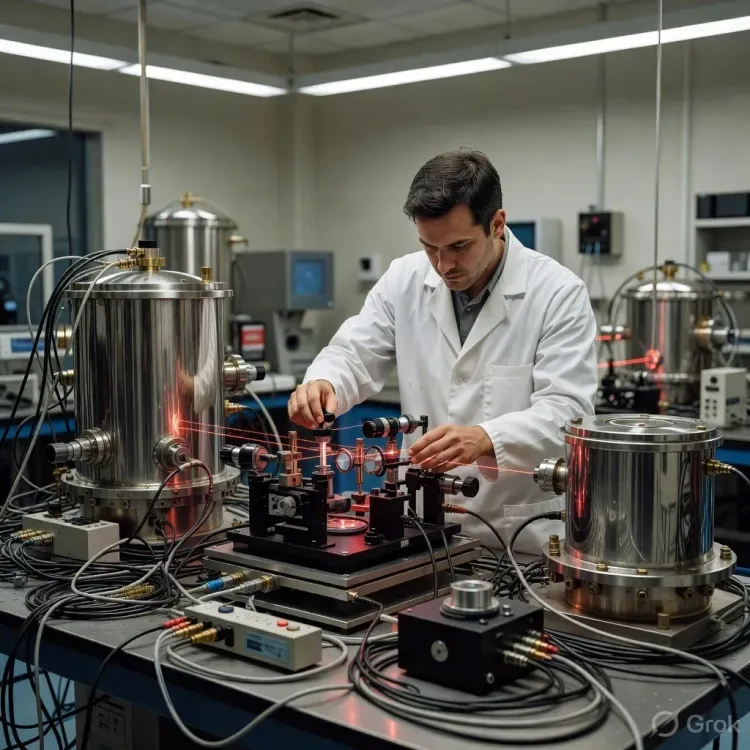
He is building an ultracold atom experiment platform at Renmin University , a technology central to next-generation quantum simulation and computing.
Guo has published research in both Science and Nature and was named to MIT Technology Review 's 'Innovators Under 35 China' list.
He told DeepTech last month that 'the research environment here is more in line with my research characteristics.' Guo cited better long-term institutional support in China as a key driver, alongside a philosophical alignment between his debate-oriented scientific style and the domestic research culture.
Guo Yanliang, a 33-year-old quantum physicist and champion debater, has left one of Europe's leading quantum research laboratories to establish his own group at Renmin University of China in Beijing, in a move that underscores the accelerating reverse brain-drain reshaping global science.
The return and what it means
Guo joined Renmin University of China this year as an associate professor, where he is building an ultracold atom experiment platform. His departure from a premier European quantum facility marks another high-profile instance of Chinese-born researchers choosing domestic institutions over Western ones, a trend that has drawn increasing attention from science-policy circles worldwide.
The physicist cited alignment between China's research environment and his personal scientific style as the decisive factor. "The research environment here is more in line with my research characteristics," he told DeepTech, the Chinese branch of MIT Technology Review, last month.
An unusual profile: debater turned quantum physicist
Guo is notable for combining elite competitive debating — honed in international contests and on online variety shows — with serious academic credentials. He views scientific inquiry as a structured contest of competing ideas, a philosophy he says made him feel more at home in China's collaborative research culture than in Europe's.
His academic record is substantial: he has published in both Science and Nature, two of the world's most prestigious journals, and earned a place on MIT Technology Review's 'Innovators Under 35 China' list.
Why it matters
Quantum computing and ultracold atom research sit at the strategic frontier of the ongoing technology competition between major powers. Researchers with Guo's profile — internationally trained, published in top-tier journals, recognised by Western institutions — represent exactly the talent that both China and Western governments are competing to retain or attract.
According to reports, Guo specifically noted that China offered better long-term support for his research goals, suggesting that funding structures and institutional backing, not just patriotic sentiment, are driving such decisions.
The competitive backdrop
Guo's move is part of a broader pattern. Chinese scientists who trained or worked abroad have been returning in growing numbers, drawn by expanded government funding for frontier research, improved laboratory infrastructure, and talent programmes that offer competitive compensation. Ultracold atom platforms are foundational to next-generation quantum simulators and quantum computers, making Guo's new lab at Renmin University strategically significant.
What's next
Guo's ultracold atom experiment platform at Renmin University of China is still being established, and the research outputs from his group will be closely watched by the quantum science community. As major economies intensify investment in quantum technologies, the flow of talent between research ecosystems is likely to remain a defining variable in who leads the next wave of breakthroughs.
Point of View
The assumption was that top Chinese researchers trained in the West would stay; that calculus has visibly changed as Beijing's funding for frontier science reaches parity or superiority with many European programmes. What mainstream coverage often misses is the role of research-style fit: Guo's framing — that China's environment suits his 'research characteristics' — points to institutional culture and autonomy, not just money or nationalism, as retention levers. In quantum specifically, where ultracold atom platforms underpin both near-term simulators and long-horizon fault-tolerant computers, losing researchers of Guo's calibre to Chinese universities has compounding strategic consequences that extend well beyond any single publication in Science or Nature.
NationPress
25 Aug 2026
Frequently Asked Questions
Who is Guo Yanliang and why is he significant?
Guo Yanliang is a 33-year-old Chinese quantum physicist who has published in Science and Nature and was named to MIT Technology Review's 'Innovators Under 35 China' list. He is also a champion competitive debater, making him an unusually high-profile figure in the scientific community.
Why did Guo Yanliang leave Europe to return to China?
Guo said China's research environment is 'more in line with my research characteristics,' according to an interview with DeepTech last month. He also cited better long-term institutional support for his research goals as a decisive factor.
What will Guo Yanliang work on at Renmin University of China?
Guo is building an ultracold atom experiment platform at Renmin University of China in Beijing, where he holds the position of associate professor. Ultracold atom systems are a key technology for quantum simulation and next-generation quantum computers.
Is this part of a broader trend of Chinese scientists returning from the West?
Yes. Guo's move reflects a growing pattern of internationally trained Chinese researchers returning home, driven by expanded government funding, improved laboratory infrastructure, and competitive talent programmes. The trend has attracted significant attention from science-policy analysts globally.
Why does quantum physics talent matter geopolitically?
Quantum computing and related technologies are at the centre of the strategic competition between major powers. Researchers specialising in ultracold atom platforms contribute directly to advances in quantum simulation and computing, areas where both China and Western governments are investing heavily to secure long-term technological leadership.