Envision Group's 2GW AI campus puts Inner Mongolia on the global compute map
Synopsis
Envision Group has brought a 120,000-sq-metre AI campus online in Ulanqab, Inner Mongolia, with planned capacity exceeding 2 gigawatts and room for one million AI accelerators — potentially making it the world's largest AI computing facility, surpassing xAI's Colossus 2.
Key Takeaways
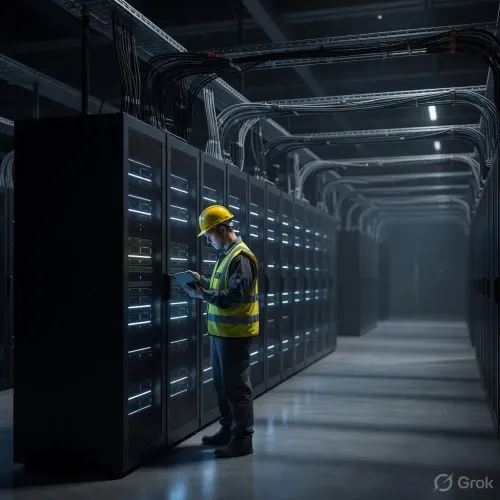
Envision Group launched its Galaxy Campus in Ulanqab, Inner Mongolia earlier in August 2026 , centred on a 120,000-square-metre AI data centre.
The facility is designed to house up to one million AI accelerators with a planned power capacity of over two gigawatts , according to the company.
By planned capacity, the Galaxy Campus would exceed Elon Musk 's xAI Colossus 2 , which carries a projected 1.5-gigawatt IT power capacity per Epoch AI rankings.
Ulanqab 's wind and solar resources and cooler climate make it a cost-efficient location for large-scale AI compute infrastructure.
China 's inland renewable-compute model is gaining policy backing from bodies including the National Energy Administration and CAICT .
The buildout reflects China 's broader strategy to scale AI infrastructure domestically amid ongoing US semiconductor export controls.
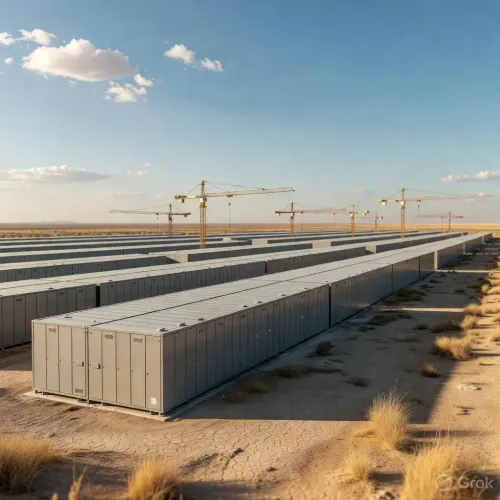
Ulanqab, a wind-swept city in Inner Mongolia roughly several hundred kilometres northwest of Beijing, has quietly emerged as one of China's most strategically important AI infrastructure hubs. Envision Group, a Chinese renewable energy company, brought its Galaxy Campus online in Ulanqab earlier this month, anchoring the facility around a 120,000-square-metre AI data centre — roughly the footprint of 20 standard football pitches — according to a company statement.
A pastoral city reinvented by compute demand
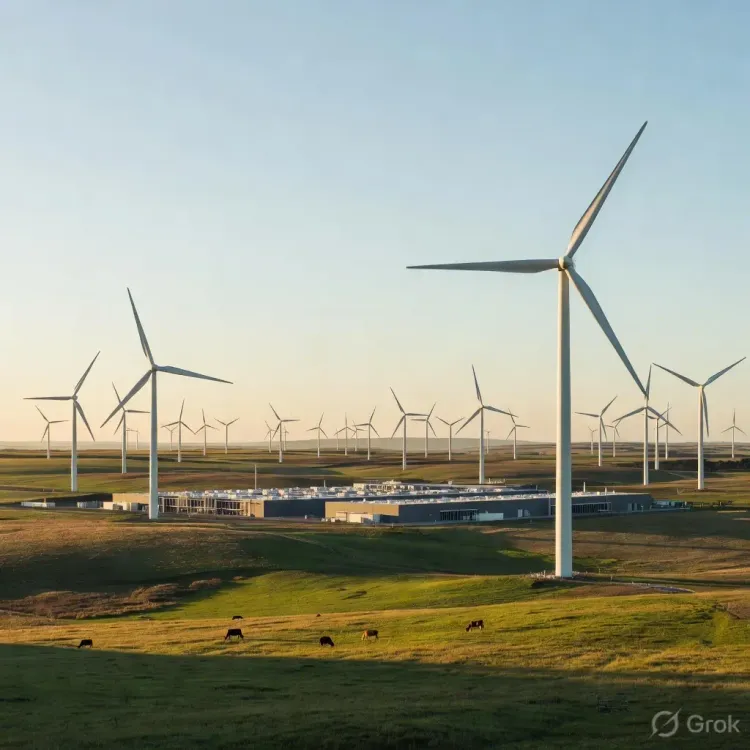
For generations, Ulanqab — whose Mongolian name translates to 'red cliff pass' — built its economy on cattle grazing and potato farming, sustained by cool breezes rolling off the Yinshan mountain range. Today, giant wind turbines stand alongside livestock on those same sloping grasslands, and the city's climatic advantages are being redeployed to cool and power some of the world's densest AI workloads.
The transition reflects a broader pattern across China: resource-rich inland regions, once peripheral to the country's technology economy, are being repositioned as critical nodes in the national AI buildout.
Scale that rivals the world's largest AI facilities
The Galaxy Campus is designed to accommodate up to one million AI accelerators, with a planned power capacity exceeding two gigawatts, according to Envision Group. That scale would, by multiple measures, rank it among the largest AI computing facilities anywhere on the planet.
For context, Colossus 2 — the flagship AI data centre operated by Elon Musk's xAI in the United States — carries a projected 1.5-gigawatt IT power capacity, according to a ranking by consultancy Epoch AI. The Galaxy Campus's planned capacity exceeds that benchmark by a third.
Why renewable energy makes Ulanqab indispensable
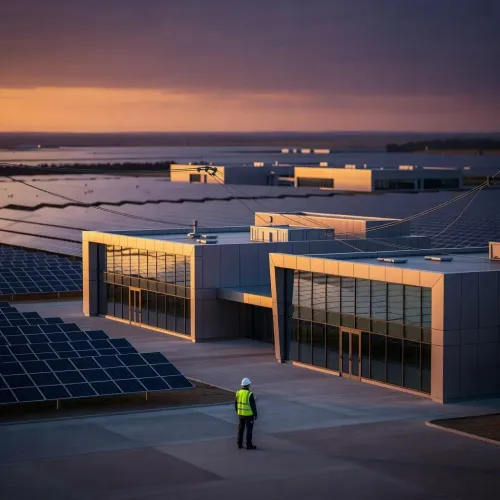
Ulanqab's combination of abundant wind and solar resources, cooler ambient temperatures, and proximity to Beijing's data-hungry technology sector makes it an unusually cost-effective location for large-scale AI compute. Renewable energy availability directly reduces the power costs that dominate hyperscale data centre operating budgets.
The global AI boom has intensified competition for low-cost, low-carbon electricity, with companies from Goldman Sachs-backed projects to Huawei Technologies and Kuaishou reportedly expanding their compute footprints in the region, according to industry reports.
The competitive backdrop
China's push to build sovereign AI infrastructure has accelerated in the face of US export controls on advanced semiconductors. Facilities like the Galaxy Campus are designed to maximise the utility of domestically available or permitted AI accelerators at massive scale, compensating through density and volume for constraints on individual chip performance.
The National Energy Administration and industry bodies including CAICT have signalled policy support for co-locating renewable generation with AI compute, a model that Ulanqab is now embodying at gigawatt scale.
What's next
As Envision Group ramps up the Galaxy Campus toward its full two-gigawatt capacity, attention will turn to which AI model developers and cloud tenants anchor the facility — and whether China's inland renewable-compute model attracts replication across other resource-rich provinces. The race to secure AI compute at scale is far from over.
Point of View
Directly countering the choke-point effect of US chip export controls by prioritising scale over per-chip performance. What mainstream coverage often underweights is the land-and-power arbitrage at play — inland cities like Ulanqab offer gigawatt-scale renewable capacity at a fraction of the cost of coastal or urban sites, giving Chinese hyperscalers a structural cost advantage that persists regardless of the semiconductor supply chain. The benchmark comparison to xAI's Colossus 2 signals that Chinese operators are now competing on the same headline metrics as their US counterparts — and winning on raw wattage. The critical unknown is utilisation: a two-gigawatt shell means little without a pipeline of frontier model training runs or inference workloads to fill it.
NationPress
9 Oct 2026
Frequently Asked Questions
What is Envision Group's Galaxy Campus in Ulanqab?
The Galaxy Campus is an AI computing facility brought online by Envision Group in Ulanqab, Inner Mongolia in August 2026 . At its core is a 120,000-square-metre AI data centre designed to accommodate up to one million AI accelerators, with a planned power capacity exceeding two gigawatts , according to the company.
How does the Galaxy Campus compare to xAI's Colossus 2?
Envision Group 's Galaxy Campus has a planned capacity of over two gigawatts , which exceeds the projected 1.5-gigawatt IT power capacity of xAI's Colossus 2 in the United States , according to rankings by consultancy Epoch AI . This would make the Galaxy Campus one of the largest AI computing facilities in the world by power capacity.
Why is Ulanqab chosen for AI data centres?
Ulanqab offers a combination of abundant wind and solar energy, cooler ambient temperatures, and relatively close proximity to Beijing , making it highly cost-effective for large-scale AI compute. These climatic conditions reduce both power costs and cooling requirements, which are the dominant operating expenses for hyperscale data centres.
How does this fit into China's broader AI infrastructure strategy?
China is accelerating domestic AI infrastructure investment partly in response to US export controls on advanced semiconductors. Facilities like the Galaxy Campus aim to compensate for chip constraints by deploying permitted accelerators at massive scale, supported by policy backing from bodies such as the National Energy Administration and CAICT .
Which companies are involved in AI infrastructure development in Inner Mongolia?
Envision Group is the lead developer of the Galaxy Campus in Ulanqab . Industry reports indicate that Huawei Technologies , Kuaishou , and other technology firms have also been expanding their compute presence in the region, drawn by the same renewable energy and climate advantages.