eSanjeevani crosses 50 crore teleconsultations, hits milestone on 15 September

Synopsis
eSanjeevani just crossed 50 crore teleconsultations — a number that makes it the world's largest government telemedicine operation. With AI-powered clinical support now embedded, emergency services integrated, and specialist OPDs live at AIIMS campuses, India's digital health experiment has crossed the threshold from promising pilot to permanent infrastructure.
Key Takeaways
eSanjeevani crossed 50 crore teleconsultations on 15 September 2026 , with a cumulative total of 50,00,92,730 .
The platform handles 2.5–3 lakh consultations daily; peak single-day usage reached 6,30,315 .
Network spans over 1.42 lakh Ayushman Arogya Mandir spokes, 19,473 medical hubs, and 901 online OPDs with 2,41,923 registered providers.
Women account for 57.14% of total users; citizens aged 46 and above make up 40.15% of consultations.
An AI-powered Clinical Decision Support System (AI-CDSS) has been integrated to enhance consultation quality.
Specialist teleconsultations are now live at AIIMS Jodhpur , AIIMS Jammu , and AIIMS Patna .
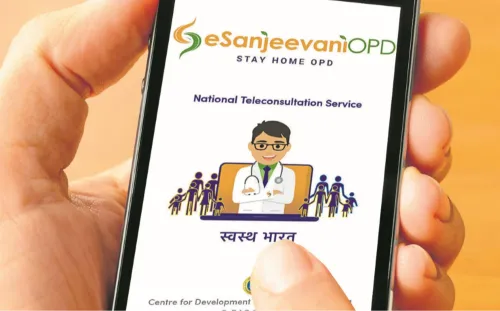
India's national telemedicine platform, eSanjeevani, surpassed the 50 crore teleconsultation mark on 15 September 2026, recording a cumulative total of 50,00,92,730 consultations, the Ministry of Health and Family Welfare announced on Tuesday. The milestone underscores the platform's rapid growth as the world's largest government-run telemedicine service, delivering quality healthcare to citizens across geographies.
Scale and Infrastructure
The platform now operates through a network of over 1.42 lakh Ayushman Arogya Mandir spokes, 19,473 medical hubs, and 901 online OPDs, supported by 2,41,923 registered healthcare providers. On a daily basis, eSanjeevani facilitates approximately 2.5 to 3 lakh consultations, with its highest single-day utilisation reaching 6,30,315 consultations. The service is available in 15 languages, including English and 14 Indian languages, ensuring broad linguistic accessibility.
Who Is Using eSanjeevani
Women account for 57.14% of total utilisation, reflecting the platform's reach among a demographic that often faces greater logistical barriers to in-person healthcare. Citizens aged 46 years and above represent 40.15% of consultations, with senior citizens aged 60 and above accounting for 16.25%. The utilisation pattern highlights eSanjeevani's growing relevance among populations for whom travel to physical facilities involves considerable time and cost.
Integration With Emergency Services and AI
To strengthen integrated healthcare delivery, eSanjeevani has been linked with the Emergency Response Support System (ERSS)-112, enabling more coordinated access to remote medical expertise during emergencies. A significant recent advancement is the integration of an Artificial Intelligence-powered Clinical Decision Support System (AI-CDSS), which assists healthcare providers during consultations and is designed to improve the quality, consistency, and efficiency of clinical decision-making.
Expansion Into Specialist Care
The platform is expanding beyond primary healthcare to facilitate specialist OPD consultations through premier government medical institutions. Patient-to-doctor teleconsultation services for select specialities have been rolled out at AIIMS Jodhpur, AIIMS Jammu, and AIIMS Patna, enabling patients to access specialist consultations remotely. This is expected to reduce the burden of long-distance travel and lengthy waits at tertiary-care facilities — a structural challenge that has historically limited specialist access for rural and semi-urban populations.
With AI integration deepening and specialist services expanding, eSanjeevani is poised to further redefine the contours of public healthcare delivery in India.
Point of View
But the more telling number is the demographic split — 57% women and 40% users aged 46 and above. These are precisely the groups that India's brick-and-mortar health system routinely underserves. The AIIMS specialist rollout is the right next step, but scaling it beyond three campuses will test whether the system can handle the specialist demand it is now unlocking. The AI-CDSS integration is promising, but its clinical validation data has not been made public — a transparency gap the Ministry should address before the tool is credited with improving outcomes.
NationPress
6 Oct 2026
Frequently Asked Questions
What is eSanjeevani and what milestone has it reached?
eSanjeevani is India's national telemedicine platform run by the Ministry of Health and Family Welfare. It crossed 50 crore cumulative teleconsultations on 15 September 2026, recording a precise total of 50,00,92,730 sessions, making it the world's largest government-operated telemedicine service.
How many daily consultations does eSanjeevani handle?
The platform currently facilitates approximately 2.5 to 3 lakh consultations per day. Its highest single-day utilisation has reached 6,30,315 consultations.
Who are the primary users of eSanjeevani?
Women account for 57.14% of total utilisation. Citizens aged 46 and above represent 40.15% of all consultations, with senior citizens aged 60 and above making up 16.25% — groups that often face the greatest barriers to accessing in-person healthcare.
What is the AI-CDSS integration in eSanjeevani?
The AI-powered Clinical Decision Support System (AI-CDSS) is a recently integrated feature that assists healthcare providers during consultations. It is designed to strengthen the quality, consistency, and efficiency of clinical decision-making on the platform.
Which AIIMS hospitals now offer specialist teleconsultations via eSanjeevani?
Specialist OPD teleconsultation services have been rolled out at AIIMS Jodhpur, AIIMS Jammu, and AIIMS Patna. The initiative allows patients to access specialist consultations remotely, reducing the need for long-distance travel to tertiary-care facilities.