Geologists uncover two major freshwater sources under Taklamakan Desert
Synopsis
Geologists have found two unexpectedly large freshwater groundwater sources beneath the Taklamakan Desert in Xinjiang — upending the assumption that only stagnant or saline water exists there, and potentially unlocking a new water supply for China's vast anti-desertification campaign.
Key Takeaways
Two large freshwater groundwater sources have been discovered beneath the Taklamakan Desert , China 's largest desert, as of 16 September 2026 .
The findings were made through a water-finding project run by Xinjiang's regional geological bureau and reported by CCTV Finance .
The discovery challenges the prevailing assumption that only stagnant or saline water exists underground in the desert.
The aquifers could support China 's Great Green Wall afforestation initiative and agricultural development in Xinjiang Uygur Autonomous Region .
Key survey areas include terrain near the Mazartag Mountains , Minfeng county , and Andir township within the Tarim Basin .
Sustainable extraction potential and aquifer replenishment rates have yet to be fully assessed.
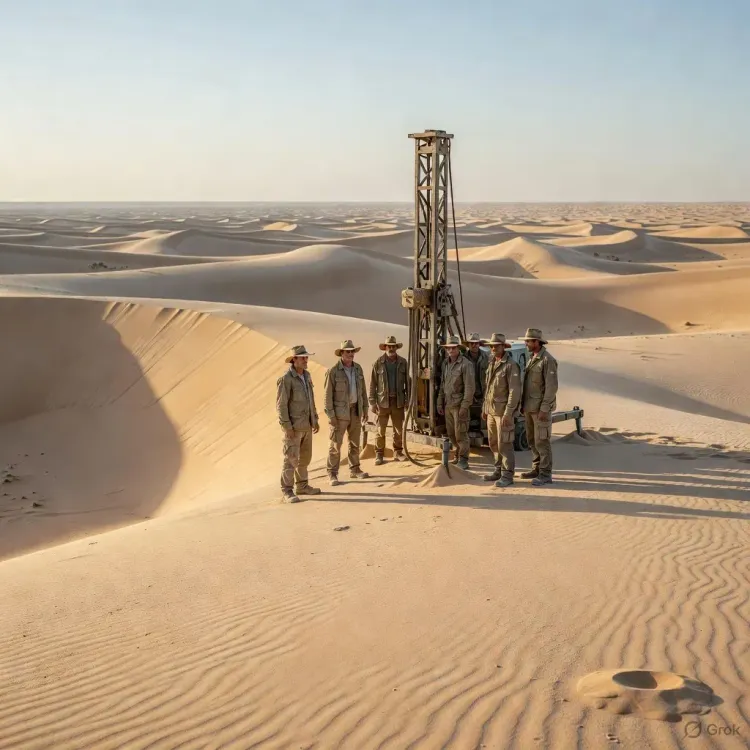
Geologists have identified two large freshwater groundwater sources beneath the Taklamakan Desert in Xinjiang Uygur Autonomous Region, northwestern China, in a discovery that could meaningfully expand water access for agriculture and sand-control programmes in one of the world's most arid landscapes. The findings were announced on Monday, 16 September 2026, based on a water-finding project conducted by Xinjiang's regional geological bureau, according to CCTV Finance.
What Was Found — and Why It Challenges Assumptions
The discovery directly contradicts the long-held assumption that only stagnant or saline water exists beneath the desert floor. According to the report, the findings challenge the perception that 'there is only stagnant water and salt water underground in the desert.' Stagnant groundwater — which has slowed or stopped moving — allows bacteria and chemicals to accumulate, rendering it unsuitable for drinking or food production. The identification of fresher, viable aquifers represents a significant departure from that baseline expectation.Where the Discoveries Were Made
The water sources were located within the Taklamakan Desert, China's largest desert, situated in the Tarim Basin of Xinjiang. The broader survey area encompasses terrain near the Mazartag Mountains, Minfeng county, and the Andir township — zones that have already been focal points for regional ecological monitoring. The Xinjiang Institute of Ecology and Geography, affiliated with the Chinese Academy of Sciences (CAS), has been active in the region's environmental research.The Bigger Picture: Green Wall and Rainfall Trends
The discovery arrives against the backdrop of intensifying anti-desertification efforts along the desert's perimeter. China's Great Green Wall initiative — a large-scale afforestation programme endorsed by the United Nations Food and Agriculture Organisation — has been rolling out tree-planting and vegetation barriers around the Taklamakan's edges, including near Kunyu. Separately, researchers have noted a measurable rainfall trend gradually transforming arid western China, adding further scientific interest to the region's hydrological future.Why It Matters for Agriculture and Sand Control
Access to viable groundwater could provide a critical resource multiplier for the Xinjiang region, which faces persistent water scarcity that constrains both agricultural expansion and the maintenance of vegetation barriers against desertification. Sand-control projects — which require sustained irrigation to keep planted vegetation alive — are particularly water-intensive. A reliable subsurface freshwater supply could reduce dependence on surface water diverted from distant river systems.What to Watch Next
The scale and replenishment rate of the newly identified aquifers remain to be fully characterised. Hydrological assessments will need to determine whether extraction is sustainable without triggering subsidence or depletion — risks that have accompanied groundwater exploitation in other arid regions globally. How quickly authorities move to integrate these sources into Xinjiang's water management framework will be the key indicator to track in the months ahead.Point of View
Agricultural expansion, and infrastructure investment in Xinjiang — a region already at the centre of international scrutiny. Mainstream coverage tends to frame such findings purely as environmental wins, but the water access question is inseparable from the region's contested land-use and demographic policies. The convergence of the Great Green Wall programme, shifting rainfall patterns, and now subsurface freshwater raises the stakes for how Xinjiang's resource endowment is governed and by whom. International bodies like the UN Food and Agriculture Organisation, already engaged on the afforestation side, may face pressure to weigh in on equitable water-use frameworks as extraction planning advances.
NationPress
16 Sept 2026
Frequently Asked Questions
What did geologists find beneath the Taklamakan Desert?
Geologists discovered two large freshwater groundwater sources beneath the Taklamakan Desert in Xinjiang, China. The find was made as part of a water-finding project conducted by Xinjiang's regional geological bureau and reported on 16 September 2026.
Why is freshwater under the Taklamakan Desert significant?
The discovery is significant because it challenges the assumption that only stagnant or saline water exists underground in the desert. Viable freshwater aquifers could supply water for agriculture and sand-control projects that are central to China's anti-desertification efforts.
Where exactly in Xinjiang were the water sources found?
The survey covered areas within the Tarim Basin, including terrain near the Mazartag Mountains, Minfeng county, and Andir township in the Xinjiang Uygur Autonomous Region. These zones are already focal points for regional ecological research, including work by the Xinjiang Institute of Ecology and Geography under the Chinese Academy of Sciences.
How does this relate to China's Great Green Wall initiative?
China's Great Green Wall is a large-scale afforestation and anti-desertification programme operating around the Taklamakan's edges, supported by the United Nations Food and Agriculture Organisation. Access to subsurface freshwater could reduce the programme's dependence on scarce surface water, making vegetation barriers more viable to sustain.
What are the risks of extracting groundwater from beneath the Taklamakan?
Hydrologists will need to assess whether the aquifers can be extracted sustainably without triggering land subsidence or long-term depletion — risks documented in other arid-region groundwater projects globally. The replenishment rate of the newly identified sources has not yet been publicly characterised.