China's Taklamakan Desert wheat trial yields double national average
Synopsis
A wheat trial in China's Taklamakan Desert produced 768 kg per mu — nearly double the 2025 national average — using a drought- and saline-resistant variety now being tested in Pakistan and Uzbekistan, raising the prospect of large-scale desert farming.
Key Takeaways
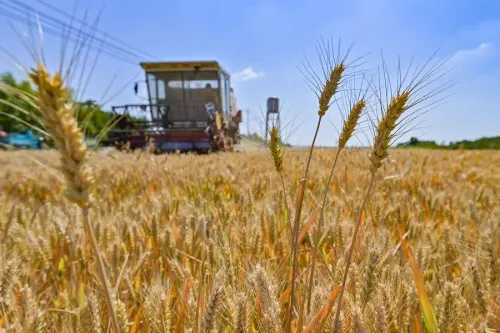
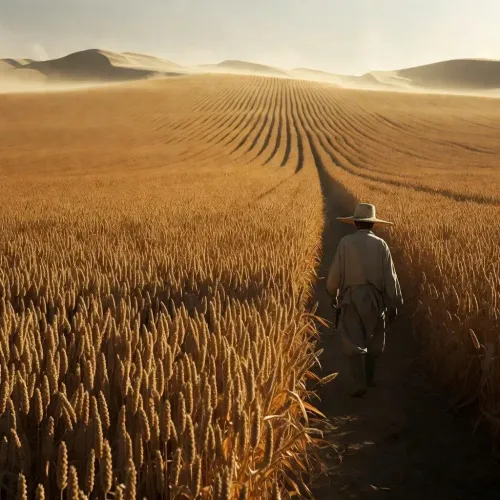
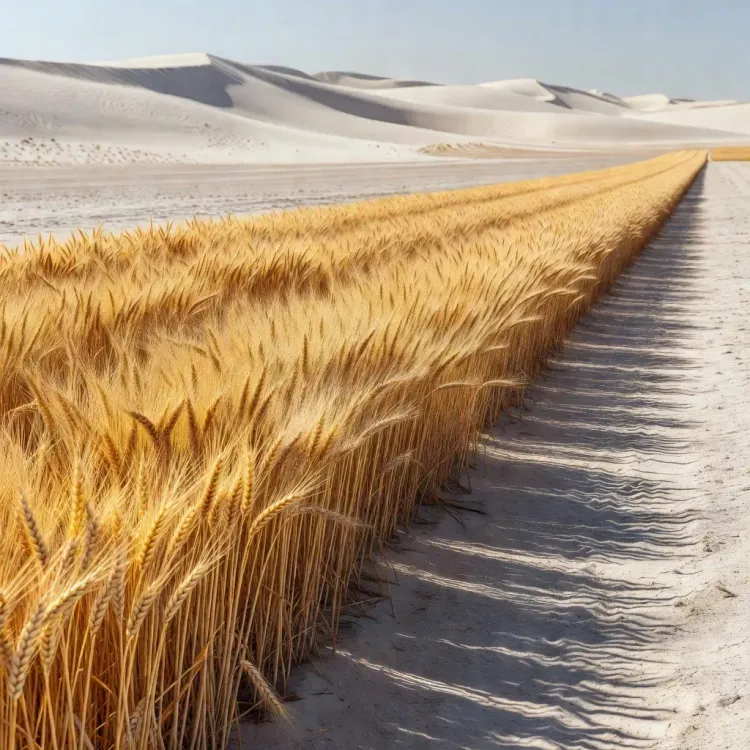
Jingmai 189 wheat yielded 768 kg per mu ( 11.5 tonnes per hectare ) on a heavily saline desert plot in Makit county, Taklamakan Desert .
The result is nearly double China's 2025 national average wheat yield of 399.2 kg per mu .
The variety was developed by the Beijing Academy of Agriculture and Forestry Sciences' Institute of Hybrid Wheat Research to tolerate drought, saline soil, and poor nutrients.
Trial cultivation of Jingmai 189 has already begun in Belt and Road Initiative countries Pakistan and Uzbekistan .
The institute announced results on June 23, 2026 ; a spokesman called the outcome 'totally beyond our expectations' on June 26 .
Independent verification and details on water and energy inputs for the managed plot have not yet been disclosed publicly.
China's Taklamakan Desert has yielded a wheat harvest of 768 kg per mu — nearly double the 2025 national average of 399.2 kg per mu — in a managed demonstration plot, the Beijing Academy of Agriculture and Forestry Sciences announced on June 23, 2026. The result, described by project officials as far exceeding expectations, signals a potential breakthrough in cultivating hyper-arid and saline land for food production.
The variety behind the record
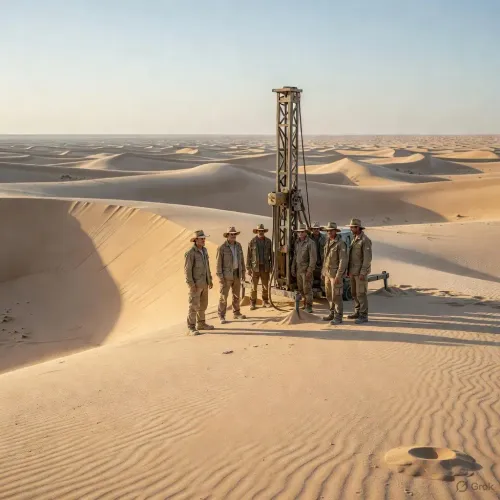
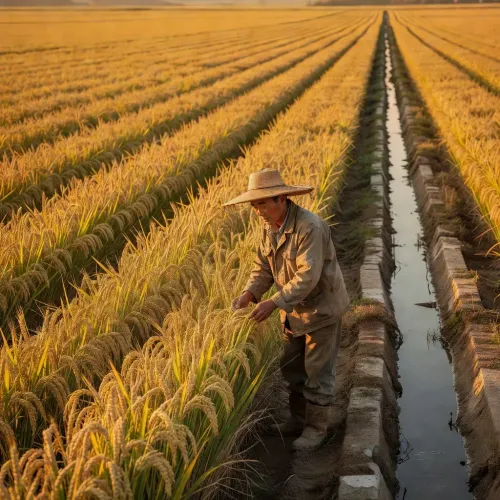
The wheat cultivar, Jingmai 189, was bred by the academy's Institute of Hybrid Wheat Research specifically to survive drought, saline soil, and nutrient-depleted terrain. The demonstration plot was located on heavily saline land in Makit county, deep within the Taklamakan Desert of western China. The controlled trial converted what would ordinarily be considered uncultivable terrain into farmland producing roughly 11.5 tonnes per hectare (10,278 lbs per acre).
Why it matters
'It was totally beyond our expectations,' an institute spokesman said on June 26. The yield gap — nearly 2x the national benchmark — is significant because it was achieved not on optimised agricultural land but on one of the world's most forbidding desert landscapes. If replicable at scale, the model could reshape how China and other arid nations think about food security and land use.
The competitive backdrop
The announcement arrives as governments and agricultural institutions worldwide race to expand productive farmland against a backdrop of accelerating desertification, shrinking arable land, and mounting climate pressures. China, home to roughly 18% of the world's population but only about 7% of its arable land, has particular strategic incentive to unlock marginal terrain. The Taklamakan, spanning more than 337,000 sq km, represents one of the largest untapped land reserves in the country.
Belt and Road reach
According to the institute, Jingmai 189's 'breeding technology was internationally competitive,' and trial cultivation has already begun in Belt and Road Initiative partner countries including Pakistan and Uzbekistan — both nations that contend with significant arid and semi-arid agricultural challenges. The international rollout suggests Beijing sees the variety as a diplomatic and agricultural export, not merely a domestic solution.
What's next
The institute has not disclosed a timeline for commercial-scale deployment within the Taklamakan or a broader expansion plan. Key variables — including the energy and water inputs required to sustain yields on managed desert plots — remain undisclosed, and independent verification of the trial results has not yet been reported. Observers will be watching whether the yields hold across larger, less intensively managed plots, and whether Pakistan and Uzbekistan trials produce comparable results.
Point of View
Beijing is quietly embedding agricultural dependency into its Belt and Road infrastructure, a softer but durable form of influence that mainstream coverage tends to underweight. The headline yield figure is striking, but the critical unknowns — irrigation volumes, soil amendment costs, and energy inputs on a managed demonstration plot — have not been disclosed, meaning the commercial viability case is still unproven. Desert farming breakthroughs have historically struggled to survive the transition from controlled trials to large-scale deployment, and this result warrants scrutiny before it is read as a scalable solution to China's arable land constraints. Still, even partial success across the Taklamakan's 337,000 sq km would materially alter global food security calculus at a moment when climate stress is compressing productive land elsewhere.
NationPress
1 Oct 2026
Frequently Asked Questions
What is Jingmai 189 and why is it significant?
Jingmai 189 is a hybrid wheat variety developed by the Beijing Academy of Agriculture and Forestry Sciences to grow in drought-prone, saline, and nutrient-poor soils. It is significant because a trial in the Taklamakan Desert produced 768 kg per mu — nearly double China's 2025 national average of 399.2 kg per mu .
Where was the Taklamakan Desert wheat trial conducted?
The demonstration plot was located in Makit county within the Taklamakan Desert in western China . The plot was described as heavily saline and managed specifically for the trial.
Is China exporting this wheat technology to other countries?
Yes. According to the Institute of Hybrid Wheat Research , trial cultivation of Jingmai 189 has already begun in Belt and Road Initiative partner countries Pakistan and Uzbekistan , both of which face significant arid-land agricultural challenges.
What are the limitations of the desert wheat trial?
The trial was conducted on a controlled, heavily managed demonstration plot, and key inputs such as water usage and soil amendment costs have not been publicly disclosed. Independent verification of the yield figures has not yet been reported, making it premature to project commercial-scale viability.
Why does China want to farm desert land?
China holds roughly 7% of the world's arable land while feeding approximately 18% of the global population, creating strong strategic pressure to unlock marginal terrain. Accelerating desertification and climate change are further shrinking productive land globally, making desert-farming research a food-security priority.