Fuyao Glass bets on AI and robotics at 90% automated Anhui plant

Synopsis
Fuyao Glass, the Chinese auto-glass giant supplying Tesla, GM, Ford and BMW, has unveiled a 90% automated AI-robotics factory in Anhui — and its chairman just sat next to Elon Musk at a US-China state banquet, spotlighting the company's rising geopolitical and industrial clout.
Key Takeaways
Fuyao Glass Industry Group commands an estimated 35 per cent of the global automotive glass market, supplying Tesla , General Motors , Ford , and BMW .
The company's new plant in Hefei, Anhui province — construction started 2024 , production began 2025 — operates at a claimed 90 per cent automation rate.
Chairman Cao Hui was seated next to Tesla CEO Elon Musk at a US-China state banquet last week, alongside the heads of Lenovo , Xiaomi , and ByteDance .
Vice-president Huang Xianqian confirmed the Anhui facility will serve as the blueprint for upgrading Fuyao 's existing factories globally.
Fuyao was founded in 1987 and gained global fame as the subject of the 2019 Oscar-winning documentary American Factory .
Fuyao Glass Industry Group, the Chinese automotive glass manufacturer that controls an estimated 35 per cent of the global market, is deploying robotics and artificial intelligence across a flagship smart factory in Hefei, Anhui province, as it deepens ties with the world's top carmakers including Tesla. The company drew fresh international attention last week when chairman Cao Hui was seated next to Tesla CEO Elon Musk at a US-China state banquet, alongside the chiefs of Lenovo, Xiaomi, and ByteDance.
Inside the smart factory
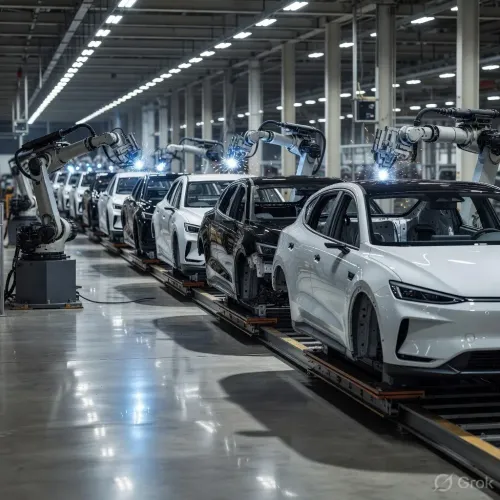
The Hefei plant, which broke ground in 2024 and began producing automotive glass just one year later, is now the technological benchmark for Fuyao's entire manufacturing network. Bright orange robotic arms and automated guided vehicles move heavy glass panes through a production line the company claims is 90 per cent automated — fully hands-off at every stage except one intermediate step.
The facility stands as a sharp contrast to the high-profile diplomacy surrounding Cao Hui's appearance at the state dinner, yet it signals the same strategic ambition: positioning Fuyao as an indispensable partner to global automakers at a time of intense competition in automotive supply chains.
What the company says
Huang Xianqian, vice-president of Fuyao, outlined the company's roadmap at a media briefing on Tuesday, 20 May 2026. 'Every time we build a new factory, we summarise and build upon our past experiences,' he said. 'This Anhui plant is superior to our older facilities in terms of automation and intelligence. Our next step is to take the lessons learned here and feed them back into our existing factories to continuously boost productivity.'
The competitive backdrop
Founded in 1987, Fuyao has spent nearly four decades refining automotive glass manufacturing, rising to supply industry heavyweights including General Motors, Ford, and BMW. The company first gained global visibility as the subject of the 2019 Oscar-winning documentary American Factory, which examined its operations at a plant in Ohio.
Its current push into AI-driven manufacturing reflects a broader trend among Chinese industrial suppliers racing to reduce labour dependency and raise output quality as electric-vehicle demand reshapes procurement priorities worldwide.
Why it matters
The Hefei plant is more than a showcase — it is Fuyao's declared template for retrofitting older facilities, meaning the automation gains demonstrated here are expected to ripple across its global production footprint. With Tesla among its key customers and Cao Hui's seat at a high-stakes diplomatic table, Fuyao is navigating both the technological and geopolitical dimensions of the automotive supply chain simultaneously.
What's next
The company's stated priority is back-integrating the Anhui plant's automation learnings into its legacy factories to drive continuous productivity gains. Investors and automakers alike will be watching whether Fuyao's AI-and-robotics bet translates into measurable cost and quality advantages as the global auto glass market grows more competitive.
Point of View
But the more durable story is structural: a supplier holding 35 per cent of global auto glass supply is now systematically encoding that dominance into robotics and AI, making it harder for rivals to close the gap on cost or quality. This sits squarely within the broader pattern of Chinese industrial champions using domestic smart-manufacturing programmes to insulate themselves from geopolitical friction — if tariffs or trade barriers tighten, a leaner cost base buys resilience. The open question is whether Western automakers, already dependent on Fuyao's scale, will accelerate supplier diversification or deepen the relationship as EV glass complexity grows.
NationPress
21 Sept 2026
Frequently Asked Questions
What is Fuyao Glass and why is it in the news?
Fuyao Glass Industry Group is a Chinese automotive glass manufacturer founded in 1987 that supplies roughly 35 per cent of the global auto glass market. It returned to international headlines after chairman Cao Hui was seated next to Tesla CEO Elon Musk at a US-China state banquet, and following a media tour of its new AI-driven smart factory in Anhui province .
How automated is Fuyao's new Anhui factory?
The Hefei, Anhui plant operates at a claimed 90 per cent automation rate, meaning only one intermediate production step still requires human involvement. The facility uses bright orange robotic arms and automated guided vehicles to handle heavy automotive glass panes throughout the production process.
Why was Fuyao's chairman at the US-China state banquet with Elon Musk?
Cao Hui , chairman of Fuyao Glass , was among a select group of Chinese technology and industrial leaders invited to the US-China state banquet, seated alongside Elon Musk and the chiefs of Lenovo , Xiaomi , and ByteDance . The seating reflects Fuyao 's status as a critical global supplier to major automakers including Tesla .
Which major carmakers does Fuyao Glass supply?
Fuyao Glass supplies automotive glass to a broad roster of global manufacturers including Tesla , General Motors , Ford , and BMW . The company holds an estimated 35 per cent share of the global automotive glass market.
What is Fuyao's plan for its older factories?
Vice-president Huang Xianqian said the company intends to feed the automation and AI lessons from the new Anhui plant back into its existing facilities worldwide. The goal is to continuously boost productivity across Fuyao 's entire manufacturing network using the Hefei plant as the template.