Nandan Nilekani: India can be AI use-case capital of the world
Synopsis
Nandan Nilekani’s argument at NCAER 2026 is a quiet but pointed challenge to India’s AI policy instincts: stop chasing frontier models, start dominating applications. With DPI as the launchpad and 1.5 lakh startups already in play, he sees a credible path to India becoming the world’s AI use-case capital — if it rethinks jobs, portable benefits, and who actually builds the next economy.
Key Takeaways
Nandan Nilekani spoke at the NCAER India Policy Forum 2026 in New Delhi on 6 August 2026 .
He argued India should lead AI’s application layer , not compete on chips or large language models.
India’s digital public infrastructure (DPI) — Aadhaar, UPI — provides the foundation for AI deployment at scale.
India has grown from fewer than 10,000 startups a decade ago to around 1.5 lakh today; Nilekani projects over 10 lakh startups by 2035 at 20% annual growth .
He called for portable social security — pensions, insurance, healthcare — that moves with workers across jobs and gig work.
The government recently appointed Nilekani to lead a task force on reforming India’s examination and testing systems .
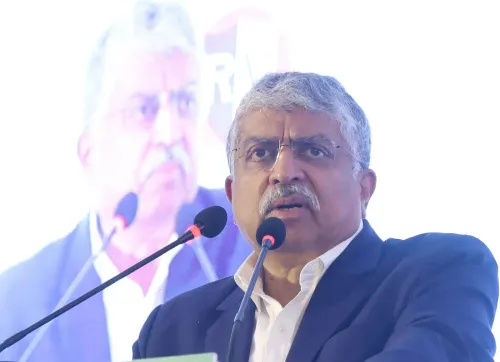
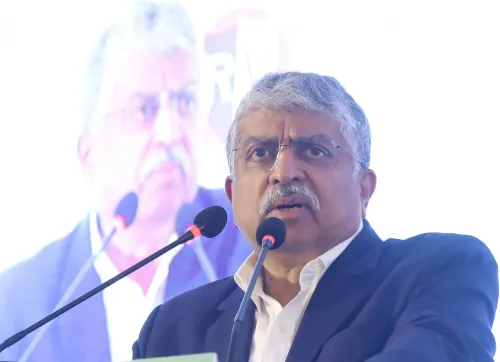
Nandan Nilekani, co-founder of Infosys and head of India's national examination and testing task force, said on Thursday, 6 August 2026 that India is positioned to lead the next phase of the global artificial intelligence revolution — not by chasing chips or large language models, but by building real-world applications at population scale. He was speaking at the NCAER India Policy Forum 2026 in New Delhi.
The Application Layer Argument
Nilekani argued that the centre of gravity in AI is shifting away from infrastructure. “The Western focus on AI is on infrastructure like larger models, more chips, more data centres. But infrastructure eventually gets commoditised. The value shifts to the application layer, and India can become the AI use-case capital of the world,” he said.
This is a significant reframing of India’s AI ambitions. Rather than competing with the United States or China on frontier model development — a race that demands massive capital and compute — Nilekani sees India’s competitive edge in deploying AI across agriculture, healthcare, and education at a scale few other nations can match.
Digital Public Infrastructure as the Foundation
India’s decade-long investment in digital public infrastructure (DPI) — from Aadhaar to UPI — gives it a structural head start, according to Nilekani. He said this existing stack provides a ready foundation for AI deployment across sectors, particularly when combined with Indian-language interfaces and voice-based access that can reach citizens beyond the English-speaking urban tier.
Notably, this positions India’s AI strategy as an extension of its DPI playbook rather than a departure from it — a continuity that could prove decisive in execution.
Startups, Jobs, and the Future of Work
Nilekani highlighted that India has grown from fewer than 10,000 startups a decade ago to approximately 1.5 lakh today. If the ecosystem sustains its current growth rate of around 20 per cent annually, India could cross 10 lakh startups by 2035, he projected.
However, he cautioned that the nature of job creation in the AI era will look fundamentally different. Large organisations with structured processes are, he argued, more exposed to automation. Smaller enterprises are likely to be the primary engines of employment. “We have to rethink how jobs get created. It may not be one company employing a million people, but a million companies employing one person each,” he said.
The Case for Portable Social Security
On labour market reform, Nilekani called for a structural overhaul of how social security is delivered. He said India needs portable benefits — covering pensions, insurance, and healthcare — that travel with workers across employers, gig assignments, and entrepreneurial stints. This comes amid growing recognition that India’s existing social security architecture was designed for a formal, salaried workforce that no longer represents the majority of working Indians.
Nilekani’s Broader Role
The remarks carry added weight given that the government recently appointed Nilekani to lead a high-powered task force on reforming India’s examination and testing systems. His dual role — as a technology architect and a policy principal — makes his AI outlook both a vision statement and, potentially, a blueprint for state action. How quickly India’s policy apparatus translates this application-first framing into funded programmes will be the real test.
Point of View
With most value concentrated in a few dozen firms. The portable social security call is the most underreported and arguably most urgent part of his remarks — without it, AI-era job fragmentation becomes a welfare crisis, not an opportunity.
NationPress
6 Aug 2026
Frequently Asked Questions
What did Nandan Nilekani say about India and AI at NCAER 2026?
Nilekani said India should position itself as the world’s AI use-case capital by building real-world applications at scale, rather than competing in the race for advanced chips or large language models. He made these remarks at the NCAER India Policy Forum 2026 in New Delhi on 6 August 2026.
Why does Nilekani believe India has an AI advantage?
He pointed to India’s established digital public infrastructure — including Aadhaar and UPI — as a ready foundation for AI deployment across agriculture, healthcare, and education. He also highlighted the importance of Indian-language and voice-based interfaces for reaching citizens at population scale.
What is Nilekani’s projection for India’s startup ecosystem?
Nilekani said India has grown from fewer than 10,000 startups a decade ago to around 1.5 lakh today. If the ecosystem sustains approximately 20 per cent annual growth, India could have more than 10 lakh startups by 2035.
How does Nilekani say AI will change job creation in India?
He argued that large, structured organisations are more vulnerable to automation, making smaller enterprises the likely primary job creators in the AI era. He summarised this as potentially ‘a million companies employing one person each’ rather than a single company employing a million.
What labour reforms did Nilekani call for?
Nilekani called for portable social security benefits — covering pensions, insurance, and healthcare — that remain with workers as they move between employers, gig work, and entrepreneurship. He framed this as essential to managing the workforce disruption that AI-driven automation will accelerate.