McDonald's and Meituan launch China's first brand-exclusive drone delivery route in Shanghai
Synopsis
McDonald's and Meituan have launched China's first catering brand-exclusive drone-delivery route along Shanghai's West Bund, covering 3.1km with drones carrying up to 2.4kg and delivering orders in as little as 10 minutes — a potential template for urban aerial food logistics nationwide.
Key Takeaways
McDonald's and Meituan have launched China's first catering brand-exclusive drone-delivery route, commencing operations last week in Shanghai's Xuhui district .
The flight path spans 3.1 kilometres (1.93 miles) , originating from a McDonald's restaurant in Xuhui and serving office workers and tourists along the West Bund waterfront.
Drones on the route support a maximum payload of 2.4 kilograms (5.29 lbs) and can complete deliveries in as fast as 10 minutes , according to Meituan .
District authorities in Xuhui confirmed the route, signalling active local government support for low-altitude commercial logistics.
The launch intensifies competition with drone-delivery rivals including JD.com and Alibaba Group Holding -backed platforms across China .
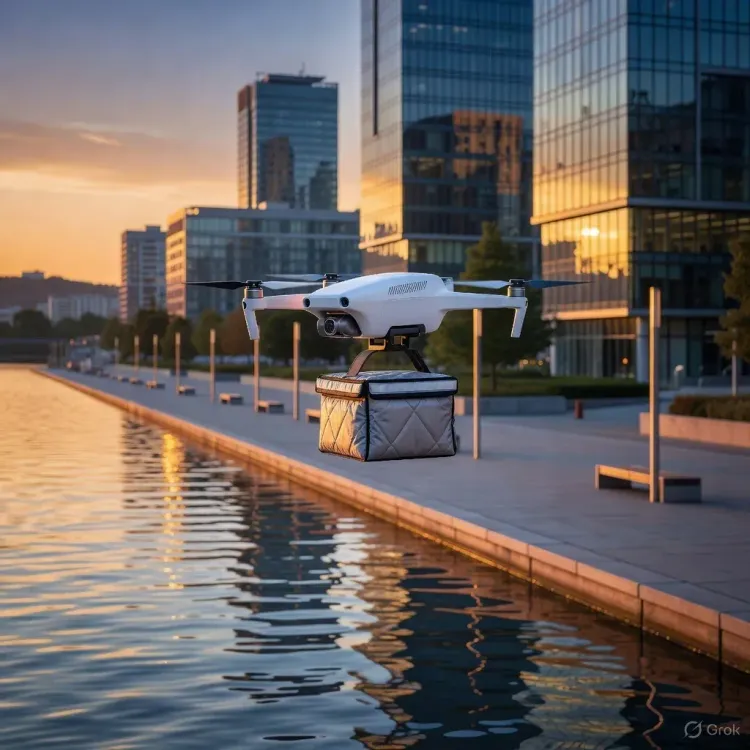
McDonald's and Chinese food-delivery platform Meituan have jointly launched China's first catering brand-exclusive drone-delivery route, operating along the scenic West Bund waterfront in Shanghai's Xuhui district. The service, which commenced operations last week, marks a significant step in urban aerial logistics, enabling fast-food orders to be airdropped directly to designated kiosks along one of the city's most frequented riverside corridors.
How the drone route works
The 3.1-kilometre (1.93-mile) flight path originates from a McDonald's restaurant in Xuhui and is engineered to serve the area's dense population of office workers as well as the large tourist crowds that frequent the riverside promenade, according to a statement by district authorities. Customised drones deployed on the route can carry a maximum payload of 2.4 kilograms (5.29 lbs) and complete waterfront deliveries in as little as 10 minutes, according to an official Meituan statement.Why it matters
The launch represents a convergence of two powerful trends reshaping urban commerce in China: the rapid scaling of drone-delivery infrastructure and the growing appetite among global fast-food chains to integrate with hyperlocal tech platforms. By anchoring the route exclusively to a single catering brand, the partnership sets a replicable template that other restaurant chains and delivery operators could adopt across major Chinese cities. The West Bund corridor, known for its high foot traffic and open airspace, provides an ideal operational environment for demonstrating commercial drone viability.The competitive backdrop
The move intensifies rivalry in China's drone-delivery sector, where Meituan competes directly with JD.com and platforms backed by Alibaba Group Holding, all of which have been aggressively expanding low-altitude logistics networks. Shenzhen has historically led drone-delivery trials in China, making Shanghai's Xuhui district a notable new frontier for commercial aerial food delivery at scale. Regulatory support from local district authorities, who issued the route statement, signals continued government backing for low-altitude economy initiatives.What's next
The success of the Xuhui pilot is likely to determine how quickly Meituan and McDonald's expand the model to other high-density urban zones across China. Industry analysts have noted that brand-exclusive drone corridors could become a premium tier within food-delivery ecosystems, commanding higher margins and deeper brand integrations. Observers will be watching whether competing platforms accelerate their own fast-food drone partnerships in response.Point of View
Where platform dominance is being carved out route by route before national regulations fully crystallise. What mainstream coverage underplays is the brand-exclusivity structure: by tying a dedicated flight path to a single fast-food chain, Meituan is effectively monetising airspace as a premium product category, not just a delivery mechanism. This mirrors the playbook seen in cloud computing, where anchor enterprise clients legitimise infrastructure before it scales to mass-market use. The real question is whether municipal governments beyond Xuhui will grant similar corridor approvals at speed, or whether regulatory friction becomes the binding constraint on the model's national rollout.
NationPress
16 Sept 2026
Frequently Asked Questions
What is the McDonald's and Meituan drone delivery route in Shanghai?
McDonald's and Meituan have launched China's first catering brand-exclusive drone-delivery route along the West Bund waterfront in Shanghai's Xuhui district . The 3.1-kilometre route allows customers to order fast food and receive it via drone at designated kiosks in as little as 10 minutes .
When did the Meituan McDonald's drone delivery service start?
The service commenced operations last week, according to a statement by Xuhui district authorities issued in September 2026 . It is described as the first drone-delivery route exclusively dedicated to a single catering brand in China .
How far and how fast do the drones deliver food in Shanghai?
The drones operate along a 3.1-kilometre (1.93-mile) flight path and can complete deliveries in as fast as 10 minutes , according to an official Meituan statement. Each drone supports a maximum payload of 2.4 kilograms (5.29 lbs) .
Who are Meituan's main competitors in China's drone delivery market?
Meituan competes primarily with JD.com and platforms affiliated with Alibaba Group Holding in China's drone-delivery sector. All three have been expanding low-altitude logistics networks, with Shenzhen historically serving as the main testing ground before Shanghai emerged as a new frontier.
Why is the West Bund in Shanghai significant for drone delivery?
The West Bund area in Xuhui district is a high-traffic riverside corridor frequented by large numbers of office workers and tourists, making it an ideal environment for commercial drone operations. Its open airspace and concentration of potential customers provide optimal conditions for demonstrating the viability of urban aerial food delivery at scale.