Nvidia CEO Jensen Huang: AI Shift Is Biggest in 60 Years

Synopsis
Nvidia CEO Jensen Huang, addressing Sequoia Capital, declared computing is undergoing its biggest shift in 60 years — from retrieval to generation — framing generative AI as a multi-trillion-dollar, five-layer ecosystem opportunity with global implications for developers, investors, and governments.
Key Takeaways
Nvidia called the move from retrieval-based to generative computing the biggest shift in 60 years .
CEO Jensen Huang addressed the remarks to venture firm Sequoia Capital , signalling a joint ecosystem narrative for investors.
The company described the opportunity as spanning a ' five-layer AI cake ecosystem ' worth multiple trillions of dollars.
Nvidia's CUDA platform, launched in 2006 , is the two-decade foundation underpinning today's generative AI infrastructure dominance.
The thesis has direct relevance for India's national AI mission and sovereign compute strategies globally.
Upcoming GTC developer conference and earnings releases are the next milestones to watch for ecosystem metrics.
Chip giant Nvidia on Saturday, 13 June 2026 declared that computing is undergoing its biggest transformation in six decades, with the company's chief executive Jensen Huang framing the global move from retrieval-based to generative systems as a multi-trillion-dollar opportunity spanning a five-layer AI ecosystem.
Context
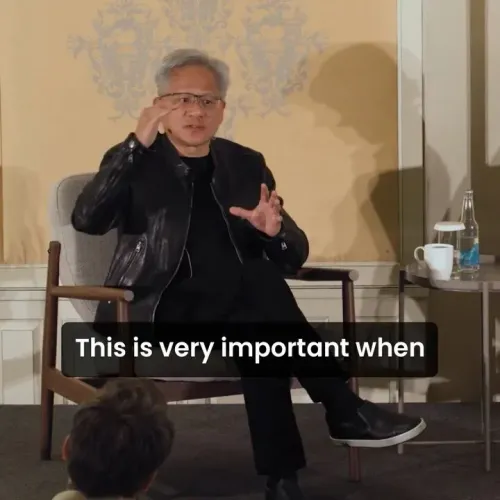
In a post directed at venture firm Sequoia Capital, Nvidia's official account quoted Huang explaining the structural shift in how computers process and produce information. 'Computing is undergoing its biggest shift in 60 years,' the post stated, adding that the world is 'moving from retrieval to generation — expanding what humanity can build, discover, and solve.' The post referenced a video address by Huang, the details of which were shared in the exchange with Sequoia.
The retrieval-to-generation framing captures a fundamental change: earlier computing paradigms stored and fetched existing data, while generative AI systems synthesise new content, code, drug compounds, and more. This distinction is central to Nvidia's positioning as the dominant supplier of the specialised chips that power generative workloads.
Policy Backdrop
Nvidia's journey to this moment stretches back two decades. The company introduced its CUDA parallel-computing platform in 2006, enabling its graphics processors to handle general-purpose scientific and machine-learning workloads far beyond their original gaming purpose. That early bet laid the infrastructure foundation for today's large-language-model training pipelines.
The generative AI wave accelerated sharply after late 2022, when publicly available large language models demonstrated mass-market capability, triggering a surge in data-centre investment by hyperscale cloud providers globally. Nvidia's data-centre revenue has since become the dominant share of its overall business, displacing gaming as the company's core growth engine.
Governments and sovereign wealth funds — including in India, the United States, and across the Gulf — have begun treating AI compute infrastructure as a strategic national asset, further amplifying demand for the hardware stack Nvidia leads.
Stakeholders and Impact
The 'five-layer AI cake ecosystem' framing referenced in the post — though its precise layer-by-layer composition has not been formally published — signals Nvidia's intent to map value creation across the full stack: from silicon and networking, through cloud infrastructure, platforms, applications, and end-user services. Each layer, in Nvidia's telling, represents an independent but compounding market opportunity.
Sequoia Capital, the addressee of the post, is among the most active venture investors in AI startups that depend on Nvidia hardware. The pairing of a chip-infrastructure giant with a top-tier venture firm to articulate a 'multi-trillion-dollar' thesis is itself a signal to capital allocators globally — including India's fast-growing startup and deep-tech investment community — about where the next decade of value creation is expected to concentrate.
For Indian AI developers, semiconductor policy planners, and enterprise technology buyers, the shift Huang describes has direct implications. India's national AI mission and its push to build domestic GPU capacity are downstream bets on exactly the generational transition Nvidia is describing.
What's Next
Nvidia's next earnings release and its annual GTC developer conference are expected to provide more granular metrics on ecosystem growth across the five layers. Regulatory scrutiny of AI chip exports — particularly US government controls on advanced GPU sales to certain markets — remains a live variable that could reshape supply chains.
As generative AI moves from research novelty to industrial infrastructure, the multi-trillion-dollar framing Huang offered to Sequoia is likely to become a benchmark against which quarterly results, venture funding rounds, and national technology strategies are measured for years ahead.
Point of View
The company is positioning itself not merely as a chip supplier but as the defining infrastructure layer of a new computing era. For India, where the government is actively building sovereign AI compute capacity and courting Nvidia partnerships, this framing raises the strategic stakes of every GPU procurement and data-centre policy decision. The retrieval-to-generation thesis, if it holds, suggests that nations and enterprises still optimised for search and database architectures face a structural competitiveness gap that only accelerated capital deployment can close.
NationPress
13 Sept 2026
Frequently Asked Questions
What did Nvidia's Jensen Huang say about the AI computing shift?
Jensen Huang said computing is undergoing its biggest shift in 60 years, moving from retrieval-based systems to generative AI, which he described as a multi-trillion-dollar opportunity across a five-layer AI ecosystem.
What is the 'five-layer AI cake ecosystem' Nvidia mentioned?
Nvidia referenced a 'five-layer AI cake ecosystem' to describe the full generative AI value chain — spanning hardware, infrastructure, platforms, applications, and services — though the company has not published a formal breakdown of each layer.
Why is Nvidia's generative AI shift relevant to India?
India's national AI mission and its push for domestic GPU and data-centre capacity are directly tied to the generative AI infrastructure wave Nvidia is describing; Indian developers, cloud providers, and policy planners are key stakeholders in this transition.
What is Sequoia Capital's connection to Nvidia?
Sequoia Capital is a leading Silicon Valley venture firm that backs numerous AI startups reliant on Nvidia hardware; Nvidia addressed the generative AI opportunity post directly to Sequoia, signalling a shared ecosystem narrative for investors.
When did Nvidia's shift from gaming to AI infrastructure begin?
Nvidia's pivot began in earnest with the launch of its CUDA parallel-computing platform in 2006, which allowed its GPUs to handle scientific and machine-learning workloads, laying the foundation for today's generative AI dominance.