Nvidia Claims 5x Lower AI Token Cost via Software Alone
Synopsis
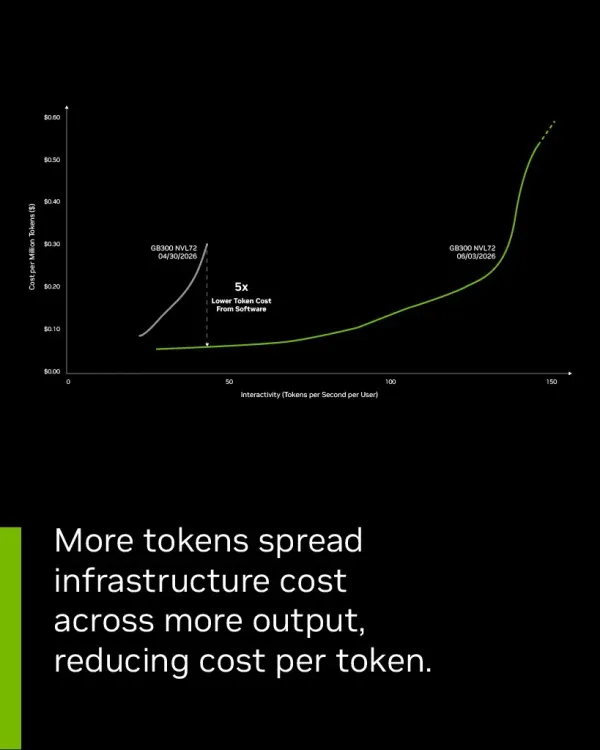
Nvidia's official X account claimed on 13 July 2026 that software optimisations on existing hardware have delivered a 5x reduction in AI token costs within a single month — a development that could reshape inference economics for cloud providers and AI developers globally.
Key Takeaways
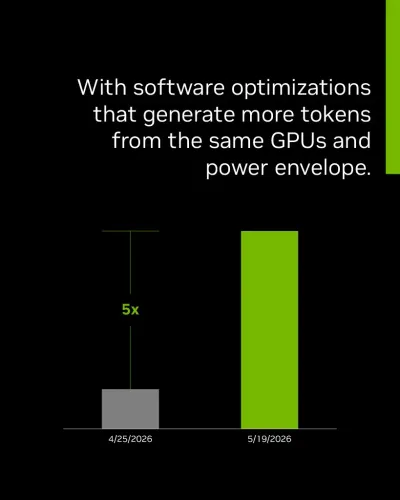
Nvidia's official X account claimed a 5x reduction in AI token costs achieved through software optimisations in one month .
The gains were stated to be on existing hardware , requiring no new GPU purchases.
The claim aligns with Nvidia's history of shipping inference-library updates — including TensorRT and CUDA — that raise throughput on current GPU fleets.
Cloud providers and AI developers are the primary stakeholders positioned to benefit from reduced inference operating costs.
Independent benchmark validation will be essential before the industry treats the 5x figure as a confirmed baseline.
The announcement reinforces Nvidia's full-stack strategy , where software tooling extends the value of hardware beyond the initial purchase.
Chip giant Nvidia announced on Monday, 13 July 2026 that token costs for AI inference have fallen by a factor of five through software optimisations alone — achieved within a single month and on the same underlying hardware, according to a post on the company's official X account.
Context
Nvidia's post states plainly: 'That's 5x lower token cost from software in just one month — on the same hardware.' The claim, if borne out, would represent a significant leap in the economics of running large language models and other generative AI workloads. Token cost — the price of processing each unit of text through an AI model — is a primary operating expense for cloud providers and AI developers worldwide.
The announcement points to software-layer gains rather than a new chip generation, underscoring that efficiency improvements need not wait for the next silicon cycle. Nvidia has a history of shipping inference-library updates — including successive versions of TensorRT and CUDA — that have meaningfully raised throughput on existing GPU fleets in prior years.
Policy Backdrop
The AI infrastructure landscape has intensified pressure on compute costs as enterprises scale generative AI deployments. Reducing token costs directly affects the commercial viability of AI-powered products, from enterprise chatbots to autonomous coding assistants. Nvidia's full-stack strategy — pairing its GPUs with proprietary software tooling — has been central to its dominance in the data-centre market.
Competitors in the GPU and AI-accelerator space have sought to challenge Nvidia on both silicon performance and software ecosystems. A software-driven 5x cost reduction on existing hardware, if validated by independent benchmarks, would raise the competitive bar without requiring customers to upgrade physical infrastructure.
Stakeholders and Impact
AI developers and cloud providers stand to benefit most directly. Lower token costs translate into reduced inference bills, enabling broader deployment of AI features at lower margins or higher volumes. Startups building on top of cloud GPU capacity could see their unit economics improve substantially if the gains are passed through by hyperscalers.
For enterprises running on-premise Nvidia hardware, the implication is that existing capital expenditure on GPU clusters could yield significantly more AI throughput without additional hardware spend. This dynamic reinforces Nvidia's argument that its platform value extends well beyond the initial chip purchase.
What's Next
Independent enterprise benchmark reports on token economics will be critical to validating the scale of the claimed improvement. The AI developer community will be watching closely for technical documentation and reproducible results tied to the software release Nvidia referenced in its post.
Nvidia's next round of software releases and any accompanying performance disclosures will set the benchmark against which rivals must respond. The pace of software-driven efficiency gains is fast becoming as strategically important as the hardware roadmap itself.
Point of View
A narrative that strengthens its full-stack platform argument. If independently validated, it pressures rivals to accelerate their own software tooling rather than relying solely on next-generation silicon to compete on cost. For Indian cloud and AI startups, lower inference costs could meaningfully improve unit economics at a time when the government is pushing domestic AI adoption. The announcement also signals that the competitive frontier in AI infrastructure is shifting as much to software libraries and compilers as to chip design.
NationPress
14 Jul 2026
Frequently Asked Questions
What did Nvidia announce about AI token costs?
Nvidia announced on 13 July 2026 that software optimisations on its existing hardware have reduced AI token costs by five times within a single month, with no new GPU required.
What is a token cost in AI?
Token cost refers to the expense of processing each unit of text — called a token — through an AI model during inference. It is a key metric for cloud providers and developers running large language models at scale.
How did Nvidia achieve the 5x token cost reduction?
Nvidia attributed the reduction to software optimisations alone, consistent with its history of releasing updates to inference libraries such as TensorRT and CUDA that improve throughput on existing GPUs.
Who benefits from lower AI token costs?
AI developers, cloud providers, and enterprises running on-premise GPU clusters all benefit, as lower token costs reduce operating expenses and can make AI-powered products commercially viable at greater scale.
Does this mean users need to buy new Nvidia hardware?
No. Nvidia specifically stated the cost reduction was achieved 'on the same hardware,' meaning existing GPU deployments can benefit from the software update without new capital expenditure.