Nvidia GB300 NVL72 Targets Production AI Inference at Scale
Synopsis
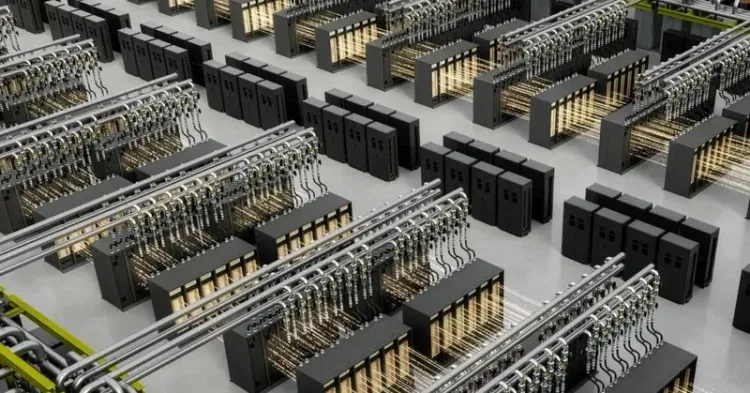
Nvidia on 14 July 2026 highlighted its GB300 NVL72 rack-scale system as delivering industry-leading performance per watt and the lowest token cost for production inference, targeting AI labs and enterprises scaling live AI workloads beyond the benchmarking stage.
Key Takeaways
Nvidia promoted the GB300 NVL72 on 14 July 2026 as its flagship production inference platform.
The system is built on Nvidia's Blackwell architecture, succeeding the GB200 NVL72 introduced in 2024 .
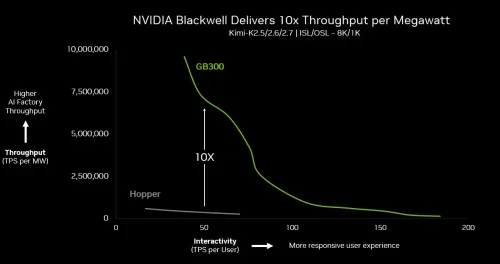
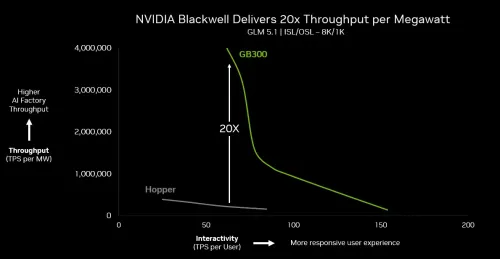
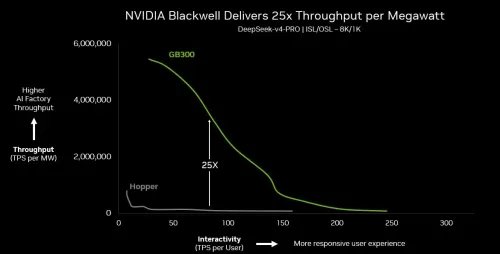
Nvidia claims 'industry-leading performance per watt,' directly addressing data-centre energy efficiency concerns.
The primary audience is leading AI labs and enterprises moving inference from benchmarking into revenue-generating production.
Low token cost is positioned as a key lever for improving profit margins in AI service deployment.
Customer adoption and data-centre revenue figures in upcoming earnings updates will be the key metrics to watch.
Chip giant Nvidia on Tuesday, 14 July 2026 promoted its GB300 NVL72 rack-scale system as an industry-leading solution for production inference workloads, highlighting performance-per-watt efficiency and low token costs as key selling points for AI labs and enterprises.
Context
In its post, Nvidia described the GB300 NVL72 as delivering 'industry-leading performance per watt to maximize revenue and deliver the lowest token cost to improve profit margins.' The company positioned the system as a 'reliable foundation for production inference' suitable for deployment by leading AI labs and large enterprises moving workloads from benchmarking stages into live, revenue-generating environments.
The GB300 NVL72 is a rack-scale system built on Nvidia's Blackwell architecture, the successor to the earlier GB200 NVL72 platform that Nvidia introduced in 2024 for both training and inference at scale. The new designation signals an incremental generational step within the same rack-scale form factor.
Policy Backdrop
The announcement sits within a broader industry shift: as large language models and generative AI services mature, the centre of gravity in AI infrastructure spending is moving from model training toward inference — the compute-intensive process of serving model outputs to end users in real time.
Energy efficiency has become a central competitive axis in this segment. Data-centre operators and cloud providers face mounting pressure from regulators, investors, and electricity grids to reduce power consumption per unit of useful output. Nvidia's emphasis on performance per watt and token cost directly addresses those concerns, framing the GB300 NVL72 as a tool for improving the economics of AI deployment rather than raw speed alone.
Stakeholders and Impact
AI labs running large inference fleets stand to benefit most immediately if the system's efficiency claims hold in production. For these organisations, token cost — the expense of generating each unit of model output — is a direct input into pricing and margin calculations, making hardware efficiency a commercial priority.
Enterprises deploying AI at scale, from financial services to healthcare and manufacturing, are the secondary audience. For them, the promise of a 'reliable foundation' matters as much as raw performance: production inference demands consistent latency and uptime, not just peak benchmark numbers. Nvidia's framing of the GB300 NVL72 as a proven, benchmark-to-production system is aimed squarely at reducing procurement risk for these buyers.
The announcement also intensifies competitive pressure on rivals in the AI accelerator market, where multiple chip designers and cloud providers are racing to offer lower cost-per-token solutions for inference workloads.
What's Next
Market observers will watch for customer adoption disclosures in Nvidia's upcoming earnings updates, where data-centre revenue figures and hyperscaler order volumes typically signal real-world uptake of new platforms. Analyst attention will also focus on whether the GB300 NVL72's efficiency gains translate into measurable reductions in total cost of ownership for early enterprise adopters.
As the AI infrastructure market matures, Nvidia's ability to hold its dominant position will increasingly depend on demonstrating production-grade reliability and energy economics — not just benchmark leadership — making the GB300 NVL72's real-world deployment record a key indicator to track through the remainder of 2026.
Point of View
Higher-margin choice for inference at scale. In the broader arc of the global AI infrastructure race, this positions Nvidia to defend its dominant data-centre share even as the market transitions from the training-heavy capex cycle of 2023-24 toward an inference-driven revenue model.
NationPress
14 Jul 2026
Frequently Asked Questions
What is the Nvidia GB300 NVL72?
The Nvidia GB300 NVL72 is a rack-scale AI accelerator system built on Nvidia's Blackwell architecture, designed for large-scale production inference workloads. It succeeds the GB200 NVL72 and is marketed for its performance-per-watt efficiency and low token cost.
What does 'token cost' mean in AI hardware?
Token cost refers to the computational expense of generating each unit of output — such as a word or character — from a large language model. Lower token cost means an AI service can serve more queries at lower expense, directly improving profit margins for AI labs and enterprises.
Who is the target customer for the GB300 NVL72?
Nvidia has positioned the GB300 NVL72 for leading AI labs and large enterprises that are moving AI inference workloads from testing and benchmarking into live, revenue-generating production environments.
How does the GB300 NVL72 differ from the GB200 NVL72?
The GB300 NVL72 is an incremental generational update to the GB200 NVL72 within the same Blackwell-based rack-scale form factor. Nvidia introduced the GB200 NVL72 in 2024 for both training and inference; the GB300 variant sharpens the focus on inference efficiency and production reliability.
Why is energy efficiency important in AI chips?
Data centres running large AI models consume significant electricity. Regulators, investors, and grid operators are pressuring operators to reduce power use per unit of output. Higher performance per watt means more AI queries can be served from the same power budget, lowering both costs and environmental impact.