Nvidia Launches Open Secure AI Alliance for AI Safety
Synopsis
Nvidia has launched the Open Secure AI Alliance, an industry coalition to develop open-source security techniques and tools for AI software and autonomous agents. By sharing models, tooling and research, the Alliance aims to widen the pool of defenders against threats like prompt injection and model theft.
Key Takeaways
Nvidia announced the Open Secure AI Alliance on 27 July 2026 to build open-source AI security tools.
The Alliance will share models, tooling, and research across founding member organisations to 'broaden the community of defenders'.
Key threats the coalition targets include prompt injection, model theft, and AI supply-chain vulnerabilities.
The initiative follows the AI Alliance formed in December 2023 by IBM and Meta, continuing the industry shift toward collaborative AI governance.
Indian AI developers and IT firms running workloads on Nvidia infrastructure stand to benefit directly from shared security frameworks.
Technical contributions and reference implementations from founding members are expected to be published openly for community use.
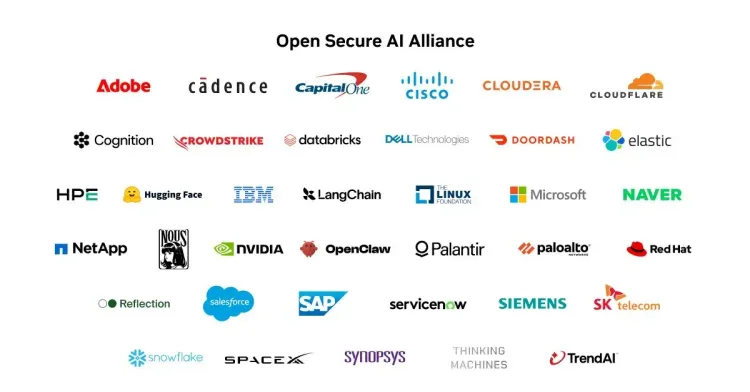
Chip giant Nvidia on Monday, 27 July 2026 announced the formation of the Open Secure AI Alliance, a new industry coalition aimed at developing open-source techniques and tools to protect AI software and autonomous agents. The initiative brings together multiple industry leaders who will share models, tooling, and research to collectively strengthen defences against emerging AI security threats.
Context
In its post, Nvidia stated: 'AI security advances when the industry builds in the open, together.' The company framed the Alliance as a mechanism to 'broaden the community of defenders' by making security research freely accessible rather than proprietary. The founding members are contributing specific techniques and tools, details of which are outlined in a linked technical document.
The announcement comes as autonomous AI agents — software systems that can plan and execute multi-step tasks with minimal human oversight — have proliferated rapidly across enterprise and consumer applications. The expanded attack surface these agents create has made coordinated, open defensive research increasingly urgent for the industry.
Policy Backdrop
The Open Secure AI Alliance follows a pattern established by earlier industry consortia. In December 2023, IBM, Meta, and allied firms formed the AI Alliance to promote open and responsible AI model development, signalling broad industry appetite for collaborative governance outside any single company's control.
Threats that open AI security coalitions aim to address include model theft, prompt injection attacks — where malicious inputs manipulate an AI agent's behaviour — and supply-chain vulnerabilities in AI frameworks. Regulators in the United States, the European Union, and increasingly in India have flagged AI security as a priority area, creating policy tailwinds for industry-led standards bodies.
Stakeholders and Impact
The primary beneficiaries of the Alliance's work will be AI developers, cybersecurity researchers, and cloud infrastructure providers who deploy large-scale AI systems. By pooling defensive research, smaller organisations that lack dedicated AI security teams gain access to tools and reference implementations they could not develop independently.
For India's rapidly expanding AI ecosystem — spanning startups, public-sector digital infrastructure, and large IT services firms — open security tooling carries particular relevance. Indian enterprises increasingly run AI workloads on Nvidia hardware, and any shared security framework Nvidia anchors will directly affect how those deployments are hardened against attack.
The open-source model mirrors earlier collaborative movements in operating systems and cryptography, where shared foundations proved more resilient than proprietary alternatives. Security researchers argue that transparency in defensive tooling does not aid attackers but instead accelerates the identification and patching of vulnerabilities across the entire ecosystem.
What's Next
Observers will watch for the release of specific technical contributions and reference implementations from the Alliance's founding members, as well as potential integration into major AI frameworks such as PyTorch and Hugging Face. Regulatory bodies developing AI safety standards may also look to the Alliance's published research as a baseline for compliance guidance.
As autonomous agents move deeper into critical infrastructure — from financial services to healthcare — the Alliance's ability to deliver actionable, interoperable security tools will determine whether open collaboration can outpace an equally fast-moving threat landscape.
Point of View
Nvidia extends its influence beyond hardware into the software and standards layer — a space that will increasingly shape regulatory conversations in Washington, Brussels, and New Delhi. The open-source framing is deliberate: it lowers barriers for smaller defenders while generating goodwill that proprietary security products cannot. For India, where AI policy is still being codified, an Nvidia-led open standard could quietly become a de facto compliance benchmark before domestic regulators set their own.
NationPress
27 Jul 2026
Frequently Asked Questions
What is the Open Secure AI Alliance announced by Nvidia?
The Open Secure AI Alliance is an industry coalition launched by Nvidia on 27 July 2026 to develop open-source techniques and tools for securing AI software and autonomous agents by sharing models, research, and tooling among its founding members.
Why is Nvidia launching an AI security alliance?
Nvidia says AI security improves when the industry builds defences collectively in the open. The Alliance is designed to widen the pool of security researchers and developers who can contribute to and benefit from shared defensive tools, particularly as autonomous AI agents create new attack surfaces.
Who are the founding members of the Open Secure AI Alliance?
Nvidia has confirmed the Alliance includes multiple industry leaders whose specific contributions are detailed in the official announcement, though a full public list of founding members had not been independently verified at the time of publication.
How does this affect Indian AI developers and companies?
Indian enterprises and startups that run AI workloads on Nvidia hardware will gain access to open security frameworks and reference implementations they may not have the resources to develop independently, strengthening their defences against threats like prompt injection and model theft.
What threats does the Open Secure AI Alliance aim to address?
The Alliance targets key AI security risks including model theft, prompt injection attacks that manipulate agent behaviour, and supply-chain vulnerabilities embedded in AI development frameworks and infrastructure.