Nvidia Metropolis Cuts Vision AI Agent Build Time With 80+ Skills
Synopsis
Nvidia announced on 15 July 2026 that its Metropolis platform now provides 80+ open agent skills covering synthetic data generation, model fine-tuning, and deployment — all via natural-language interfaces — sharply reducing the engineering effort needed to build production-ready vision AI agents.
Key Takeaways
Nvidia Metropolis now offers more than 80 open agent skills for vision AI development and deployment.
The platform covers synthetic data generation, model fine-tuning, application deployment, and real-time analytics in a single suite.
A natural-language interface allows non-specialist operators to configure and deploy vision AI agents without deep ML expertise.
Metropolis was originally launched in 2017 and has been progressively expanded with generative AI tooling since 2023 .
The announcement targets AI developers, enterprise integrators, and smart city operators as primary beneficiaries.
Nvidia's move mirrors a wider industry shift toward integrated, agentic AI platforms from competitors including Intel, Qualcomm, and cloud hyperscalers .
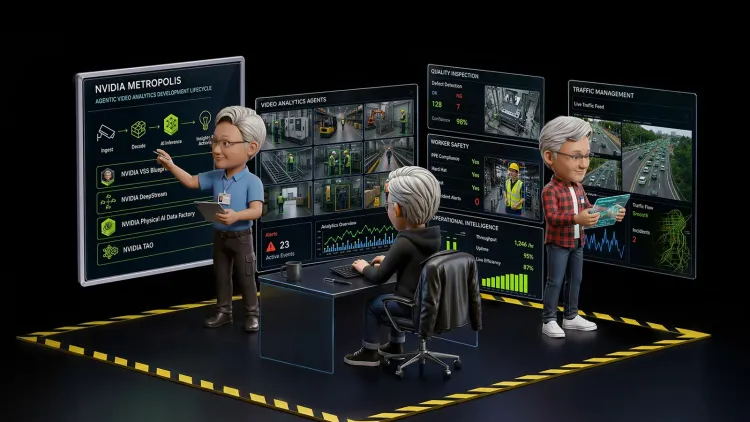
Chip giant Nvidia on Wednesday, 15 July 2026, announced that building a production-ready vision AI agent no longer requires thousands of developer hours, pointing to its Nvidia Metropolis platform as the solution — a suite offering more than 80 open agent skills spanning synthetic data generation, model fine-tuning, application deployment, and real-time insights, all accessible through natural-language interfaces.
Context
The post, shared from Nvidia's official corporate account, signals a significant lowering of the barrier to entry for enterprise and municipal teams looking to deploy vision AI at scale. The company states that the Metropolis platform consolidates what previously demanded extensive engineering effort into a modular, open skill library. The natural-language interface layer is positioned as the key differentiator, allowing operators without deep ML expertise to configure and deploy agents.
Nvidia Metropolis was first introduced in 2017 as an AI-based video analytics platform targeting smart cities and enterprises. Over the following years, particularly from 2023 onward, Nvidia expanded the platform with generative AI tooling — including synthetic data pipelines and fine-tuning capabilities built on top of its CUDA and TensorRT infrastructure.
Policy Backdrop
The announcement sits within a broader industry shift away from hardware-only AI offerings toward integrated, full-stack software platforms. Nvidia, under chief executive Jensen Huang — who has led the company since 1993 — has been central to repositioning the firm from a graphics chip maker to an end-to-end AI infrastructure provider. The Metropolis expansion is consistent with that trajectory.
Competing stacks from Intel, Qualcomm, and major cloud hyperscalers are pursuing similar strategies in computer vision at scale, making the race to reduce deployment friction a defining competitive axis. The emphasis on 'open' agent skills also reflects an industry-wide push toward interoperability and developer adoption over proprietary lock-in.
Stakeholders and Impact
AI developers, enterprise system integrators, and smart city operators stand to benefit most directly from the Metropolis skill expansion. For municipal governments and retail chains — traditional Metropolis customers — the natural-language interface could dramatically reduce the cost and timeline of deploying intelligent video analytics for traffic management, loss prevention, or industrial safety monitoring.
For India specifically, where government-led smart city initiatives under programmes such as the Smart Cities Mission have sought scalable AI-based surveillance and analytics tools, platforms like Metropolis represent a potential off-the-shelf pathway that reduces dependence on bespoke development contracts. Indian enterprise integrators working in the infrastructure and retail sectors are among the most relevant downstream stakeholders in this context.
What's Next
Further integration announcements are expected at upcoming Nvidia GTC conferences, which have historically served as the company's primary venue for platform-level reveals. Enterprise and municipal pilot deployments of the expanded agent skill set will be a key metric to watch as the platform moves from announcement to adoption. The degree to which third-party developers contribute additional open skills to the Metropolis library will also determine whether the '80+' figure grows into a more expansive ecosystem or remains a curated set.
As agentic AI systems become the dominant deployment model across industries, Nvidia's move to commoditise vision AI agent construction through open, natural-language-driven tooling could set the benchmark that competitors are measured against through the remainder of 2026 and beyond.
Point of View
Nvidia is competing directly with cloud hyperscalers on ease-of-use — a front where GPU dominance alone is insufficient. For Indian enterprise and government buyers, this lowers the cost calculus for vision AI adoption, potentially accelerating uptake in smart city and industrial automation contexts. The emphasis on 'open' skills is also a deliberate counter-positioning against proprietary ecosystems, signalling that Nvidia sees ecosystem breadth, not exclusivity, as its moat in the agentic AI era.
NationPress
16 Jul 2026
Frequently Asked Questions
What is Nvidia Metropolis and what does it do?
Nvidia Metropolis is a platform for vision AI and intelligent video analytics, used in smart cities, retail, and industrial settings. It provides tools for synthetic data generation, model fine-tuning, and deployment, and as of July 2026 includes more than 80 open agent skills accessible through natural-language interfaces.
What are the 80+ open agent skills in Nvidia Metropolis?
Nvidia describes the skills as covering four main areas: generating synthetic data, fine-tuning AI models, deploying vision AI applications, and unlocking real-time insights. The skills are described as 'open,' meaning they are available for developers to use and build upon within the Metropolis ecosystem.
How does Nvidia Metropolis reduce developer hours for vision AI?
By bundling pre-built agent skills and a natural-language interface into a single platform, Metropolis removes the need for teams to build core pipeline components from scratch. Nvidia's claim is that this reduces what previously required thousands of developer hours to a significantly shorter implementation cycle.
How can Indian smart city projects use Nvidia Metropolis?
Indian municipalities and enterprise integrators working under programmes like the Smart Cities Mission can use Metropolis as an off-the-shelf platform for deploying AI-based video analytics — covering traffic monitoring, public safety, and industrial applications — without building custom ML pipelines.
Who are Nvidia's main competitors in vision AI platforms?
Intel, Qualcomm, and major cloud hyperscalers are all developing competing stacks for computer vision at scale. The key competitive dimension in 2026 is reducing deployment friction, an area where Nvidia's Metropolis platform is now directly positioning itself through open skills and natural-language interfaces.