Nvidia Partners with LangChain to Build Governed AI Agents
Synopsis
Nvidia has announced a collaboration with LangChain to help enterprises build AI agents that are not just high-performing but governable and improvable. The move extends Nvidia's reach from GPU hardware into the agentic software layer, addressing enterprise demand for control, auditability, and adaptability in AI deployments.
Key Takeaways
Nvidia announced a collaboration with LangChain on 8 July 2026 focused on enterprise-grade, governed AI agents.
The partnership targets enterprise needs for AI agents that can be shaped, governed, and improved as business requirements evolve.
LangChain is a leading open-source framework for large language model agent orchestration and memory management.
Nvidia first entered enterprise AI software with its AI Enterprise suite launched in 2021 , and this collaboration extends that strategy to the agentic layer.
Enterprise IT teams and AI developers — including those in India's BFSI and healthcare sectors — are the primary stakeholders who stand to benefit.
Further details are expected at upcoming developer events such as Nvidia GTC .
Chip giant Nvidia announced on Wednesday, 8 July 2026 that it is collaborating with AI framework provider LangChain to help enterprises build AI agents that can be shaped, governed, and improved over time — moving beyond raw performance to focus on control and auditability.
In its post on X, Nvidia stated: 'Enterprises don't just need agents that perform. They need agents they can shape, govern and improve as their business evolves.' The company described this as the core idea behind its work with LangChain, directing readers to a detailed explainer via a linked article.
Context
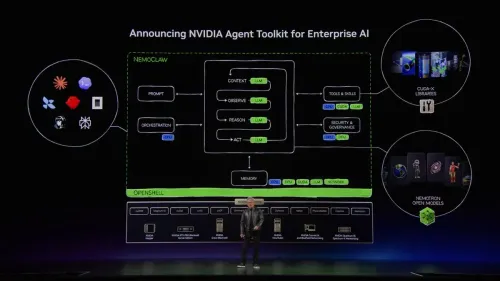
LangChain is a widely used open-source framework for building applications powered by large language models, with particular strength in agent orchestration and memory management. Its tools are popular among enterprise developers who need to chain model calls, manage context, and integrate AI into existing workflows. By aligning with LangChain, Nvidia is extending its footprint from the hardware layer — where it dominates through its GPUs and data-center infrastructure — into the software and tooling layer that enterprises rely on to deploy AI in production.Policy Backdrop
Nvidia launched its AI Enterprise software suite in 2021 to support production deployment of generative AI workloads on its GPUs. That initiative signalled an early recognition that selling chips alone was insufficient; enterprises needed certified, supported software stacks to move AI from experimentation into regulated, auditable business processes. The current collaboration with LangChain is a continuation of that strategy, now applied specifically to the agentic AI layer — systems that can reason, plan, and act across multi-step tasks. Across the industry, hardware vendors are increasingly moving into the software and framework layer of generative AI. The motivation is clear: enterprises operating under compliance regimes — whether financial, healthcare, or government — require AI systems that are not merely powerful but controllable, traceable, and improvable without full retraining cycles.Stakeholders and Impact
The primary beneficiaries of this collaboration are enterprise IT teams and AI application developers who are under pressure to deploy AI agents that meet governance and auditability standards. For large organisations, the ability to 'shape and improve' an agent as business needs evolve — rather than replacing it wholesale — reduces both cost and operational risk. For LangChain, the partnership with a company of Nvidia's scale provides significant validation and potentially deeper hardware-level optimisations for its orchestration frameworks. For Nvidia, it deepens developer ecosystem lock-in at the application layer, making its GPU infrastructure more indispensable to enterprise AI stacks. Indian enterprises — particularly in BFSI, healthcare, and IT services — that are exploring agentic AI deployments stand to benefit from reference architectures and tooling that emerge from this collaboration, as these sectors face stringent data governance requirements domestically.What's Next
Further details of the Nvidia-LangChain collaboration are expected to surface at developer-focused events such as Nvidia GTC, where the company typically unveils agent tooling integrations and enterprise reference architectures. As agentic AI moves from pilot to production across global enterprises, the ability to govern, audit, and iteratively improve AI agents is likely to become a baseline expectation rather than a differentiator — and the frameworks that enable this will occupy a critical position in the enterprise AI stack.Point of View
Nvidia is following the same playbook that made cloud providers indispensable — owning the platform, not just the compute. For Indian enterprises navigating AI governance mandates and sector-specific compliance requirements, the emergence of governed agentic frameworks backed by Nvidia's scale could accelerate production adoption. The broader signal is that the next competitive frontier in enterprise AI is not model performance but controllability — and the companies that own that layer will define the next decade of enterprise software.
NationPress
8 Jul 2026
Frequently Asked Questions
What is the Nvidia and LangChain collaboration about?
Nvidia and LangChain are collaborating to help enterprises build AI agents that can be governed, shaped, and improved over time, moving beyond raw performance to focus on control and auditability in production deployments.
What is LangChain and why does it matter for enterprise AI?
LangChain is an open-source framework widely used for building large language model applications, specialising in agent orchestration and memory management. It helps enterprise developers chain AI model calls and integrate agents into existing business workflows.
How does this Nvidia partnership fit into its broader AI strategy?
Nvidia launched its AI Enterprise software suite in 2021 to support production AI deployments on its GPUs. The LangChain collaboration extends this strategy specifically to agentic AI, deepening Nvidia's presence in the software and tooling layer beyond its core GPU hardware business.
What does 'governed AI agents' mean for businesses?
Governed AI agents are systems that enterprises can monitor, audit, customise, and iteratively improve without replacing them entirely. This is critical for industries like banking, healthcare, and government that operate under strict compliance and data governance requirements.
How does this Nvidia-LangChain news affect Indian enterprises?
Indian enterprises in sectors such as BFSI, healthcare, and IT services that are exploring agentic AI stand to benefit from reference architectures and tooling emerging from this collaboration, particularly given India's growing regulatory focus on AI accountability and data governance.