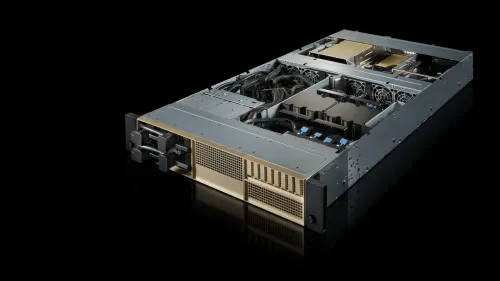
Nvidia Spectrum-6 Switch Hits AI Factories at CoreWeave, Microsoft, Tesla
Synopsis
Nvidia's Spectrum-6, a 102.4 Tbps Ethernet switch built for its Vera Rubin platform, has begun arriving at gigascale AI factories operated by CoreWeave, Microsoft, Nebius, SpaceX AI, and Tesla — extending Nvidia's hardware dominance from GPUs into high-speed data-centre networking.
Key Takeaways
Spectrum-6 delivers 102.4 terabits per second of Ethernet switching capacity, making it one of the highest-bandwidth data-centre switches announced for AI workloads.
The switch is built for Nvidia's Vera Rubin platform , aligning networking upgrades with the company's next-generation GPU architecture roadmap.
First adopters include CoreWeave , Microsoft , Nebius , SpaceX AI , and Tesla — spanning GPU cloud, hyperscale cloud, and industrial AI operators.
Nvidia entered the networking market at scale after acquiring Mellanox Technologies in 2020 and launched the predecessor Spectrum-X Ethernet platform in 2023 .
Faster interconnects are critical for frontier AI training, where thousands of GPUs must exchange data with minimal latency across multi-rack clusters.
The deployment signals Nvidia's intent to capture revenue across the full AI infrastructure stack, not just the GPU layer.
Chip giant Nvidia announced on Tuesday, 21 July 2026 that its Spectrum-6 Ethernet switch — capable of 102.4 terabits per second — is now being deployed at gigascale AI factories worldwide, with CoreWeave, Microsoft, Nebius, SpaceX AI, and Tesla among the first operators to receive the hardware.
Context
In its post, Nvidia stated that Spectrum-6, built for the Vera Rubin platform, is 'now arriving across the world's gigascale AI factories.' The switch is designed to serve as the high-bandwidth networking backbone for large-scale AI training infrastructure, offering 102.4 Tbps of Ethernet throughput per unit. Nvidia directed readers to a technical blog for deeper specifications.
The Spectrum-6 sits within Nvidia's broader effort to extend its hardware stack beyond graphics processing units into the high-speed interconnect fabric that links thousands of GPUs together inside a single AI cluster. Faster, lower-latency networking is a critical bottleneck as frontier AI models grow in scale and require tighter synchronisation across compute nodes.
Policy Backdrop
Nvidia's push into networking accelerated after its 2020 acquisition of Mellanox Technologies, which gave it control over both InfiniBand and Ethernet switching portfolios used in high-performance computing. In 2023, the company launched the Spectrum-X Ethernet platform specifically targeting AI workloads, positioning Ethernet as a competitive alternative to proprietary interconnects that had long dominated AI data centres.
Spectrum-6 represents the next generation of that strategy, timed to coincide with the rollout of Nvidia's Vera Rubin compute platform. The broader industry context is one of intense capital expenditure by cloud providers and industrial AI labs to build dedicated 'AI factories' — purpose-built facilities optimised for continuous, large-scale model training rather than general-purpose computing.
Stakeholders and Impact
CoreWeave, a specialised GPU cloud provider, has historically been among the earliest adopters of Nvidia networking products and is named as a first receiver of Spectrum-6. Microsoft, which operates the Azure cloud platform and is one of Nvidia's largest infrastructure partners, is also on the initial deployment list, signalling that hyperscale cloud operators see the switch as production-ready.
Tesla's inclusion is notable given the company's ongoing build-out of large AI clusters for its autonomous driving and Optimus robotics programmes. The participation of Nebius and SpaceX AI further indicates that Spectrum-6 is targeting a diverse set of AI-first operators beyond traditional cloud hyperscalers. For these organisations, higher interconnect bandwidth translates directly into faster training runs and lower operational cost per model iteration.
What's Next
Industry observers will watch for production benchmark disclosures and additional customer announcements as Spectrum-6 deployments scale up. The integration pathway between Spectrum-6 and Nvidia's upcoming Blackwell and Rubin GPU generations will be a key technical detail, as the two product lines are designed to work in tandem to maximise throughput across an entire AI factory floor.
As more operators bring Spectrum-6 online, Nvidia's ability to capture networking revenue alongside its GPU sales could deepen its lock-in across the full AI infrastructure stack — a strategic position that will draw close attention from competitors in both the chip and networking markets.
Point of View
Microsoft, and Tesla, Nvidia demonstrates that its networking ambitions are already production-grade, not roadmap promises. For Indian cloud and AI infrastructure policy, this matters because global AI factory build-outs set the benchmark costs and architectures that domestic data-centre investors must match or license. The deeper question is whether Nvidia's end-to-end stack — GPUs, networking, and software — creates a dependency that regulators in multiple jurisdictions will eventually scrutinise.
NationPress
22 Jul 2026
Frequently Asked Questions
What is Nvidia Spectrum-6?
Nvidia Spectrum-6 is a high-speed Ethernet switch capable of 102.4 terabits per second of throughput, designed to interconnect thousands of GPUs inside large AI training clusters as part of Nvidia's Vera Rubin platform.
Which companies are deploying Nvidia Spectrum-6?
CoreWeave , Microsoft , Nebius , SpaceX AI , and Tesla are among the first organisations to deploy Spectrum-6 in their AI factory infrastructure, according to Nvidia's announcement on 21 July 2026.
What is the Nvidia Vera Rubin platform?
The Vera Rubin platform is Nvidia's next-generation AI compute architecture. Spectrum-6 is the networking layer built to support it, providing the high-bandwidth fabric needed to link Rubin-generation GPUs at scale.
Why does AI factory networking matter?
In large AI training runs, thousands of GPUs must constantly exchange data. The speed and latency of the network between them — the interconnect — directly determines how fast a model can be trained and at what cost, making switches like Spectrum-6 a critical piece of infrastructure.
How does Spectrum-6 differ from Nvidia's earlier networking products?
Spectrum-6 follows the Spectrum-X platform launched in 2023 , which was Nvidia's first major push to position Ethernet as an AI-workload alternative to InfiniBand. Spectrum-6 roughly doubles or exceeds earlier bandwidth targets and is matched to the Vera Rubin GPU generation rather than prior architectures.