Nvidia Unveils Vera Rubin NVL72 Compute Tray
Synopsis
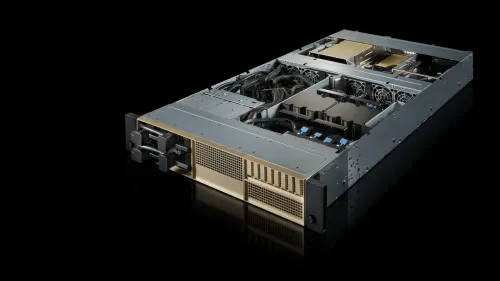
Nvidia has unveiled the Vera Rubin NVL72 Compute Tray, a fully automated, cableless, fanless compute unit claimed to assemble in one minute, targeting faster AI cluster deployment for hyperscale data centres.
Key Takeaways
Nvidia announced the Vera Rubin NVL72 Compute Tray on 7 August 2026 .
The tray features no cables, no hoses, and no fans , enabling 100% automated assembly.
Nvidia claims full assembly takes under one minute , directly reducing data-centre ramp time.
The Vera Rubin platform is Nvidia's planned successor to its Blackwell GPU architecture.
The design targets hyperscale data centres and AI cloud providers seeking faster time-to-revenue from GPU clusters.
The announcement continues Nvidia's broader shift toward integrated rack-scale and tray-scale AI infrastructure systems.
The race to shrink AI infrastructure deployment from weeks to minutes just got a vivid new entry. Nvidia on 7 August 2026 unveiled the Vera Rubin NVL72 Compute Tray, a cableless, fanless, hoseless compute unit the company says can be fully assembled in under one minute through a 100% automated process.
What the NVL72 tray actually changes
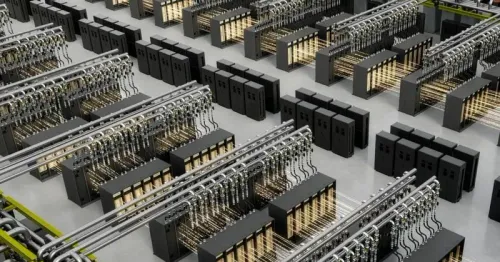
The pitch is deceptively simple: strip out every manual touchpoint from the assembly line. No cables to route, no liquid-cooling hoses to connect, no fans to seat — the Vera Rubin NVL72 tray slots together in a single automated step. Nvidia frames this as a direct attack on the two costs that most frustrate hyperscale buyers: ramp time and time-to-revenue. Every day a compute cluster sits unassembled in a data-centre hall is a day of lost AI workload throughput. The 'NVL72' designation follows Nvidia's rack-scale naming convention — the number typically signals the GPU count at the rack or tray level — placing this squarely in the company's high-density, integrated-system product line that has defined its hardware strategy since the Hopper generation.Vera Rubin: Nvidia's post-Blackwell architecture
Nvidia named the Vera Rubin architecture after the pioneering American astronomer whose observations provided foundational evidence for dark matter. The platform represents Nvidia's planned successor to its Blackwell GPU family, continuing the company's tradition of naming GPU generations after scientists. Nvidia has been publicly signalling the Rubin roadmap as the next step in its accelerated computing stack, targeting the demands of frontier AI training and inference at scale.Rack-scale design as competitive strategy
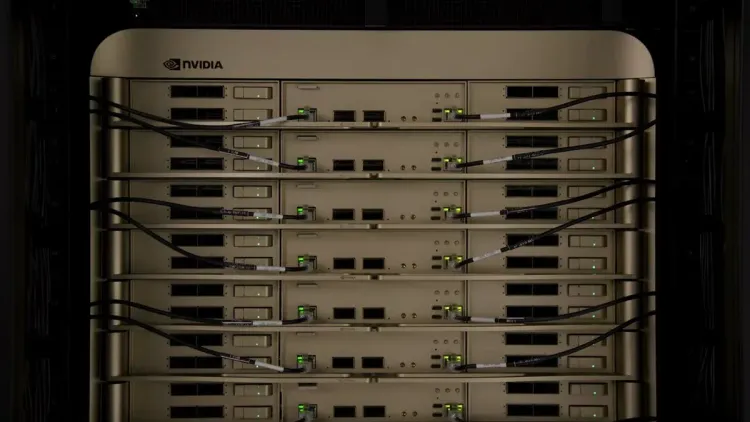
The NVL72 tray announcement is not an isolated product reveal — it is a statement of architectural philosophy. Nvidia has been steadily shifting emphasis toward rack-scale and tray-scale systems that co-design compute, networking, and power delivery as a single integrated unit. The logic is straightforward: as AI clusters grow to thousands of GPUs, the bottleneck is no longer raw silicon performance but the speed and reliability of deployment. Automated, cableless assembly directly compresses that bottleneck. Hyperscale data-centre operators and AI cloud providers stand to benefit most immediately. For them, faster cluster bring-up translates directly into earlier revenue from AI services — a metric that has become as commercially critical as peak FLOP counts. The Vera Rubin NVL72 sets a new benchmark for what 'ready to deploy' means in the AI infrastructure era. The question now is how quickly Nvidia's biggest customers can absorb it at scale.Point of View
Nvidia is effectively industrialising AI cluster build-out, a move that tightens its grip on hyperscale customers for whom every idle GPU-day carries real revenue cost. This mirrors a broader industry pattern where chipmakers are evolving into full-stack infrastructure vendors, competing on operational simplicity as much as silicon specs. If the one-minute automated assembly claim holds at production scale, it sets a benchmark that rival platforms will be measured against regardless of their raw compute numbers.
NationPress
7 Aug 2026
Frequently Asked Questions
What is the Nvidia Vera Rubin NVL72 Compute Tray?
The Vera Rubin NVL72 is Nvidia's latest AI compute tray, designed for fully automated assembly with no cables, hoses, or fans, targeting faster deployment in hyperscale data centres.
How long does it take to assemble the Vera Rubin NVL72?
Nvidia claims the NVL72 Compute Tray can be fully assembled in under one minute through a 100% automated process.
What is the Vera Rubin GPU architecture?
Vera Rubin is Nvidia's planned successor to its Blackwell GPU architecture, named after the astronomer whose work provided evidence for dark matter. It targets frontier AI training and inference workloads.
Why does Nvidia remove cables and fans from the NVL72 tray?
Eliminating cables, hoses, and fans removes manual assembly steps, allowing full automation and reducing the time between hardware delivery and live AI workloads — a key cost for cloud and data-centre operators.
Who benefits from the Nvidia NVL72 Compute Tray design?
Hyperscale data-centre operators and AI cloud providers benefit most, as faster automated assembly shortens cluster bring-up time and accelerates time-to-revenue from AI services.