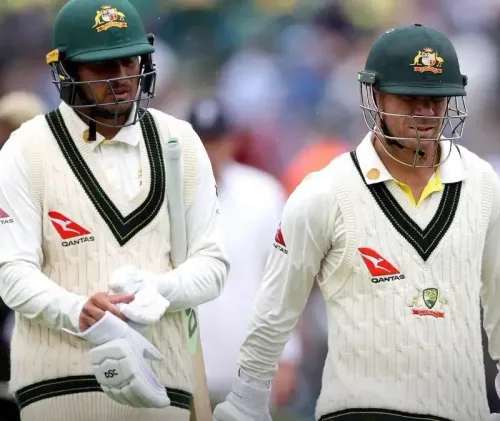
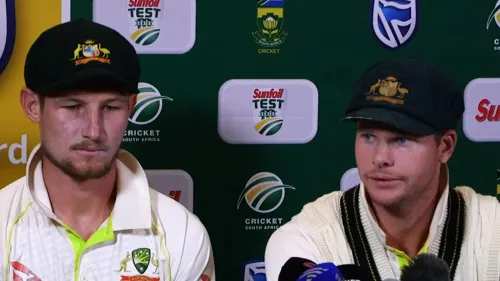
Sandpapergate 2018: CA says player consensus 'very unlikely' as Sayers backs Khawaja
Synopsis
Cricket Australia has conceded that the players involved in the 2018 Sandpapergate scandal will 'very likely' never agree on what happened — a remarkable admission as Chadd Sayers publicly backs Usman Khawaja's claim that the entire Australian team knew, and David Warner accuses CA of withholding key evidence when he was 'forced to make decisions' eight years ago.
Key Takeaways
Cricket Australia said on Sunday that it is 'very unlikely' players will reach an agreed account of the 2018 Sandpapergate incident.
Batter Usman Khawaja alleged the entire Australian Test team knew about the ball-tampering, and that sandpaper was also used in the Port Elizabeth Test.
Former bowler Chadd Sayers backed Khawaja, saying he was 'comfortable' believing 'everyone in that side knew what was going on.' David Warner accused CA of withholding information about bowler interviews when he was 'forced to make decisions in 2018.' The Sydney Morning Herald confirmed that Josh Hazlewood , Mitchell Starc , and Nathan Lyon were in fact interviewed during the original investigation.
Cricket Australia (CA) has acknowledged that the players involved in the 2018 Sandpapergate ball-tampering scandal are unlikely to ever agree on a shared account of what happened during the Cape Town Test, as fresh claims from multiple former cricketers continue to reignite one of cricket's most damaging controversies.
CA Admits Consensus Is Out of Reach
In a statement issued on Sunday, a CA spokesperson said the governing body respects the right of those present in South Africa in 2018 to share their personal versions of events. However, the organisation stopped short of adjudicating between the conflicting accounts.
'We respect the right of those in South Africa in 2018 to share their version of what they believe happened on that tour,' the spokesperson said, as quoted by the Sydney Morning Herald. 'The significant differences in the views expressed continues to demonstrate that it is very unlikely an agreed version of events will be reached without relevant material evidence,' the spokesperson added.
Sayers Backs Khawaja, Claims Everyone in the Side Knew
The latest escalation was triggered by batter Usman Khawaja, who made explosive allegations that the entire Australian Test team was aware of the ball-tampering scheme — and that sandpaper had also been used during the preceding Test in Port Elizabeth, not just Cape Town.
Former Australian bowler Chadd Sayers, who was part of the touring squad for the 2018 series, rejected skipper Pat Cummins' account and echoed Khawaja's position. Speaking to SEN radio on Sunday, Sayers said he was personally confident the entire side was in the know.
'I'm comfortable sitting here … that I believe that everyone in that side knew what was going on and what was being used,' Sayers told SEN radio. He added: 'I'm not taking sides. I'm neutral in all this … I'm just trying to tell my side of the story and what I believe happened.'
Sayers also addressed media characterisations of him as an ally of Khawaja, insisting he holds no allegiances: 'There are no sides; they've both been great to me throughout my time in the Test squad, so I'm not taking sides; I'm neutral in all this.'
Warner Hits Out at CA Over Withheld Information
Former opener David Warner added another layer to the controversy via an Instagram post, alleging he was forced to accept responsibility in 2018 without being given full information about the incident.
Warner had earlier claimed that fast bowlers Josh Hazlewood, Mitchell Starc, and Nathan Lyon were not interviewed as part of CA's original investigation — a claim the Sydney Morning Herald subsequently disputed, confirming the trio did in fact provide statements.
Responding to the clarification, Warner wrote on social media: 'Just to clarify, ‘as far as I am aware’ was the POINT. I was never told the bowlers had been interviewed or provided statements. That information would’ve been pretty useful when I was forced to make decisions in 2018. Why weren't we given all the evidence by CA?'
Background: What Sandpapergate Was and Why It Still Matters
The Sandpapergate scandal broke in March 2018 during Australia’s third Test against South Africa in Cape Town, when then-opener Cameron Bancroft was caught on camera using sandpaper to alter the condition of the ball. Steve Smith and Warner were subsequently banned for 12 months each, while Bancroft received a nine-month ban. The episode remains a flashpoint for questions about team culture, accountability, and institutional oversight within Australian cricket.
Notably, this is not the first time lingering disagreements have surfaced — but Khawaja’s allegation that the deception extended to a previous Test match, if substantiated, would significantly widen the scope of the original misconduct findings. With no new material evidence in sight, the rift among former players appears set to deepen rather than resolve.
Point of View
The institution still cannot produce a definitive account of what happened under its own watch. Khawaja's claim that the tampering pre-dated Cape Town, if credible, would render the original bans both selective and incomplete. What is striking is that the loudest voices challenging the official narrative — Khawaja, Sayers, Warner — are all players who had little to gain from silence; the loudest defenders of the status quo are those who faced no consequences. CA's refusal to reopen a formal inquiry, even as the evidence picture shifts, risks looking less like restraint and more like institutional self-protection.
NationPress
15 Nov 2026
Frequently Asked Questions
What is the Sandpapergate scandal?
Sandpapergate refers to the ball-tampering incident during Australia's third Test against South Africa in Cape Town in March 2018, when Cameron Bancroft was caught using sandpaper to illegally alter the ball's condition. Steve Smith and David Warner each received 12-month bans, while Bancroft was banned for nine months. The scandal triggered a wide-ranging review of Australian cricket culture.
What new claims has Usman Khawaja made about Sandpapergate?
Usman Khawaja has alleged that the entire Australian Test team was aware of the ball-tampering scheme and that sandpaper was also used during the preceding Test in Port Elizabeth — not just in Cape Town as originally established. These claims go significantly beyond the findings of Cricket Australia's 2018 investigation.
Why did Cricket Australia say consensus is 'very unlikely'?
Cricket Australia said the 'significant differences in the views expressed' by players present on the 2018 South Africa tour demonstrate that an agreed account cannot be reached 'without relevant material evidence.' The statement came amid public contradictions between players including Khawaja, Chadd Sayers, and Pat Cummins.
What did Chadd Sayers say about Sandpapergate?
Sayers, who was part of the 2018 touring squad, told SEN radio that he believed 'everyone in that side knew what was going on and what was being used.' He described himself as neutral but said acknowledging Khawaja's version as 'probably the truth' was simply his honest account of events.
What is David Warner's complaint against Cricket Australia?
Warner alleged on Instagram that he was forced to accept responsibility for Sandpapergate in 2018 without being told that bowlers Josh Hazlewood, Mitchell Starc, and Nathan Lyon had been interviewed or had provided statements to CA investigators. He questioned why that information was not shared with him at the time he 'was forced to make decisions.'