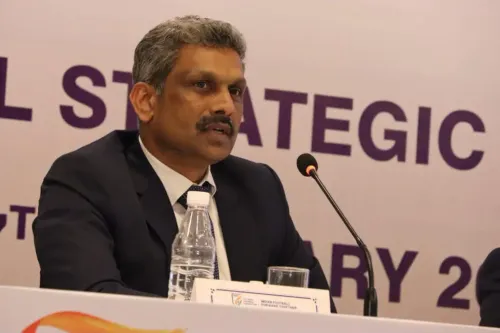
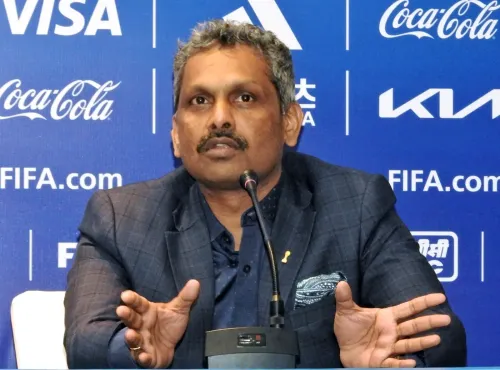
Shaji Prabhakaran's FIFA World Cup roadmap for India: 'Not rocket science'
Synopsis
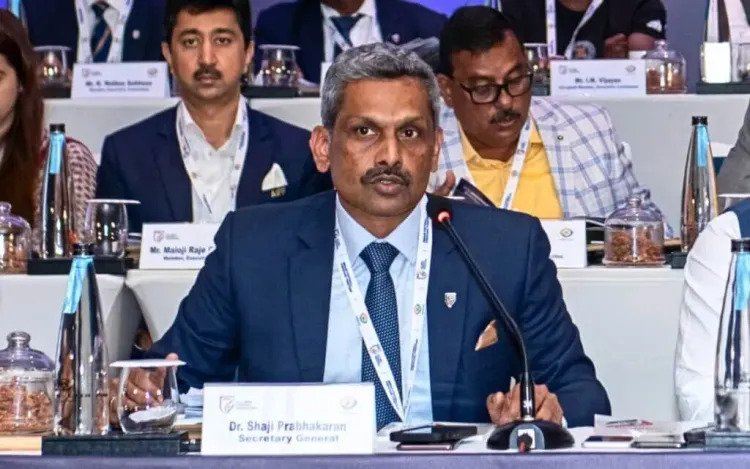
Shaji Prabhakaran, former AIFF general secretary, says India qualifying for the FIFA World Cup is 'not rocket science' — but only if the country unites behind a 12-to-15-year grassroots-to-elite pyramid plan, secures government backing, and commits to transparent governance. The roadmap is clear; the will to follow it is the real question.
Key Takeaways
Former AIFF general secretary Shaji Prabhakaran says India's FIFA World Cup qualification is achievable, calling it 'not rocket science.' He cited lack of consistent effort, unity, and transparent governance — not resources — as India's core obstacles.
Prabhakaran called for a 12-to-15-year investment cycle spanning grassroots to the senior national team.
He proposed building 10-12 age-group national teams with around 2,000 elite players per group as a structural backbone.
Nations like Cape Verde and Curaçao were cited as proof that population and wealth are irrelevant to World Cup qualification.
Prabhakaran described World Cup qualification as a potential soft-power milestone for India, capable of showcasing the country's culture to a global audience.
Former All India Football Federation (AIFF) general secretary Shaji Prabhakaran has laid out a detailed roadmap for India's FIFA World Cup qualification, asserting that reaching football's grandest stage is 'not rocket science' — provided the country commits to sustained effort, transparent governance, and a unified long-term vision. His remarks come as the footballing world prepares for the FIFA World Cup final between Argentina and Spain, an event expected to draw around 2 billion viewers globally.
The World Cup Final and Football's Global Power
Prabhakaran described the expanded 48-team World Cup as a landmark moment for the sport, noting that the tournament has reportedly contributed around $20 billion to the US economy alone, with a combined global economic impact exceeding $40 billion. Beyond the numbers, he emphasised football's unmatched social reach. 'Football brings people and nations together, becoming the biggest celebration and the largest assembly of cultures,' he said.
The final between Argentina and Spain, he noted, transcends sport — it is a demonstration of football's power to unite billions, irrespective of political or cultural divides.
Messi's Legacy and Argentina's Moment
On Lionel Messi — who enters the final having scored eight goals and delivered decisive contributions including two assists in the semi-final against England — Prabhakaran was emphatic. 'With Messi, Argentina only gets bigger,' he said, pointing to the country's three World Cup victories and Messi's role as a unifying force within the squad. With Argentina chasing a second consecutive title and Messi appearing in his third final, Prabhakaran argued the legacy being built is 'unmatched' in the sport's history.
On the controversy surrounding Argentina — allegations of rough play and social media criticism — Prabhakaran was dismissive. 'It's the social media era; this is what happens,' he said, calling much of the criticism 'more fiction than reality' and a product of rivalry amplified online rather than grounded in fact.
India's World Cup Obstacle: Effort, Not Complexity
Asked why a nation of over 1.4 billion people has never qualified for a FIFA World Cup, Prabhakaran was direct: 'The truth is, we're not working hard enough.' He rejected the framing that India's absence reflects an insurmountable structural problem, arguing instead that the country has the resources and talent but lacks consistent effort, unity, and honest governance.
He pointed to smaller nations — including Cape Verde and Curaçao — as proof that population size and economic power are irrelevant to World Cup qualification. 'Sporting success has nothing to do with the size of a country,' he said. 'It is about the will to achieve something, the passion to drive change, putting all your effort into one direction.' These nations, he noted, have attracted diaspora talent and pursued a collective national football project — an approach India has yet to replicate at scale.
What India Must Do: Grassroots, Governance, and Government Support
Prabhakaran outlined a multi-layered approach to reform. He called for a pyramid model — simultaneous investment at every level from grassroots to the senior national team — warning that Indian football has become overly dependent on the professional league while neglecting youth development. 'The grassroots is the foundation,' he said. 'If you look at football as a pyramid, every level needs the energy and vibrancy to grow.'
He also stressed the need for elite academies, more competitive domestic leagues, and regular exposure for Indian players in high-level international environments. Critically, he argued that a generational shift in Indian football requires 12 to 15 years of uninterrupted investment — meaning there is no room for cyclical neglect at any level of the system.
On governance, Prabhakaran called for transparency — ensuring fans, stakeholders, and the government can see exactly how funds are raised and deployed. He advocated building 10 to 12 national age-group teams, from Under-17 to the senior level, each comprising around 2,000 elite players, as a structural backbone for the next decade.
The 2040 Target and Football as Soft Power
Prabhakaran expressed genuine belief that India can qualify for a FIFA World Cup by 2040, describing it as one of his personal goals. 'One of my biggest goals before leaving this universe is to see India play at the FIFA World Cup,' he said. Beyond the sporting achievement, he framed World Cup qualification as a soft-power opportunity — a chance for India to showcase its culture globally and connect with billions through the sport.
He called on football administrators to secure broader government support and forge partnerships with major industries, noting that sustained political and financial backing — which India has not yet fully achieved — is the one ingredient that separates aspiring nations from qualifying ones. 'With support, success is possible,' he said. 'Improving is achievable; it's not impossible.'
Whether India's football ecosystem can translate that conviction into coordinated action over the next decade will determine if the country's World Cup dream moves from aspiration to fixture list.
Point of View
Time-stamped plan. The 2040 target is credible on paper; the missing ingredient is institutional accountability, not ambition. What India's football ecosystem has consistently lacked is not a roadmap but a mechanism to enforce it — and Prabhakaran's own tenure at the AIFF offers a cautionary example of how structural intent can outpace structural delivery. The real test of any new blueprint will be whether it survives the next change in federation leadership.
NationPress
18 Oct 2026
Frequently Asked Questions
What is Shaji Prabhakaran's roadmap for India's FIFA World Cup qualification?
Prabhakaran advocates a 12-to-15-year pyramid approach — simultaneous investment from grassroots to the senior national team — combined with transparent governance, government backing, and industry partnerships. He proposes building 10-12 age-group national squads, each with around 2,000 elite players, as a structural foundation for the next decade.
Does Shaji Prabhakaran believe India can qualify for a FIFA World Cup by 2040?
Yes. Prabhakaran has stated that qualifying by 2040 is achievable, calling it 'not rocket science.' He believes India has the resources and talent, but requires consistent effort, unity among stakeholders, and sustained government support to convert potential into results.
Why hasn't India qualified for the FIFA World Cup despite having 1.4 billion people?
According to Prabhakaran, the primary reason is insufficient sustained effort and a lack of collective unity — not a shortage of resources or talent. He argues India has been inconsistent in grassroots development, governance, and long-term planning, unlike smaller qualifying nations that pursue football as a unified national project.
What can India learn from nations like Cape Verde and Curaçao?
Prabhakaran points to Cape Verde and Curaçao as proof that population size and economic power are irrelevant to World Cup qualification. These nations succeeded by channelling collective will into a single football vision, attracting diaspora talent, and optimising limited resources — a model he believes India can replicate.
How does Prabhakaran view the balance between professional leagues and grassroots football in India?
He believes India has become overly reliant on its professional league while neglecting the grassroots base. Prabhakaran calls for a bottom-up and top-down approach simultaneously, arguing that stronger grassroots participation will surface better talent for clubs to develop, ultimately strengthening the national team pipeline.