Sandpapergate: Chadd Sayers says 'bad timing' forced him to back Khawaja's claims
Synopsis
Eight years after Sandpapergate, Australia's 2018 Cape Town 12th man Chadd Sayers says he was comfortable keeping the truth buried — until Usman Khawaja's book Sabr left him with nowhere to hide. His claim that the entire squad knew about the ball-tampering is the most damaging public assertion yet, and it puts Cricket Australia's official account under renewed pressure.
Key Takeaways
Chadd Sayers , the 12th man during the 2018 Cape Town Test , says he was 'pretty comfortable' keeping Sandpapergate a secret until Usman Khawaja 's book Sabr was published.
Sayers says 'bad timing' — his pre-scheduled commentary duties during the Australia-England ODI series — forced him to speak publicly.
He claims the sandpaper was used in two Test matches and alleges the entire squad was aware of the ball-tampering plan.
Sayers expressed regret at not speaking out sooner, citing the ordeal endured by Cameron Bancroft over eight years .
He praised Bancroft for sustaining high-level performance 'while carrying' the burden, calling it 'a credit to him.'
Retired Australian pacer Chadd Sayers, who served as the 12th man during the infamous 2018 Cape Town Test against South Africa, has revealed he was 'pretty comfortable' keeping his knowledge of the Sandpapergate scandal private — until Usman Khawaja's explosive memoir Sabr forced his hand. Speaking on SEN Radio on Thursday, 19 November 2026, Sayers explained that the timing of his public disclosure was driven by circumstance, not choice.
Why Sayers Spoke Out When He Did
Sayers, whose only Test appearance for Australia came in the fourth and final match of that 2018 South Africa series, was already scheduled to commentate on the Australia-England ODI series for SEN when Khawaja's book resurfaced the saga. 'I think it was just probably bad timing for me. The One-Day International was on, and I was always down to commentate that,' Sayers said.
He clarified the disclosure was not a media ambush. 'It wasn't SEN ringing me to ask me to come on and tell my part. I was always commentating, so I knew it was always going to come up, and you get a lot of media pressure with them ringing you and asking you what actually happened,' he explained.
Backing Khawaja's Account
Once Khawaja's book was published and quotations from it began circulating, Sayers felt ready to publicly validate the claims. 'So when his book came out, and there's a few quotations coming out of that book, I was happy to say that I was confident in what Usman had said was the truth,' he said. Sayers, however, emphasised he sees himself as a neutral party. 'I think I've probably been portrayed in the media as taking Usman's side because I've spoken out and acknowledged that that was probably the truth. But I'm neutral in all this. I'm just trying to tell my side of the story and what I believe happened,' he added.
Sayers Claims the Whole Team Knew
In remarks he made a few days prior, Sayers went further, alleging collective awareness across the squad. 'I'm comfortable saying, where I'm sitting now, that everyone knew what was going on in South Africa in 2018. It (sandpaper) was used in two Test matches and there were discussions in change rooms,' he said. He attributed this to the practical mechanics of ball-tampering: 'I would have thought as a team, when you're trying to get the ball to reverse, that everyone would buy in because if one little thing goes wrong in the field to the ball, it stops it from reversing straight away.'
Sympathy for Cameron Bancroft
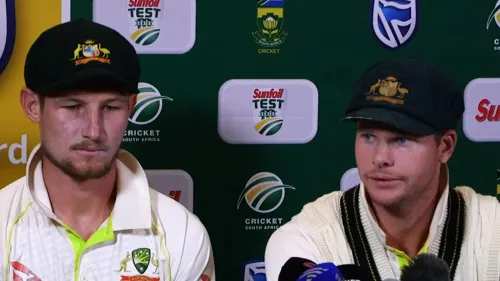
Sayers expressed regret that he did not come forward sooner, particularly in light of what Cameron Bancroft endured. Bancroft was one of three cricketers sanctioned over the scandal, along with Steve Smith and David Warner. 'Now knowing what Cameron Bancroft actually had gone through and all the different scenarios that have happened, I probably wish I did come out a bit earlier,' Sayers said. He also paid tribute to Bancroft's resilience: 'The mental side of things is that he's been able to just hold himself together and be able to perform at a high level in a high-performance environment. To carry that with you for eight years, regardless of what's happening right now, is just a credit to him.'
What This Means for the Sandpapergate Narrative
Sayers's testimony adds fresh corroboration to Khawaja's account and raises renewed questions about how widely knowledge of the scheme extended beyond the three players who were punished. This comes amid broader public scrutiny of Cricket Australia's handling of the 2018 ball-tampering affair — a scandal that resulted in lengthy bans, public apologies, and lasting reputational damage to Australian cricket. With Khawaja's book now in circulation and multiple former players speaking out, pressure may mount for a more comprehensive accounting of events that unfolded in Cape Town eight years ago.
Point of View
Operationally dependent act as Sayers describes, the selective punishment of Bancroft, Smith and Warner looks not just incomplete but structurally unfair. Cricket Australia has never publicly revisited its findings; Khawaja's book and now Sayers's corroboration may make that silence increasingly untenable. The more voices emerge, the harder it becomes to treat the 2018 sanctions as a closed chapter.
NationPress
19 Nov 2026
Frequently Asked Questions
Who is Chadd Sayers and what is his connection to Sandpapergate?
Chadd Sayers is a retired Australian pace bowler who was the 12th man during the 2018 Cape Town Test against South Africa — the match at the centre of the Sandpapergate ball-tampering scandal. He played only one Test for Australia, which was the fourth and final game of that same series.
What did Chadd Sayers say about Sandpapergate?
Sayers said he was confident that Usman Khawaja's account in his book Sabr was the truth. He also claimed that the sandpaper was used in two Test matches and that the entire Australian squad was aware of the ball-tampering plan, describing it as a collective team effort to get the ball to reverse.
Why did Sayers speak out now rather than earlier?
Sayers said it was 'bad timing' — he was already scheduled to commentate on the Australia-England ODI series for SEN when Khawaja's book reignited the story, making it impossible to avoid. He added that he had been comfortable keeping his knowledge private until that point.
What is Usman Khawaja's book Sabr about?
Sabr is a memoir by Australian Test opener Usman Khawaja that includes explosive claims about the 2018 Sandpapergate scandal. Quotations from the book circulating publicly prompted several former players, including Sayers, to speak on the record about what they witnessed.
Who was punished for the 2018 Sandpapergate scandal?
Cameron Bancroft, Steve Smith, and David Warner were the three Australian cricketers formally sanctioned by Cricket Australia for their roles in the ball-tampering incident during the Cape Town Test in 2018. Sayers's recent comments raise questions about whether wider knowledge within the squad was ever fully investigated.