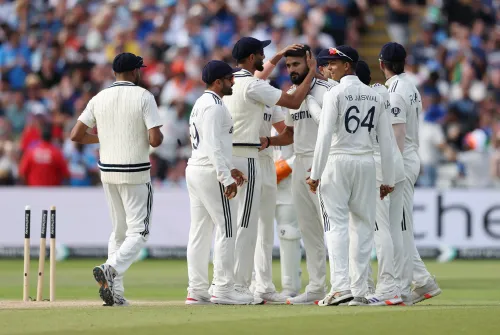
Morkel backs India's 20-wicket bowling threat, leaves Siraj call to Gill

Synopsis
India bowling coach Morne Morkel has publicly backed Mohammed Siraj as a world-class performer while handing the final XI decision to captain Shubman Gill — a subtle but significant moment that reveals the team's internal dynamic ahead of a high-stakes Wellington Test where India need 20 wickets to win.
Key Takeaways
Morne Morkel told head coach Gautam Gambhir that India 'have enough in attack to take 20 wickets ' in the Wellington Test .
Mohammed Siraj was described as a 'world-class performer' by Morkel, though his inclusion remains a decision for captain Shubman Gill .
India have added extra bowling options to the squad to cover different role requirements — into the wind, with the wind, and in partnerships.
Morkel urged the attack to block outside noise, get the ball in the right areas, and avoid overcomplicating conditions at Wellington .
The bowling coach stressed the need for match-winning spells on day four or five , not just strong opening sessions.
India bowling coach Morne Morkel has expressed full confidence in the team's pace attack ahead of the upcoming Test match in Wellington, describing Mohammed Siraj as a world-class performer while making clear that the final decision on the bowling combination rests with captain Shubman Gill. Speaking at the pre-match press conference on 18 November, Morkel said he had already communicated his assessment to head coach Gautam Gambhir.
Morkel's Message to Gambhir
'Siraj is a world-class performer, whenever he has stepped in the India jersey, whenever he has played. My feedback to Gautam was that we have enough in attack to take 20 wickets. Ultimately, the call will be taken by Shubman,' Morkel said at the press conference.
The bowling coach noted that additional options had been brought into the squad to ensure the team was prepared for varying conditions and roles, while also emphasising that players who have been performing deserve continued backing and security.
No Stone Unturned in Selection Planning
'That is the reason why we have added a couple of guys even on the wings, you know, so we leave no stone unturned, but also you want to give guys who are doing well in the jersey also that security and that opportunity,' Morkel said. He added that the best combination would be determined by which bowlers can fulfil specific roles — into the wind, with the wind, and through sustained partnerships.
Morkel stressed the importance of accountability within the attack, urging bowlers to stay locked in on execution and tune out external distractions. 'We need to block outside noise and get the ball in the right areas. We cannot afford to lose points. The team needs to take ownership and get quicker to the mark. The responsibility lies with the bowler and the captain,' he said.
Adapting to Wellington Conditions
Morkel acknowledged that Wellington's notorious wind could shape how bowlers approached their spells, but cautioned against overthinking it. 'When you bowl into the wind, you get a bit of shape. Your thought process is important. You can hold your actions a bit longer. Don't overthink conditions,' he explained.
He also pointed to data suggesting that bowlers who get their lengths right tend to succeed on days one and two at the venue, reinforcing the value of discipline over complexity. 'I think sometimes we can get caught out by seeing the colour of the wicket, the grass, the wind, looking at stats, and we forget to bowl the ball in the right area consistently enough,' he noted.
The Fourth and Fifth Day Factor
Morkel underlined that Test matches are rarely won in the first session alone, and that the attack must remain committed and aggressive deep into the contest. 'The best way of winning is to set the tone in the first session, but the first session doesn't always win a Test. You need guys who can produce a magical spell on the fourth or fifth day,' he stated.
He called for strong body language and mental resilience from the bowlers throughout, even when tasked with grinding through long spells from one end. 'I do believe it is a matter of just having a strong mindset. Somebody needs to do the job from one end and I expect our guys to have good body language in terms of still wanting the ball and wanting to do a job for the team,' he said.
Back to Red-Ball Basics
Morkel's overarching message was a return to fundamentals — finding the right lengths, bowling in partnerships, and rebuilding the red-ball mindset quickly. 'For us it's getting as quick as possible back into red-ball cricket mindset, back into what is our process that gives us success, and can we then do that for a long period of time,' he said.
With the Test match imminent, all eyes will be on Shubman Gill's final XI announcement and whether Mohammed Siraj earns a place in the attack as India seek to execute their 20-wicket plan.
Point of View
The head coach deliberates, and the captain decides. That chain matters when managing Siraj's confidence ahead of a high-stakes Test. Notably, Morkel's emphasis on 'blocking outside noise' and 'returning to red-ball basics' points to a broader concern: India's recent white-ball dominance may have softened their Test-match instincts, and Wellington's conditions will offer very little margin for a confused length. The public endorsement of Siraj while simultaneously leaving the door open for others is a delicate act of stakeholder management — the kind that can backfire if the attack underperforms.
NationPress
18 Nov 2026
Frequently Asked Questions
What did Morne Morkel say about India's bowling options for the Wellington Test?
Morne Morkel said India 'have enough in attack to take 20 wickets' and conveyed this confidence directly to head coach Gautam Gambhir. He also called Mohammed Siraj a world-class performer while clarifying that the final bowling combination decision rests with captain Shubman Gill.
Will Mohammed Siraj play in the Wellington Test?
A final decision on Siraj's inclusion has not been confirmed. Morkel endorsed Siraj as a world-class performer but explicitly stated that the call on the bowling combination would be made by captain Shubman Gill.
How is India planning to handle Wellington's wind conditions?
Morkel advised bowlers not to overthink conditions, noting that bowling into the wind can generate shape while holding the action a little longer. He stressed the importance of getting lengths right consistently, pointing to data suggesting that bowlers who do so are most successful on days one and two at the venue.
What is Morkel's key message to India's pace bowlers ahead of the Test?
Morkel's core message is to block outside noise, bowl in the right areas, take accountability, and maintain strong body language throughout the match — including delivering crucial spells as late as the fourth or fifth day.
Why has India added extra bowlers to the squad for the Wellington Test?
According to Morkel, additional bowling options were brought in to ensure the team could cover different roles — bowling into the wind, with the wind, and sustaining pressure in partnerships. The final selection will be determined by which combination best serves India's plan to take 20 wickets.